Volume 21, Issue 1 (Spring- In Press 2026)
Salmand: Iranian Journal of Ageing 2026, 21(1): 112-125 |
Back to browse issues page




Download citation:
BibTeX | RIS | EndNote | Medlars | ProCite | Reference Manager | RefWorks
Send citation to:


BibTeX | RIS | EndNote | Medlars | ProCite | Reference Manager | RefWorks
Send citation to:
Shareh E, Farokhnezhad Afshar P, Bayat M. The Relationship Between Quality of Life, Loneliness, and Perceived Social Support in Older Adults With Immigrant Children. Salmand: Iranian Journal of Ageing 2026; 21 (1) :112-125
URL: http://salmandj.uswr.ac.ir/article-1-2994-en.html
URL: http://salmandj.uswr.ac.ir/article-1-2994-en.html


1- Department of Geriatric Health, School of Behavioral Sciences and Mental Health, Tehran Institute of Psychiatry, Iran University of Medical Sciences, Tehran, Iran.
2- Department of Geriatric Health, School of Behavioral Sciences and Mental Health, Tehran Institute of Psychiatry, Iran University of Medical Sciences, Tehran, Iran. ,Farokhnezhad.p@iums.ac.ir
2- Department of Geriatric Health, School of Behavioral Sciences and Mental Health, Tehran Institute of Psychiatry, Iran University of Medical Sciences, Tehran, Iran. ,
Full-Text [PDF 5963 kb]
(307 Downloads)
| Abstract (HTML) (1763 Views)
Full-Text: (24 Views)
Introduction
The aging process involves changes, such as children’s independence, spousal death, retirement, and reduced social connections, which may contribute to loneliness in older adults [6]. Migration is a key factor in both population aging and elderly loneliness [7] and often leads young people to relocate from less developed to more developed areas for employment or better living conditions [8]. This can result in physical separation and diminished contact between older parents and their children [7]. Since children are a significant source of happiness and mental well-being for the elderly [10], the migration of adult children raises questions about their impact on older adults’ social support, loneliness, and quality of life. However, due to the novelty of this issue, few studies have examined elderly individuals with immigrant children. Thus, this study aimed to determine the relationship between quality of life, loneliness, and perceived social support in older adults with immigrant children.
Methods & Materials
This cross-sectional study assessed 200 participants above 60 years with immigrant children referred to the vaccination department of the Pasteur Institute of Iran. The inclusion criteria were informed consent, age ≥60 years, adequate literacy to complete the questionnaire, and a minimum of 3 months since the child(ren)’s migration; Exclusion criteria included incomplete questionnaire responses and the presence of cognitive impairments. Data were collected using demographic characteristics checklist, the loneliness questionnaire (UCLA), the multidimensional scale of perceived social support (MSPSS), and the SF-12 quality of life questionnaire. The validity and reliability of the Persian version of all tools had been confirmed in previous studies. For data analysis, descriptive statistics (frequency and percentage for qualitative variables and Mean±SD for quantitative variables) were used to describe demographic characteristics and main study variables. Inferential statistics (Spearman’s correlation coefficient and multiple regression analysis using the Enter method) were employed to examine relationships between quantitative variables and differences among groups. All collected data were analyzed using SPSS software, version 24 (α= 0.05).
Results
This study included 200 older adults with a mean age of 66.84 ± 5.27 years, comprising 56.5% female (n=113) and 43.5% male (n=87). Regarding marital status, 164 participants (82%) were married, 28(14%) were widowed, and 8(4%) were divorced. Educational backgrounds varied: 124(62%) held university degrees, 64(32%) had high school diplomas, 9(4.5%) completed middle school, and 3(1.5%) possessed basic literacy. Employment status indicated that 126(63%) were retirees, 55(27.5%) were homemakers, 18(9%) were employed, and 1(0.5%) was disabled.
The total quality of life score indicates that the participants had a desirable quality of life. The perceived social support score among study participants was 49, within a possible range of 12 to 60, where higher scores signify greater social support. Loneliness levels indicated that participants generally fell within the mild loneliness category.
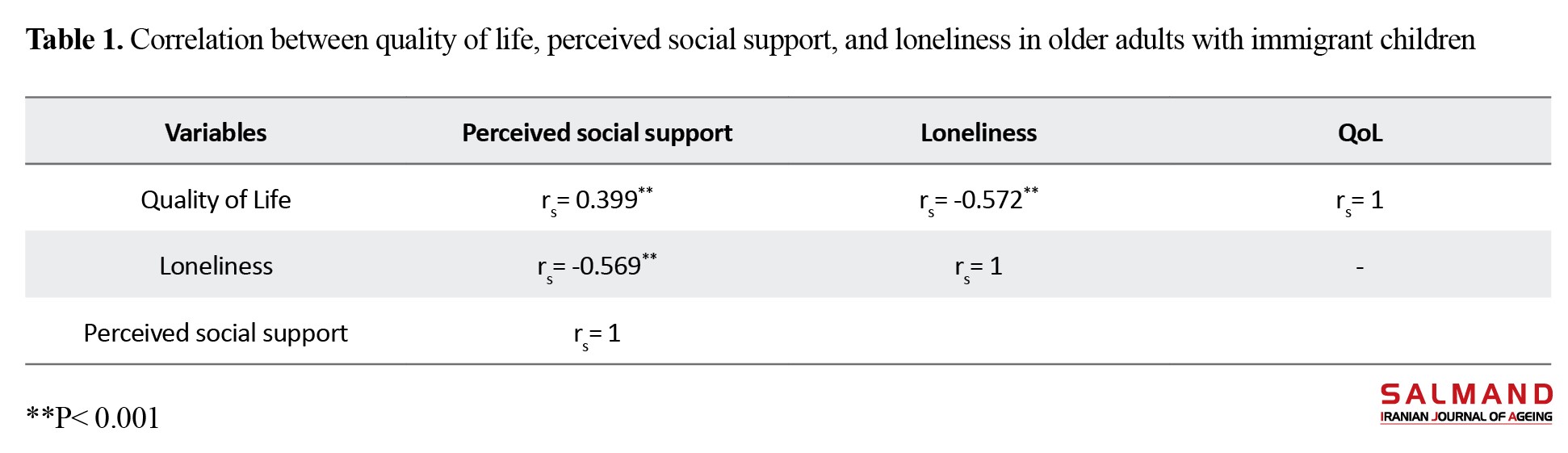
Analysis revealed significant positive correlations between total quality of life scores and perceived social support (rs= 0.399, P<0.001). Conversely, significant negative correlations were found between quality of life and loneliness (rs=-0.572, P<0.001). Perceived social support scores also showed a significant inverse relationship with loneliness (rs=-0.569, P<0.001) (Table 1).
Multiple regression analysis showed that loneliness was able to explain changes in overall perception of health (β=-0.02, P<0.001), physical function (β=-0.03, P<0.001), emotional problems (β=-0.03, P<0.001), physical pain (β=-0.04, P<0.001), social function (β=-0.05, P<0.001), vitality and vital energy (β=-0.06, P<0.001), and mental health (β=-0.11, P<0.001). However, perceived social support was not able to explain changes in quality of life dimensions (P>0.05).
Conclusion
This study investigated the relationship between quality of life, loneliness, and perceived social support among older adults with migrant children. participants maintained a good quality of life, experienced mild loneliness, and demonstrated moderate levels of perceived social support. The results demonstrated that loneliness reduces quality of life in this population. The study highlights the crucial need for families, communities, and policymakers to strengthen social support systems for older adults. Given the inevitability of children’s migration, concerted efforts should focus on establishing and maintaining robust social networks to mitigate the negative impacts on seniors’ quality of life. Such measures can effectively reduce loneliness and its adverse consequences while improving overall well-being in older adults.
Ethical Considerations
Compliance with ethical guidelines
This study was approved by the Ethics Committee of Iran University of Medical Sciences, Tehran, Iran (Code: IR.IUMS.REC.1403.206). The researchers explained the study’s goals. They assured participants that their personal information would be confidential. All participants signed the consent form before questionnaire administration.
Funding
This article was a extracted from the master's thesis Elham Shareh, approved by the in in the Geriatric Health Department of Iran University of Medical Sciences and Health Services. This research did not receive any grant from funding agencies in the public, commercial, or non-profit sectors.
Authors' contributions
Conceptualization, methodology, validation, analysis, research and review, sources, editing and finalization of the manuscript, supervision, project management, visualization: all authors; sampling and drafting: Elham Shareh.
Conflicts of interest
The authors declared no conflict of interest.
Acknowledgments
We sincerely thank and appreciate all participants who generously contributed their time and cooperation with utmost patience.
References
The aging process involves changes, such as children’s independence, spousal death, retirement, and reduced social connections, which may contribute to loneliness in older adults [6]. Migration is a key factor in both population aging and elderly loneliness [7] and often leads young people to relocate from less developed to more developed areas for employment or better living conditions [8]. This can result in physical separation and diminished contact between older parents and their children [7]. Since children are a significant source of happiness and mental well-being for the elderly [10], the migration of adult children raises questions about their impact on older adults’ social support, loneliness, and quality of life. However, due to the novelty of this issue, few studies have examined elderly individuals with immigrant children. Thus, this study aimed to determine the relationship between quality of life, loneliness, and perceived social support in older adults with immigrant children.
Methods & Materials
This cross-sectional study assessed 200 participants above 60 years with immigrant children referred to the vaccination department of the Pasteur Institute of Iran. The inclusion criteria were informed consent, age ≥60 years, adequate literacy to complete the questionnaire, and a minimum of 3 months since the child(ren)’s migration; Exclusion criteria included incomplete questionnaire responses and the presence of cognitive impairments. Data were collected using demographic characteristics checklist, the loneliness questionnaire (UCLA), the multidimensional scale of perceived social support (MSPSS), and the SF-12 quality of life questionnaire. The validity and reliability of the Persian version of all tools had been confirmed in previous studies. For data analysis, descriptive statistics (frequency and percentage for qualitative variables and Mean±SD for quantitative variables) were used to describe demographic characteristics and main study variables. Inferential statistics (Spearman’s correlation coefficient and multiple regression analysis using the Enter method) were employed to examine relationships between quantitative variables and differences among groups. All collected data were analyzed using SPSS software, version 24 (α= 0.05).
Results
This study included 200 older adults with a mean age of 66.84 ± 5.27 years, comprising 56.5% female (n=113) and 43.5% male (n=87). Regarding marital status, 164 participants (82%) were married, 28(14%) were widowed, and 8(4%) were divorced. Educational backgrounds varied: 124(62%) held university degrees, 64(32%) had high school diplomas, 9(4.5%) completed middle school, and 3(1.5%) possessed basic literacy. Employment status indicated that 126(63%) were retirees, 55(27.5%) were homemakers, 18(9%) were employed, and 1(0.5%) was disabled.
The total quality of life score indicates that the participants had a desirable quality of life. The perceived social support score among study participants was 49, within a possible range of 12 to 60, where higher scores signify greater social support. Loneliness levels indicated that participants generally fell within the mild loneliness category.
Analysis revealed significant positive correlations between total quality of life scores and perceived social support (rs= 0.399, P<0.001). Conversely, significant negative correlations were found between quality of life and loneliness (rs=-0.572, P<0.001). Perceived social support scores also showed a significant inverse relationship with loneliness (rs=-0.569, P<0.001) (Table 1).
Multiple regression analysis showed that loneliness was able to explain changes in overall perception of health (β=-0.02, P<0.001), physical function (β=-0.03, P<0.001), emotional problems (β=-0.03, P<0.001), physical pain (β=-0.04, P<0.001), social function (β=-0.05, P<0.001), vitality and vital energy (β=-0.06, P<0.001), and mental health (β=-0.11, P<0.001). However, perceived social support was not able to explain changes in quality of life dimensions (P>0.05).
Conclusion
This study investigated the relationship between quality of life, loneliness, and perceived social support among older adults with migrant children. participants maintained a good quality of life, experienced mild loneliness, and demonstrated moderate levels of perceived social support. The results demonstrated that loneliness reduces quality of life in this population. The study highlights the crucial need for families, communities, and policymakers to strengthen social support systems for older adults. Given the inevitability of children’s migration, concerted efforts should focus on establishing and maintaining robust social networks to mitigate the negative impacts on seniors’ quality of life. Such measures can effectively reduce loneliness and its adverse consequences while improving overall well-being in older adults.
Ethical Considerations
Compliance with ethical guidelines
This study was approved by the Ethics Committee of Iran University of Medical Sciences, Tehran, Iran (Code: IR.IUMS.REC.1403.206). The researchers explained the study’s goals. They assured participants that their personal information would be confidential. All participants signed the consent form before questionnaire administration.
Funding
This article was a extracted from the master's thesis Elham Shareh, approved by the in in the Geriatric Health Department of Iran University of Medical Sciences and Health Services. This research did not receive any grant from funding agencies in the public, commercial, or non-profit sectors.
Authors' contributions
Conceptualization, methodology, validation, analysis, research and review, sources, editing and finalization of the manuscript, supervision, project management, visualization: all authors; sampling and drafting: Elham Shareh.
Conflicts of interest
The authors declared no conflict of interest.
Acknowledgments
We sincerely thank and appreciate all participants who generously contributed their time and cooperation with utmost patience.
References
- Rahimzadehsani M, Momtaz YA, Foroughan M, Zanjari N. The relationship between personality traits of older adults and elder abuse. Salmand. 2023; 18(1):92-103. [DOI:10.32598/sija.2022.3436.1]
- Ayoubi-Mahani S, Eghbali-Babadi M, Farajzadegan Z, Keshvari M. Facilitators and barriers to active aging in Iran: A gualitative study. Salmand. 2023; 18(3):438-59. [DOI:10.32598/sija.2023.3604.1]
- Hajizadeh A, Albelbeisi AH, Tajvar M. Impacts of population ageing on the functions of the health system: A systematic review. Salmand. 2024; 19(3):328-61. [DOI:10.32598/sija.2024.3681.1]
- Garousi S, Safizadeh H, Samadian F. The study of relationship between social support and quality of life among elderly people in Kerman. Jundishapur Scientific Medical Journal. 2012; 11(3):303-15. [Link]
- Noto S. Perspectives on aging and quality of life. Healthcare. 2023; 11(15):2131. [DOI:10.3390/healthcare11152131] [PMID]
- Khosravan S, Alaviani M, Alami A, Tavakolizadeh J. Epidemiology of loneliness in elderly women. Journal of Research and Health. 2014; 4(4):871-7. [Link]
- Yahirun JJ, Arenas E. Offspring migration and parents' emotional and psychological well-being in Mexico. Journal of Marriage and Family. 2018; 80(4):975-91. [DOI:10.1111/jomf.12479] [PMID]
- Abdollahi A, Rezaee M. [An investigation of inclination to migrate from Iran and factors affecting the process: Results of the secondary analysis of social capital survey in 2018 (Persian)]. Interdisciplinary Studies in the Humanities. 2022; 14(4):159-87. [DOI:10.22035/isih.2022.4600.4549]
- Sadeghi R, Ghaffari G, Rezaei M. The effects of social capital on tendency to emigration from Iran. Population Studies. 2018; 4(2):83-108. [Link]
- Sukontamarn P, Asadullah MN, Photphisutthiphong N, Nguyen YTH. Happiness in old age: The daughter connection. Journal of Happiness Studies. 2023; 24(5):1729-57. [DOI:10.1007/s10902-023-00655-1] [PMID]
- Nabavi SH, Alipour F, Hejazi A, Rabani e, Rashedi V. Relationship between social support and mental health in older adults. Medical Journal of Mashhad University of Medical Sciences. 2014; 57(7):841-6. [Link]
- Tabatabaeichehr M, Mortazavi H, Sharifiyan E, Mehraban Z. Comparative study of received social support and perceived social support from the viewpoint of the elderly people. North Khorasan University of Medical Sciences. 2019; 11(2):98-106. [DOI:10.52547/nkums.11.2.98]
- Garousi S, Khodaparast Z. The relationship between functional social support and quality of life amongst married women after childbirth in Kerman city (Case: Women referred to health centers). Journal of Iranian Social Studies. 2014; 8(2):104-27. [Link]
- Sadegh Moghaddam L, Delshad Novbaghi A, Farhadi A, Nazari S, Eshghizadeh M, Chopan Vafa F, et al. [Life satisfaction in older adults: role of perceived social support (Persian)]. Journal of Sabzevar University of Medical Sciences. 2016; 22(6):1043-51.[Link]
- Saber M, Nosratabadi M. Social support and health-related quality of life in elderly people covered by the Welfare organization of Kerman city. Health and Development Journal. 2014; 3(3):189-99. [Link]
- Mahmoudpour A, Shariatmadar A, Borjali A, Shafiabadi A. The lived experiences of iranian older adults with empty nest syndrome: A phenomenological study. Salmand. 2024; 19(2):276-95. [DOI:10.32598/sija.2024.3694.1]
- Goudarz talejerdi M, Vahdani nia V. The relationship between "quality of life" and social support of the retired military personnel. Military Caring Sciences. 2018; 5(4):263-72. [DOI:10.29252/mcs.5.4.263]
- Chang H, Zhou J, Wang Z. Multidimensional factors affecting successful aging among empty-nesters in china based on social-ecological system theory. International Journal of Environmental Research and Public Health. 2022; 19(19):11885. [DOI:10.3390/ijerph191911885] [PMID]
- Noghani F, Navab E, Mehran A, Yaghobi L. [The Effects of Group Reminiscence Therapy on Loneliness and Spiritual Well- being among Residents of Kahrizak Nursing Home (Persian)]. Iranian Journal of Nursing Research. 2018; 13(1):47-56. [DOI:10.21859/ijnr-13017]
- Yousefzadeh P, Bastani F, Haghani H, Hosseini RS. Loneliness and the contributing factors in the elderly patients with type II diabetes: A descriptive cross-sectional study. Iran Journal of Nursing. 2021; 33(128):27-39. [DOI:10.52547/ijn.33.128.27]
- Kousha A, Lotfalinezhad E, Nadrian H, Bhalla D, Asghari-jafarabadi M, Sohrabi A, et al. Determinants of subjective loneliness and quality of life among community-dwelling older adults in Gorgan, Iran. Advances in Gerontology. 2022; 12(4):423-32. [DOI:10.1134/S2079057022040099]
- Riahi ME, Aliverdinia A, Pourhossein Z. [Relationship between Social Support and Mental Health (Persian)]. Social Welfare. 2011; 10(39):85-121. [Link]
- Beyrami M, Movahedi Y, Movahedi M. The relationship between perceived social support and the feeling of social-emotional loneliness with internet addiction in university students. Social Cognition. 2015; 3(2):109-22. [Link]
- Karami J, Moradi A, Hatamian P. The effect of resilience, self-efficacy, and social support on job satisfaction among the employed, middle-aged and elderly. Iranian Journal of Ageing. 2017; 12(3):300-11. [DOI:10.21859/sija.12.3.300]
- Jafarian Yazdi A, Pashaee Sabet F, Farokhnezhad Afshar P. The relationship between frailty and quality of life in hospitalized old patient. Journal of Gerontology. 2022; 7(2):1-8. [Link]
- Sheykhi M. [Sociology of ageing (Persian)]. 1th ed. Tehran: Harir; 2011. [Link]
- Ashayeri T, Jahanparvar T, Abbasi E. [Iranian collectivist values: a meta-analysis of altruism (Persian)]. Human Sciences Elite Discourse. 2021; 4(8):57-82. [Link]
- Bahrevar V, Abolfathi Momtaz Y, Hosseini S. Feeling lonely among the elderly in Iran: A systematic review. Medical Journal of Tabriz University of Medical Sciences. 2023; 45(5):389-401. [DOI:10.34172/mj.2023.041]
- Zarghami H, Mahmoodian H. [Effects of out-migration of children on social support of aged rural parents left behind (Persian)]. Journal of Rural Research. 2016; 7(1):29-53. [Link]
- Abas M, Tangchonlatip K, Punpuing S, Jirapramukpitak T, Darawuttimaprakorn N, Prince M, et al. Migration of children and impact on depression in older parents in rural Thailand, Southeast Asia. JAMA Psychiatry. 2013; 70(2):226-33. [DOI:10.1001/jamapsychiatry.2013.271] [PMID]
- Zhang C, Lyu K, Cheng X, Zhang C. The impact of adult children rural-urban migration on left-behind parents' health: Evidence from China. Frontiers in Public Health. 2022; 10:951124. [DOI:10.3389/fpubh.2022.951124] [PMID]
- Antman FM. The impact of migration on family left behind. International handbook on the economics of migration. Camberley: Edward Elgar Publishing; 2013. [DOI:10.4337/9781782546078.00025]
- Alipoor F, Sajadi H, Forozan A, Biglarian A. [The role of social support in elderly quality of life (Persian)]. Social Welfare. 2009; 8(33):149-67. [Link]
- Mombeini I, Bereyhe Bereyhi H. Life satisfaction in the elderly: The role of mental health and loneliness. Aging Psychology. 2022;8(3):287-98. [Link]
- Rasouli A, Faraz A. [Comparison of quality of life, life satisfaction and death anxiety among intra-oriented and outward elderly (Persian)]. Rooyesh-e-Ravanshenasi Journal. 2019; 8(10):19-26. [Link]
- Huang B, Lian Y, Li W. How far is Chinese left-behind parents' health left behind? China Economic Review. 2016; 37:15-26. [DOI:10.1016/j.chieco.2015.07.002]
- Fuller HR. The emotional toll of out-migration on mothers and fathers left behind in Mexico. International Migration. 2017; 55(3):156-72. [DOI:10.1111/imig.12324]
- Moeini B, Barati M, Farhadian M, Ara MH. The association between social support and happiness among elderly in Iran. Korean Journal of Family Medicine. 2018; 39(4):260. [DOI:10.4082/kjfm.17.0121] [PMID]
Type of Study: Research |
Subject:
gerontology
Received: 2024/12/30 | Accepted: 2025/06/30 | Published: 2026/04/01
Received: 2024/12/30 | Accepted: 2025/06/30 | Published: 2026/04/01
Send email to the article author
| Rights and permissions | |
 |
This work is licensed under a Creative Commons Attribution-NonCommercial 4.0 International License. |

Copyright © The Author(s);
This is an open access article distributed under the terms of the Creative Commons Attribution License (CC-By-NC), which permits use, distribution, and reproduction in any medium, provided the original work is properly cited and is not used for commercial purposes.
Contact Information