Volume 21, Issue 3 (Autumn 2026)
Salmand: Iranian Journal of Ageing 2026, 21(3): 414-429 |
Back to browse issues page


Download citation:
BibTeX | RIS | EndNote | Medlars | ProCite | Reference Manager | RefWorks
Send citation to:


BibTeX | RIS | EndNote | Medlars | ProCite | Reference Manager | RefWorks
Send citation to:
Abdipour N, Rakhshanderou S, Ghaffari M. Iranian Older Adults’ Perception of Online Social Participation Advantages: A Cross-sectional Study. , Salmand: Iranian Journal of Ageing. 2026; 21 (3) :414-429
URL: http://salmandj.uswr.ac.ir/article-1-3122-en.html
URL: http://salmandj.uswr.ac.ir/article-1-3122-en.html


1- Department of Aging, Iranian Research Center on Aging, University of Social Welfare and Rehabilitation Sciences, Tehran, Iran.
2- Department of Public Health, School of Public Health and Safety, Shahid Beheshti University of Medical Sciences, Tehran, Iran.
3- Department of Public Health, School of Public Health and Safety, Shahid Beheshti University of Medical Sciences, Tehran, Iran. ,MohtashamGhaffari@sbmu.ac.ir
2- Department of Public Health, School of Public Health and Safety, Shahid Beheshti University of Medical Sciences, Tehran, Iran.
3- Department of Public Health, School of Public Health and Safety, Shahid Beheshti University of Medical Sciences, Tehran, Iran. ,
Full-Text [PDF 6323 kb]
(607 Downloads)
| Abstract (HTML) (1542 Views)
References
Full-Text: (123 Views)
Introduction
Rapid growth of the aged population and the advancement of information & communication technologies are among the major transformations of the contemporary world, with wide-ranging social and health-related consequences. As health systems shift their focus from increasing life expectancy to improving quality of life, the concept of successful aging and the role of social participation have gained prominence. Aging is often associated with reduced social interactions and increased isolation, and the World Health Organization (WHO) considers social participation a key strategy for maintaining older adults’ health and well-being. In this context, social participation in online social media facilitates communication, maintains relationships, reduces loneliness, and contributes to older adults’ mental and cognitive health. Despite international evidence, a knowledge gap exists in Iran. Therefore, this study aims to examine Iranian older adults’ perceptions of the benefits of online social participation and its associated factors.
Materials & Methods
This is a cross-sectional study conducted on older adults covered by Shahid Beheshti University of Medical Sciences (SBMU), Tehran, Iran. Based on the standard deviation obtained from a pilot study (SD=0.4), a 95% confidence level, a 5% margin of error, and an anticipated 10% attrition rate, the sample size was estimated at approximately 420. Multistage random sampling was employed; three health regions in Tehran covered by the SBUS (East, North, and Shemiranat) were first selected. From these regions, 14 comprehensive health centers were randomly selected as clusters. From each center, approximately 30 eligible older adults were selected using systematic random sampling. Inclusion criteria were age ≥60 years, Iranian nationality, literacy, ability to complete the questionnaire, absence of cognitive impairment, willingness to participate, and a score of 7 or higher in the Abbreviated Mental Test Score (AMTs). Incomplete return of the questionnaire was an exclusion criterion.
Data collection instruments included a demographic questionnaire and the social participation questionnaire developed by Anderberg et al. [33], with 6 items rated on a five-point Likert scale; higher scores indicate greater perceived advantages. In the present study, we validated the instrument through translation, face validity, content validity, and construct validity assessments. Factor analysis confirmed a single-factor structure. The Persian version, named Internet Social Participation Advantages Questionnaire (ISPAQ), demonstrated excellent validity and reliability indices (KMO=0.878, ICC=0.99, Cronbach’s alpha=0.94). Data were analyzed in SPSS software, version 16, using descriptive statistics, independent t-test, and one-way analysis of variance. A significance level of P<0.05 was considered. Normality of data distribution was assessed using skewness and kurtosis indices. The obtained values (skewness=0.39, kurtosis=0.50) confirmed a normal distribution, justifying the use of parametric statistical tests.
Results
In this study, 420 older adults participated, mostly aged 65–69 years (40%) and were male (52.9%), married (76%), and unemployed (67.6%), with a university education (48.3%), a moderate economic status (70%), moderate IT (smartphone and tablet use) skills (42.14%), living with their spouse (41.2%), and using the internet on a daily basis (67.38%) (Table 1).
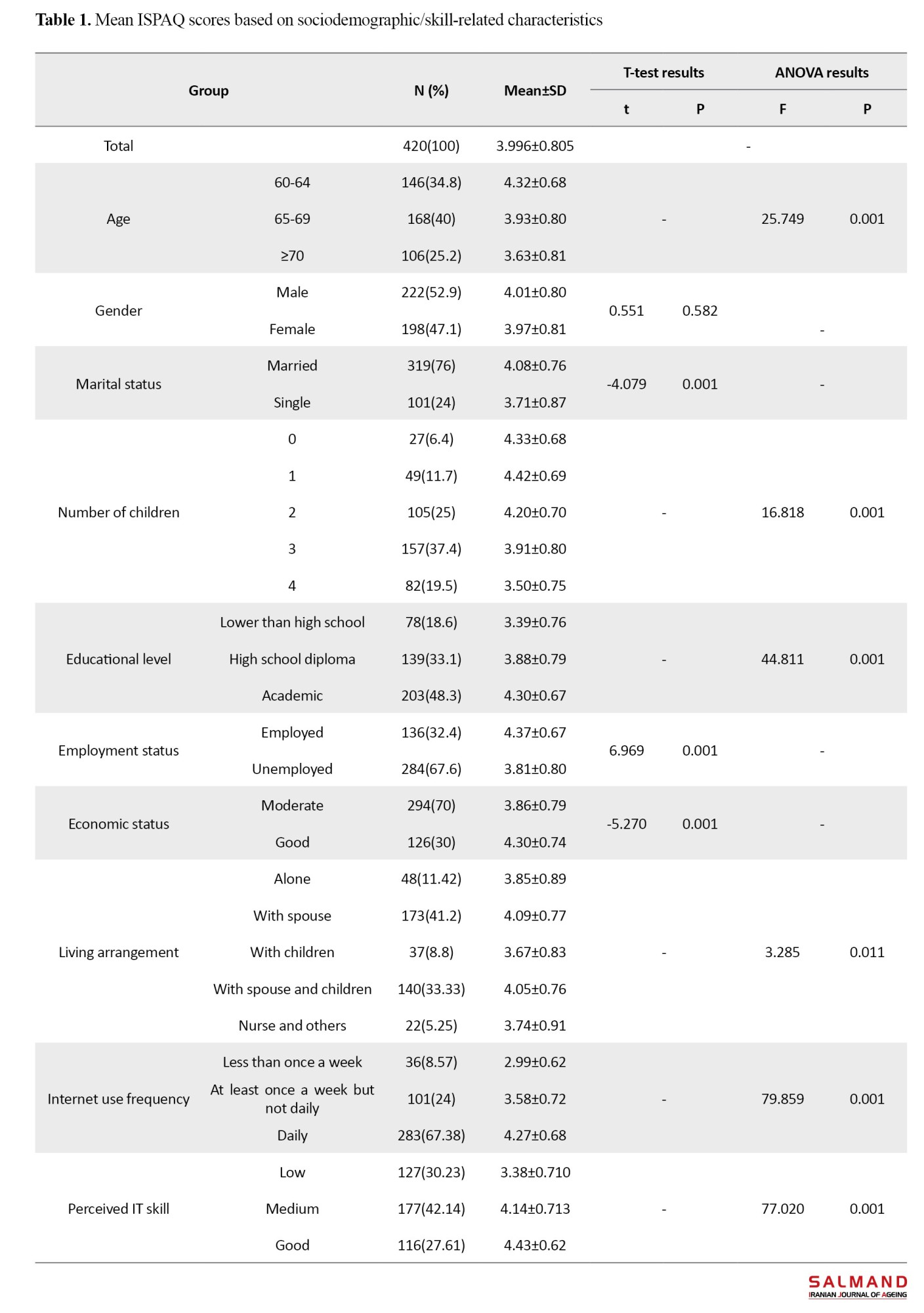
The mean ISPAQ score was 3.996±0.805, indicating a positive attitude towards the role of the internet in social participation. The highest level of agreement was with the internet’s role in maintaining social relationships (53.6%). Most participants believed that the use of the internet reduces feelings of loneliness (78.1%) and enhances their social participation (85.3%). In addition, a considerable proportion of older adults (67.6%) perceived the internet as an effective tool for expanding and creating new social networks. The mean ISPAQ score decreased with increasing age. The difference between age groups was statistically significant (P=0.001), with the 60–64 age group having the highest score. No significant difference was found between men and women (P=0.582). Married older adults, those with fewer children and higher educational level, employed people, and those with better economic status reported significantly higher scores. Regarding living arrangement, the difference in the ISPAQ score was also significant, with higher scores among those living with their spouse (P<0.05). Furthermore, the frequency of internet use and the level of IT skills showed significant differences, such that daily internet users and those with higher IT skills had the highest scores. Overall, sociodemographic and skill-related factors played a significant role in older adults’ perceptions of the benefits of online social participation (Table 1).
Conclusion
The findings indicate that Iranian older adults’ perceptions of the benefits of online social participation are influenced by their sociodemographic characteristics and level of digital skills. Aging is a complex, multidimensional, and diverse phenomenon. Therefore, planning to enhance online social participation of older adults should not rely exclusively on chronological age but also consider their sociodemographic and technological skill differences. However, realizing the potential of online social participation requires policies tailored to the older adults’ diverse needs and capacities. Developing targeted training programs, improving equitable access to technology, and strengthening family and social support can play a significant role in improving older adults’ online social participation and increasing their ability to benefit from digital opportunities.
Ethical Considerations
Compliance with ethical guidelines
This study was conducted in accordance with the principles of the Declaration of Helsinki. approved by the Research Ethics Committee of the School of Public Health & Neuroscience Research Center, Shahid Beheshti University of Medical Sciences (SBMU) (Code: IR.SBMU.PHNS.REC.1402.015). Participants were assured that their information would remain confidential. They were also informed that participation was entirely voluntary and that they could withdraw from the study at any time.
Funding
This is part of a larger research project at Shahid Beheshti University of Medical Sciences (SBMU). This research did not receive any specific grant from funding agencies in the public, commercial, or not-for profit sectors.
Authors' contributions
Data collection, writing the initial draft, review, and project administration: Nasim Abdipour; Methodology, data analysis and interpretation, review and editing: Sakineh Rakhshanderou; Supervision, methodology, data analysis and interpretation, review and editing: Mohtasham Ghaffari.
Conflicts of interest
The authors declare no conflict of interest.
Acknowledgments
The authors would like to thank all seniors who participated in this study as well as the Deputy for Health at Shahid Beheshti University of Medical Sciences (SBMU) for their cooperation in data collection.
Rapid growth of the aged population and the advancement of information & communication technologies are among the major transformations of the contemporary world, with wide-ranging social and health-related consequences. As health systems shift their focus from increasing life expectancy to improving quality of life, the concept of successful aging and the role of social participation have gained prominence. Aging is often associated with reduced social interactions and increased isolation, and the World Health Organization (WHO) considers social participation a key strategy for maintaining older adults’ health and well-being. In this context, social participation in online social media facilitates communication, maintains relationships, reduces loneliness, and contributes to older adults’ mental and cognitive health. Despite international evidence, a knowledge gap exists in Iran. Therefore, this study aims to examine Iranian older adults’ perceptions of the benefits of online social participation and its associated factors.
Materials & Methods
This is a cross-sectional study conducted on older adults covered by Shahid Beheshti University of Medical Sciences (SBMU), Tehran, Iran. Based on the standard deviation obtained from a pilot study (SD=0.4), a 95% confidence level, a 5% margin of error, and an anticipated 10% attrition rate, the sample size was estimated at approximately 420. Multistage random sampling was employed; three health regions in Tehran covered by the SBUS (East, North, and Shemiranat) were first selected. From these regions, 14 comprehensive health centers were randomly selected as clusters. From each center, approximately 30 eligible older adults were selected using systematic random sampling. Inclusion criteria were age ≥60 years, Iranian nationality, literacy, ability to complete the questionnaire, absence of cognitive impairment, willingness to participate, and a score of 7 or higher in the Abbreviated Mental Test Score (AMTs). Incomplete return of the questionnaire was an exclusion criterion.
Data collection instruments included a demographic questionnaire and the social participation questionnaire developed by Anderberg et al. [33], with 6 items rated on a five-point Likert scale; higher scores indicate greater perceived advantages. In the present study, we validated the instrument through translation, face validity, content validity, and construct validity assessments. Factor analysis confirmed a single-factor structure. The Persian version, named Internet Social Participation Advantages Questionnaire (ISPAQ), demonstrated excellent validity and reliability indices (KMO=0.878, ICC=0.99, Cronbach’s alpha=0.94). Data were analyzed in SPSS software, version 16, using descriptive statistics, independent t-test, and one-way analysis of variance. A significance level of P<0.05 was considered. Normality of data distribution was assessed using skewness and kurtosis indices. The obtained values (skewness=0.39, kurtosis=0.50) confirmed a normal distribution, justifying the use of parametric statistical tests.
Results
In this study, 420 older adults participated, mostly aged 65–69 years (40%) and were male (52.9%), married (76%), and unemployed (67.6%), with a university education (48.3%), a moderate economic status (70%), moderate IT (smartphone and tablet use) skills (42.14%), living with their spouse (41.2%), and using the internet on a daily basis (67.38%) (Table 1).
The mean ISPAQ score was 3.996±0.805, indicating a positive attitude towards the role of the internet in social participation. The highest level of agreement was with the internet’s role in maintaining social relationships (53.6%). Most participants believed that the use of the internet reduces feelings of loneliness (78.1%) and enhances their social participation (85.3%). In addition, a considerable proportion of older adults (67.6%) perceived the internet as an effective tool for expanding and creating new social networks. The mean ISPAQ score decreased with increasing age. The difference between age groups was statistically significant (P=0.001), with the 60–64 age group having the highest score. No significant difference was found between men and women (P=0.582). Married older adults, those with fewer children and higher educational level, employed people, and those with better economic status reported significantly higher scores. Regarding living arrangement, the difference in the ISPAQ score was also significant, with higher scores among those living with their spouse (P<0.05). Furthermore, the frequency of internet use and the level of IT skills showed significant differences, such that daily internet users and those with higher IT skills had the highest scores. Overall, sociodemographic and skill-related factors played a significant role in older adults’ perceptions of the benefits of online social participation (Table 1).
Conclusion
The findings indicate that Iranian older adults’ perceptions of the benefits of online social participation are influenced by their sociodemographic characteristics and level of digital skills. Aging is a complex, multidimensional, and diverse phenomenon. Therefore, planning to enhance online social participation of older adults should not rely exclusively on chronological age but also consider their sociodemographic and technological skill differences. However, realizing the potential of online social participation requires policies tailored to the older adults’ diverse needs and capacities. Developing targeted training programs, improving equitable access to technology, and strengthening family and social support can play a significant role in improving older adults’ online social participation and increasing their ability to benefit from digital opportunities.
Ethical Considerations
Compliance with ethical guidelines
This study was conducted in accordance with the principles of the Declaration of Helsinki. approved by the Research Ethics Committee of the School of Public Health & Neuroscience Research Center, Shahid Beheshti University of Medical Sciences (SBMU) (Code: IR.SBMU.PHNS.REC.1402.015). Participants were assured that their information would remain confidential. They were also informed that participation was entirely voluntary and that they could withdraw from the study at any time.
Funding
This is part of a larger research project at Shahid Beheshti University of Medical Sciences (SBMU). This research did not receive any specific grant from funding agencies in the public, commercial, or not-for profit sectors.
Authors' contributions
Data collection, writing the initial draft, review, and project administration: Nasim Abdipour; Methodology, data analysis and interpretation, review and editing: Sakineh Rakhshanderou; Supervision, methodology, data analysis and interpretation, review and editing: Mohtasham Ghaffari.
Conflicts of interest
The authors declare no conflict of interest.
Acknowledgments
The authors would like to thank all seniors who participated in this study as well as the Deputy for Health at Shahid Beheshti University of Medical Sciences (SBMU) for their cooperation in data collection.
References
- Baker S, Warburton J, Waycott J, Batchelor F, Hoang T, Dow B, et al. Combatting social isolation and increasing social participation of older adults through the use of technology: A systematic review of existing evidence. Australasian Journal on Ageing. 2018; 37(3):184-93. [DOI:10.1111/ajag.12572] [PMID]
- Hofer M, Hargittai E. Online social engagement, depression, and anxiety among older adults. New Media & Society. 2024; 26(1):113-30. [DOI:10.1177/14614448211054377]
- Ghanbari Moghaddam A, Bagheri M, Ayatnia M, Hajiabadi, F, Mohammadi M. [Relationship between social participation and general health of the elderly in Mashhad, 2022 (Persian)]. Navid No. 2022; 25(83):49-57. [DOI:10.22038/nnj.2023.67001.1359]
- Benvenuti M, Giovagnoli S, Mazzoni E, Cipresso P, Pedroli E, Riva G. The relevance of online social relationships among the elderly: How using the web could enhance quality of life? Frontiers in Psychology. 2020; 11:551862. [DOI:10.3389/fpsyg.2020.551862] [PMID]
- Douglas H, Georgiou A, Westbrook J. Social participation as an indicator of successful aging: An overview of concepts and their associations with health. Australian Health Review. 2016; 41(4):455-62. [DOI:10.1071/AH16038] [PMID]
- KhazaeePool M, Naghibi SA. [Correlates and barriers of social participation in elderly living in Mazandaran, Iran (Persian)]. Payesh (Health Monitor). 2022; 21(2):183-96. [DOI:10.52547/payesh.21.2.183]
- He T, Huang C, Li M, Zhou Y, Li S. Social participation of the elderly in China: The roles of conventional media, digital access and social media engagement. Telematics and Informatics. 2020; 48:101347. [DOI:10.1016/j.tele.2020.101347]
- Hong Y, Fu J, Kong D, Liu S, Zhong Z, Tan J, et al. Benefits and barriers: A qualitative study on online social participation among widowed older adults in Southwest China. BMC Geriatrics. 2021; 21(1):450. [DOI:10.1186/s12877-021-02381-w] [PMID]
- World Health Organization. World report on ageing and health.Geneva: World Health Organization; 2015. [Link]
- Srivastava SK, Panigrahi PK. Social participation among the elderly: Moderated mediation model of information and communication technology (ICT). Communications of the Association for Information Systems. 2019; 44(1):33. [DOI:10.17705/1CAIS.04433]
- Li J, Cai X, Wamsiedel M. Perceptions, opportunities and barriers of social engagement among the Chinese older adults: A qualitative study. BMC Geriatrics. 2024; 24(1):1033. [DOI:10.1186/s12877-024-05629-3] [PMID]
- Naud D, Généreux M, Alauzet A, Bruneau JF, Cohen A, Levasseur M. Social participation and barriers to community activities among middle-aged and older Canadians: Differences and similarities according to gender and age. Geriatrics & Gerontology International. 2021; 21(1):77-84. [DOI:10.1111/ggi.14087] [PMID]
- Ang S, Chen TY. Going online to stay connected: Online social participation buffers the relationship between pain and depression. The Journals of Gerontology. Series B, Psychological Sciences and Social Sciences. 2019; 74(6):1020-31. [DOI:10.1093/geronb/gby109] [PMID]
- Kim J, Kim J, Kim Y, Han A, Nguyen MC. The contribution of physical and social activity participation to social support and happiness among people with physical disabilities. Disability and Health Journal. 2021; 14(1):100974. [DOI:10.1016/j.dhjo.2020.100974] [PMID]
- Cai S. Does social participation improve cognitive abilities of the elderly? Journal of Population Economics. 2022; 35(2):591-619. [DOI:10.1007/s00148-020-00817-y]
- Amini R, Mohammadi Shahboulaghi F, Norouzi Tabrizi K, Setareh Forouzan A. [Facilitators and barriers to social participation of community-dwelling older adults in Iran: A qualitative study (Persian)]. Salmand: Iranian Journal of Ageing. 2021; 16(2):172-87. [DOI:10.32598/sija.16.2.3052.1]
- Lee S, Choi H. Impact of older adults’ mobility and social participation on life satisfaction in South Korea. Asian Social Work and Policy Review. 2020; 14(1):4-10. [DOI:10.1111/aswp.12187]
- Nyqvist F, Pape B, Pellfolk T, Forsman AK, Wahlbeck K. Structural and cognitive aspects of social capital and all-cause mortality: A meta-analysis of cohort studies. Social Indicators Research. 2014; 116(2):545-66. [DOI:10.1007/s11205-013-0288-9]
- Anderson M, Perrin A. Tech adoption climbs among older adults. Pew Research Center. 2017. [Link]
- Zhang Q, Li Z. The impact of internet use on the social networks of the elderly in China-The mediating effect of social participation. International Journal of Environmental Research and Public Health. 2022; 19(15):9576. [DOI:10.3390/ijerph19159576] [PMID]
- Khaniki H, Alvandi P. [Online social participation and local community development in Iran (Persian)]. Social Welfare Research Quarterly. 2011; 11(41):39-67. [Link]
- Barbosa Neves B, Franz R, Judges R, Beermann C, Baecker R. Can digital technology enhance social connectedness among older adults? A feasibility study. Journal of Applied Gerontology. 2019; 38(1):49-72. [DOI:10.1177/0733464817741369] [PMID]
- Nguyen MH, Hunsaker A, Hargittai E. Older adults’ online social engagement and social capital: The moderating role of Internet skills. Information, Communication & Society. 2022; 25(7):942-58. [DOI:10.1080/1369118X.2020.1804980]
- Momeni M, Hariri N, Nobahar M, Noshinfard F. Barriers and challenges experienced by seniors in using online social networks: A phenomenological study. Middle East Journal of Rehabilitation and Health Studies. 2018; 5(1):e65310. [DOI:10.5812/mejrh.65310]
- Griffiths MD, Kuss DJ, Demetrovics Z. Social networking addiction: An overview of preliminary findings. In: Rosenberg KP, FederLC, editors. Addictions Criteria, Evidence, and Treatment. Massachusetts: Academic Press; 2014. [DOI:10.1016/B978-0-12-407724-9.00006-9]
- Whittaker E, Kowalski RM. Cyberbullying via social media. Journal of School Violence. 2015; 14(1):11-29. [DOI:10.1080/15388220.2014.949377]
- Leist AK. Social media use of older adults: A mini-review. Gerontology. 2013; 59(4):378-84. [DOI:10.1159/000346818] [PMID]
- Findlay A. Understanding social network site use for social connectedness among rural older adults [PhD dssertation]. Idaho: Idaho State University; 2017. [Link]
- Russell C, Campbell A, Hughes I. Ageing, social capital and the Internet: Findings from an exploratory study of Australian ‘silver surfers’. Australasian Journal on Ageing. 2008; 27(2):78-82. [DOI:10.1111/j.1741-6612.2008.00284.x] [PMID]
- Sum S, Mathews RM, Hughes I, Campbell A. Internet use and loneliness in older adults. CyberPsychology & Behavior. 2008; 11(2):208-11. [DOI:10.1089/cpb.2007.0010] [PMID]
- Myhre JW, Mehl MR, Glisky EL. Cognitive benefits of online social networking for healthy older adults. Journals of Gerontology Series B: Psychological Sciences and Social Sciences. 2017; 72(5):752-60. [DOI:10.1093/geronb/gbw025] [PMID]
- Foroughan M, Wahlund LO, Jafari Z, Rahgozar M, Farahani IG, Rashedi V. Validity and reliability of Abbreviated Mental Test Score (AMTS) among older Iranian. Psychogeriatrics. 2017; 17(6):460-5. [DOI:10.1111/psyg.12276] [PMID]
- Anderberg P, Abrahamsson L, Berglund JS. An instrument for measuring social participation to examine older adults’ use of the internet as a social platform: Development and validation study. JMIR Aging. 2021; 4(2):e23591. [DOI:10.2196/23591] [PMID]
- Abdipour N. [Psychometrics and application of instrument for measuring attitude towards technology (TechPH) in older people covered by shahid beheshti university of medical sciences (Persian)]. [MA Thesis] Tehran: Shahid Beheshti University of Medical Sciences; 2023. [Link]
- Ryder NB. The cohort as a concept in the study of social change. In: Mason WM, Fienberg SE, editors. Cohort analysis in social research: Beyond the identification problem. New York, NY: Springer New York; 1985. [DOI:10.1007/978-1-4613-8536-3_2]
- Smith A. Older Adults and Technology Use. Washington: Pew Research Center; 2014. [Link]
- Seifert A, Cotten SR, Xie B. A double burden of exclusion? Digital and social exclusion of older adults in times of COVID-19. The Journals of Gerontology. Series B, Psychological Sciences and Social Sciences. 2021; 76(3):e99-e103. [DOI:10.1093/geronb/gbaa098] [PMID]
- Friemel TN. The digital divide has grown old: Determinants of a digital divide among seniors. New Media & Society. 2016; 18(2):313-31. [DOI:10.1177/1461444814538648]
- Hajek A, König HH. Social isolation and loneliness of older adults in times of the COVID-19 pandemic: Can use of online social media sites and video chats assist in mitigating social isolation and loneliness? Gerontology. 2021; 67(1):121-4. [DOI:10.1159/000512793] [PMID]
- Marler W, Hargittai E. Division of digital labor: Partner support for technology use among older adults. New Media & Society. 2024; 26(2):978-94. [Link]
- Hou B, Li Y, Wang H. Internet use and health status among older adults: The mediating role of social participation. Frontiers in Public Health. 2022; 10:1072398. [DOI:10.3389/fpubh.2022.1072398] [PMID]
- Jeong M, Jen S, Kang H, Riquino M, Goldberg J. Representations of older adults in COVID-related newspaper articles: A comparison between the perspectives of older and younger adults. Journal of Aging Studies. 2022; 63:101081. [DOI:10.1016/j.jaging.2022.101081] [PMID]
Type of Study: Research |
Subject:
gerontology
Received: 2025/09/08 | Accepted: 2026/02/16 | Published: 2026/10/02
Received: 2025/09/08 | Accepted: 2026/02/16 | Published: 2026/10/02
Send email to the article author
| Rights and permissions | |
 |
This work is licensed under a Creative Commons Attribution-NonCommercial 4.0 International License. |

Copyright © The Author(s);
This is an open access article distributed under the terms of the Creative Commons Attribution-NonCommercial 4.0 (CC-By-NC 4.0), which permits use, distribution, and reproduction in any medium, provided the original work is properly cited and is not used for commercial purposes.
Contact Information