Volume 21, Issue 3 (Autumn 2026)
Salmand: Iranian Journal of Ageing 2026, 21(3): 380-391 |
Back to browse issues page


Download citation:
BibTeX | RIS | EndNote | Medlars | ProCite | Reference Manager | RefWorks
Send citation to:


BibTeX | RIS | EndNote | Medlars | ProCite | Reference Manager | RefWorks
Send citation to:
Rajabian M, Heidarzadeh A, Hosseini F, Akbari A, Ahmadinia H, Raeaszadeh M. Impact of Hemp Seed Consumption on the General Health of Older Adults: A Controlled Clinical Trial. , Salmand: Iranian Journal of Ageing. 2026; 21 (3) :380-391
URL: http://salmandj.uswr.ac.ir/article-1-3169-en.html
URL: http://salmandj.uswr.ac.ir/article-1-3169-en.html
Mohammad Rajabian1 

 , Azam Heidarzadeh2 , Fatemeh Hosseini *3 , Ali Akbari4 , Hassan Ahmadinia5 , Mahbobeh Raeaszadeh6
1- Department of Geriatric Nursing, Geriatric Care Research Center, Rafsanjan University of Medical Sciences, Rafsanjan, Iran.
2- Department of Medical Surgical Nursing, Geriatric Care Research Center, School of Nursing and Midwifery, Rafsanjan University of Medical Science s, Rafsanjan, Iran.
3- Department of Community Health Nursing, Geriatric Care Research Center, Rafsanjan University of Medical Sciences, Rafsanjan, Iran. ,Hisseubuf1317@gmail.com
4- Department of Medical Surgical Nursing, Social Determinants of Health Research Center, School of Nursing and Midwifery, Rafsanjan University of Medical Sciences, Rafsanjan, Iran.
5- Department of Epidemiology and Biostatistics, Occupational Environment Research Center, School of Health, Rafsanjan University of Medical Sciences, Rafsanjan, Iran.
6- Herbal and Traditional Medicines Research Center, Kerman University of Medical Sciences, Kerman, Iran .
2- Department of Medical Surgical Nursing, Geriatric Care Research Center, School of Nursing and Midwifery, Rafsanjan University of Medical Science s, Rafsanjan, Iran.
3- Department of Community Health Nursing, Geriatric Care Research Center, Rafsanjan University of Medical Sciences, Rafsanjan, Iran. ,
4- Department of Medical Surgical Nursing, Social Determinants of Health Research Center, School of Nursing and Midwifery, Rafsanjan University of Medical Sciences, Rafsanjan, Iran.
5- Department of Epidemiology and Biostatistics, Occupational Environment Research Center, School of Health, Rafsanjan University of Medical Sciences, Rafsanjan, Iran.
6- Herbal and Traditional Medicines Research Center, Kerman University of Medical Sciences, Kerman, Iran .
Full-Text [PDF 5204 kb]
(780 Downloads)
| Abstract (HTML) (2460 Views)
References
Full-Text: (108 Views)
Introduction
As the older adult population increases in Iran, their health problems become increasingly important. One of the major global challenges is improving the overall health of older adults. The World Health Organization (WHO) defines general health as encompassing both physical and mental well-being. Given the importance of older adult health, it is better to consider solutions that avoid the side effects of chemical medications, which are linked to illness and higher mortality in older adults. Some medicinal plants, like cannabis, enhance health due to their beneficial properties. Different strains contain varying levels of tetrahydrocannabinol (THC) and cannabidiol (CBD). Researchers have highlighted the medicinal benefits of CBD, including anti-anxiety, antipsychotic, sleep regulation, depression relief, epilepsy treatment, inflammation reduction, and pain management. Due to limited research on the effects of Hemp Seed use among older adults in Iran, this study aimed to examine its effects on the general health of older adults.
Materials and Methods
This is a randomized, triple-blind controlled trial. The sample size was calculated and set at 30 per group. Taking into account a possible 10% dropout rate in each group, 35 older adults were finally selected for each group. Participants were randomly assigned to intervention and control groups using the Minimization method. The inclusion criteria were no history of cannabis allergy, no incurable physical illnesses, age >60 years, consent to participate in the study, no record of any unfortunate incidents within the past six months, no addiction, no known mental health issues, and a score of ≥23 on the general health questionnaire (GHQ-28). The exclusion criteria were unwillingness to continue treatment, any contraindications or allergic reactions to cannabis seeds, failing to consume Hemp Seed capsules consistently for a minimum of two consecutive days, and incorporating Hemp seed into their diet.
To prepare the oral capsule, A pharmacognosy specialist first examined and approved the genus and species of the Hemp Seed plant purchased from a herbalist shop in Kerman, Iran, and assigned it a herbarium number (KF1369). To standardize the herbal product, the total phenolic compounds in Hemp seed extract were measured. The final oral capsule dose administered to the intervention group was 700 mg (three times daily for 4 weeks). Since side effects might occur with Hemp seed consumption in participants, the doctor monitored them. Additionally, they were contacted weekly, and any complications related to Hemp seed intake were recorded. A form documented unwanted side effects, and patients were asked weekly whether they experienced any issues. If a complication occurred, it was assessed whether it was related to the intervention.
Data were collected using a sociodemographic form and the self-report GHQ-28 at three time points: at baseline, 4 weeks after, and one month after the intervention. The data were analyzed in SPSS software, version 22. The assumption of normality for the quantitative variables was examined using the Kolmogorov-Smirnov test as well as skewness and kurtosis indices. Independent t-test and chi-square test were used to compare the intervention and control groups based on sociodemographic characteristics. The significance level for all tests was set at 0.05.
Results
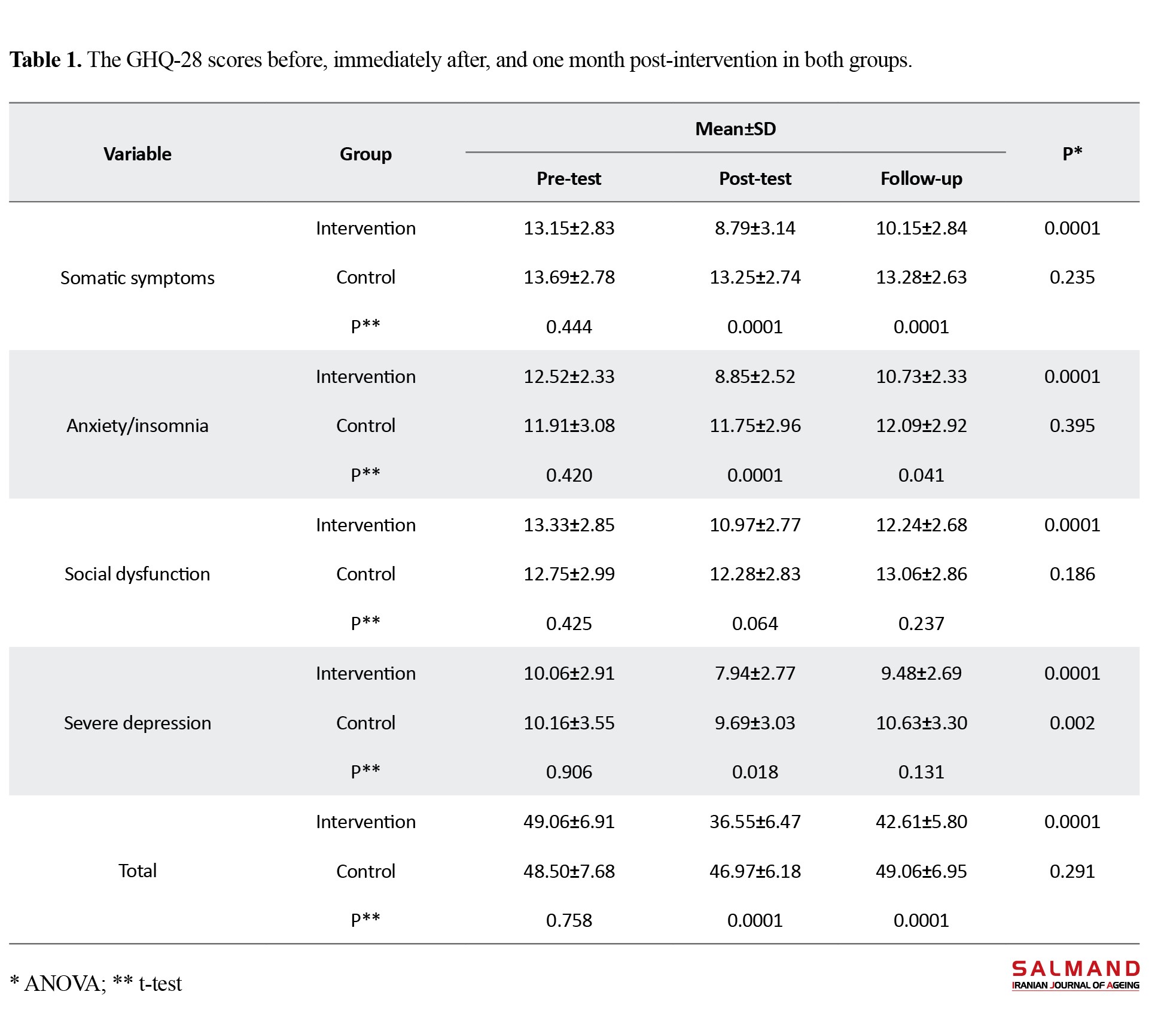
Out of the 70 participants, 65 completed the questionnaires (44.6% male and 55.3% female). The results of chi-square test and independent t-test showed no significant differences in sociodemographic characteristics between the intervention and control groups (P>0.05). There was also no significant difference in mean total GHQ-28 score before the intervention (P=0.758). However, the mean total score in the intervention group decreased from 49.06±6.91 to 55.36±6.47 immediately after the intervention, and further to 42.61±5.80 one month after the intervention. This difference between the two groups was statistically significant (P<0.001). Additionally, one month after the intervention, there was a significant difference between the two groups in the mean total GHQ-28 score (P<0.001). The results of the repeated measures ANOVA indicated that in the intervention group, there were significant changes in the mean total GHQ-28 score among the three time points (P<0.001), while in the control group, these changes were not significant (P=0.291) (Table 1).
Conclusion
The findings showed that cannabis use can effectively improve the general health of older adults in all domains except for social dysfunction. The intervention group had significantly higher scores in the total GHQ-28 and its two domains of somatic symptoms and anxiety/insomnia immediately after and one month after the intervention, compared to the control group. Given the lower costs and fewer side effects of herbal medicines compared to chemical drugs, the use of Hemp Seed—alongside other complementary therapies—can be useful in improving the general health of older adults.
Ethical Considerations
Compliance with ethical guidelines
This study received ethical approval (Code: IR.RUMS.REC.1403.010) from the Ethics Committee of Rafsanjan University of Medical Sciences, and was registered by the Iranian Registry of Clinical Trials (ID: IRCT20171002036498N6). Participants were provided with detailed explanations about the study objectives and methods, and they gave their written informed consent to participate.
Funding
This article was extracted from the Master’s thesis of Mohammad Rajabian, funded by Rafsanjan University of Medical Sciences.
Authors' contributions
Design, investigation, and writing: Fatemeh Hosseini, Mohammad Rajabian, Azam Heidarzadeh; drug dose calculation and drug production: Mahboobeh Raeiszadeh; data collection: Ali Akbari and Mohammad Rajabian; Data analysis, review & editing: Hassan Ahmadinia and Ali Akbari.
Conflicts of interest
The authors declare no conflicts of interest.
Acknowledgments
The authors would like to thank all seniors who participated in this study, as well as the selected health centers in Rafsanjan city, for their cooperation in this research.
As the older adult population increases in Iran, their health problems become increasingly important. One of the major global challenges is improving the overall health of older adults. The World Health Organization (WHO) defines general health as encompassing both physical and mental well-being. Given the importance of older adult health, it is better to consider solutions that avoid the side effects of chemical medications, which are linked to illness and higher mortality in older adults. Some medicinal plants, like cannabis, enhance health due to their beneficial properties. Different strains contain varying levels of tetrahydrocannabinol (THC) and cannabidiol (CBD). Researchers have highlighted the medicinal benefits of CBD, including anti-anxiety, antipsychotic, sleep regulation, depression relief, epilepsy treatment, inflammation reduction, and pain management. Due to limited research on the effects of Hemp Seed use among older adults in Iran, this study aimed to examine its effects on the general health of older adults.
Materials and Methods
This is a randomized, triple-blind controlled trial. The sample size was calculated and set at 30 per group. Taking into account a possible 10% dropout rate in each group, 35 older adults were finally selected for each group. Participants were randomly assigned to intervention and control groups using the Minimization method. The inclusion criteria were no history of cannabis allergy, no incurable physical illnesses, age >60 years, consent to participate in the study, no record of any unfortunate incidents within the past six months, no addiction, no known mental health issues, and a score of ≥23 on the general health questionnaire (GHQ-28). The exclusion criteria were unwillingness to continue treatment, any contraindications or allergic reactions to cannabis seeds, failing to consume Hemp Seed capsules consistently for a minimum of two consecutive days, and incorporating Hemp seed into their diet.
To prepare the oral capsule, A pharmacognosy specialist first examined and approved the genus and species of the Hemp Seed plant purchased from a herbalist shop in Kerman, Iran, and assigned it a herbarium number (KF1369). To standardize the herbal product, the total phenolic compounds in Hemp seed extract were measured. The final oral capsule dose administered to the intervention group was 700 mg (three times daily for 4 weeks). Since side effects might occur with Hemp seed consumption in participants, the doctor monitored them. Additionally, they were contacted weekly, and any complications related to Hemp seed intake were recorded. A form documented unwanted side effects, and patients were asked weekly whether they experienced any issues. If a complication occurred, it was assessed whether it was related to the intervention.
Data were collected using a sociodemographic form and the self-report GHQ-28 at three time points: at baseline, 4 weeks after, and one month after the intervention. The data were analyzed in SPSS software, version 22. The assumption of normality for the quantitative variables was examined using the Kolmogorov-Smirnov test as well as skewness and kurtosis indices. Independent t-test and chi-square test were used to compare the intervention and control groups based on sociodemographic characteristics. The significance level for all tests was set at 0.05.
Results
Out of the 70 participants, 65 completed the questionnaires (44.6% male and 55.3% female). The results of chi-square test and independent t-test showed no significant differences in sociodemographic characteristics between the intervention and control groups (P>0.05). There was also no significant difference in mean total GHQ-28 score before the intervention (P=0.758). However, the mean total score in the intervention group decreased from 49.06±6.91 to 55.36±6.47 immediately after the intervention, and further to 42.61±5.80 one month after the intervention. This difference between the two groups was statistically significant (P<0.001). Additionally, one month after the intervention, there was a significant difference between the two groups in the mean total GHQ-28 score (P<0.001). The results of the repeated measures ANOVA indicated that in the intervention group, there were significant changes in the mean total GHQ-28 score among the three time points (P<0.001), while in the control group, these changes were not significant (P=0.291) (Table 1).
Conclusion
The findings showed that cannabis use can effectively improve the general health of older adults in all domains except for social dysfunction. The intervention group had significantly higher scores in the total GHQ-28 and its two domains of somatic symptoms and anxiety/insomnia immediately after and one month after the intervention, compared to the control group. Given the lower costs and fewer side effects of herbal medicines compared to chemical drugs, the use of Hemp Seed—alongside other complementary therapies—can be useful in improving the general health of older adults.
Ethical Considerations
Compliance with ethical guidelines
This study received ethical approval (Code: IR.RUMS.REC.1403.010) from the Ethics Committee of Rafsanjan University of Medical Sciences, and was registered by the Iranian Registry of Clinical Trials (ID: IRCT20171002036498N6). Participants were provided with detailed explanations about the study objectives and methods, and they gave their written informed consent to participate.
Funding
This article was extracted from the Master’s thesis of Mohammad Rajabian, funded by Rafsanjan University of Medical Sciences.
Authors' contributions
Design, investigation, and writing: Fatemeh Hosseini, Mohammad Rajabian, Azam Heidarzadeh; drug dose calculation and drug production: Mahboobeh Raeiszadeh; data collection: Ali Akbari and Mohammad Rajabian; Data analysis, review & editing: Hassan Ahmadinia and Ali Akbari.
Conflicts of interest
The authors declare no conflicts of interest.
Acknowledgments
The authors would like to thank all seniors who participated in this study, as well as the selected health centers in Rafsanjan city, for their cooperation in this research.
References
- Hogstel MO, Kazer MW, Zembruzski C. Gerontology: Nursing care of the older adult. Albany: Delmar Thompson Learning; 2001. [Link]
- Crippa JA, Zuardi AW, Hallak JE. Therapeutical use of the cannabinoids in psychiatry. Brazilian Journal of Psychiatry. 2010; 32(suppl 1). [DOI:10.1590/S1516-44462010000500009]
- Adib-Hajbaghery M, Mousavi SN. The effects of chamomile extract on sleep quality among elderly people: A clinical trial. Complementary Therapies in Medicine. 2017; 35:109-14. [DOI:10.1016/j.ctim.2017.09.010] [PMID]
- Lame-Jouybari AH, Abbasalizad-Farhangi M. Effects of eight-week regular high-intensity interval training and hemp (Cannabis sativa L.) seed on total testosterone level among sedentary young males: double-blind, randomized, controlled clinical trial. Endocrine. 2024; 84(1):273-86. [DOI:10.1007/s12020-023-03629-8] [PMID]
- Mehrabani M, Lotfian Sargazi M, Amirkhosravi A, Farhadi S, Vasei S, Raeiszadeh M, et al. The influence of harvest time on total phenolic and flavonoid contents, antioxidant, antibacterial and cytotoxicity of Rheum khorasanicum root extract. Annales Pharmaceutiques Françaises. 2023; 81( 3):475-83. [DOI:10.1016/j.pharma.2022.11.010] [PMID]
- Hong C, Sun L, Liu G, Guan B, Li C, Luo Y. Response of global health towards the challenges presented by population aging. China CDC weekly. 2023; 5(39):884-7. [DOI:10.46234/ccdcw2023.168] [PMID]
- World Health Organization. Achieving well-being: A global framework for integrating well-being into public health utilizing a health promotion approach. Geneva: World Health Organization; 2023. [Link]
- Zarei F, Mohammadi M, Aboozade Gatabi K, Ghanbari Moghaddam A. [General health and its related factors among elderly in sabzevar 2016 (Persian)]. Journal of Gerontology. 2017; 2(2):26-33. [DOI:10.29252/joge.2.2.26]
- Esmonde L, Long AF. Complementary therapy use by persons with multiple sclerosis: Benefits and research priorities. Complementary Therapies in Clinical Practice. 2008; 14(3):176-84. [DOI:10.1016/j.ctcp.2008.03.001] [PMID]
- André B, Canhão H, Espnes GA, Rodrigues AM, Gregorio MJ, Nguyen C, et al. Is there an association between food patterns and life satisfaction among Norway’s inhabitants ages 65 years and older? Appetite. 2017; 110:108-15. [DOI:10.1016/j.appet.2016.12.016] [PMID]
- Crippa JA, Crippa AC, Hallak JE, Martín-Santos R, Zuardi AW. Δ9-THC intoxication by cannabidiol-enriched cannabis extract in two children with refractory epilepsy: Full remission after switching to purified cannabidiol. Frontiers in Pharmacology. 2016; 7:359. [DOI:10.3389/fphar.2016.00359]
- Leweke FM, Piomelli D, Pahlisch F, Muhl D, Gerth CW, Hoyer C, et al. Cannabidiol enhances anandamide signaling and alleviates psychotic symptoms of schizophrenia. Translational Psychiatry. 2012; 2(3):e94- [DOI:10.1038/tp.2012.15] [PMID]
- Chagas MH, Eckeli AL, Zuardi AW, Pena-Pereira MA, Sobreira-Neto MA, Sobreira ET, et al. Cannabidiol can improve complex sleep-related behaviours associated with rapid eye movement sleep behaviour disorder in Parkinson’s disease patients: A case series. Journal of Clinical Pharmacy and Therapeutics. 2014; 39(5):564-6. [DOI:10.1111/jcpt.12179] [PMID]
- Devinsky O, Marsh E, Friedman D, Thiele E, Laux L, Sullivan J, et al. Cannabidiol in patients with treatment-resistant epilepsy: An open-label interventional trial. The Lancet Neurology. 2016; 15(3):270-8. [DOI:10.1016/S1474-4422(15)00379-8] [PMID]
- Del-Bel E, Barros-Pereira N, Moraes RP, Mattos BA, Alves-Fernandes TA, Abreu LB, Nascimento GC, Escobar-Espinal D, Pedrazzi JFC, Jacob G, Milan BA, Bálico GG, Antonieto LR. A journey through cannabidiol in Parkinson's disease. International Review of Neurobiology. 2024; 177:65-93. [DOI:10.1016/bs.irn.2024.04.015] [PMID]
- Devinsky O, Cross JH, Laux L, Marsh E, Miller I, Nabbout R, et al. Trial of cannabidiol for drug-resistant seizures in the Dravet syndrome. New England Journal of Medicine. 2017; 376(21):2011-20. [DOI:10.1056/NEJMoa1611618] [PMID]
- Fuss J, Steinle J, Bindila L, Auer MK, Kirchherr H, Lutz B, et al. A runner’s high depends on cannabinoid receptors in mice. Proceedings of the National Academy of Sciences. 2015; 112(42):13105-8. [DOI:10.1073/pnas.1514996112] [PMID]
- Jung JB, Cho YW, Kim SY, Chung SY, Han KH, Ham BJ, et al. The effects of hemp seed consumption on depression, anxiety and cognitive improvement based on machine learning. Archives of Food and Nutritional Science. 2023; 7(1):032-9. [DOI:10.29328/journal.afns.1001047]
- Goldberg DP, Hillier VF. A scaled version of the General Health Questionnaire. Psychological Medicine. 1979; 9(1):139-45. [DOI:10.1017/S0033291700021644] [PMID]
- Malekooti SK, Mirabzadeh A, Fathollahi P, Salavati M, Kahali S, Afkham Ebrahimi A, et al. [Reliability, validity and factor structure of the GHQ-28 in Iranian elderly (Persian)]. Iranian Journal of Ageing. 2006; 1(1):11-21. [Link]
- Shannon S, Lewis N, Lee H, Hughes S. Cannabidiol in anxiety and sleep: A large case series. The Permanente Journal. 2019; 23:18-041. [DOI:10.7812/TPP/18-041] [PMID]
- Kaufmann CN, Malhotra A, Yang KH, Han BH, Nafsu R, Lifset ET, et al. Cannabis use for sleep disturbance among older patients in a geriatrics clinic. The International Journal of Aging and Human Development. 2023; 97(1):3 17. [DOI:10.1177/00914150221128971] [PMID]
- Martin EL, Strickland JC, Schlienz NJ, Munson J, Jackson H, Bonn-Miller MO, et al. Antidepressant and anxiolytic effects of medicinal cannabis use in an observational trial. Frontiers in Psychiatry. 2021; 12:729800. [DOI:10.3389/fpsyt.2021.729800] [PMID]
- Kicman A, Toczek M. The effects of cannabidiol, a non-intoxicating compound of cannabis, on the cardiovascular system in health and disease. International Journal of Molecular Sciences. 2020; 21(18):6740. [DOI:10.3390/ijms21186740] [PMID]
- Abbasifard M, Moosavi Z, Azimi M, Kamiab Z, Bazmandegan G, Madahian A, et al. Effect of Topical Hemp (Cannabis sativa L.) Seed Oil on Knee Osteoarthritis: A Randomized Double-Blind Controlled Trial. Pain Management Nursing. 2025; 26(1):e74-81. [DOI:10.1016/j.pmn.2024.08.001] [PMID]
- Monti JM, Pandi-Perumal SR. Clinical management of sleep and sleep disorders with cannabis and cannabinoids: Implications to practicing psychiatrists. Clinical Neuropharmacology. 2022; 45(2):27-31. [DOI:10.1097/WNF.0000000000000494] [PMID]
Type of Study: Research |
Subject:
Psychiatry
Received: 2025/11/14 | Accepted: 2026/04/21 | Published: 2026/10/02
Received: 2025/11/14 | Accepted: 2026/04/21 | Published: 2026/10/02
Send email to the article author
| Rights and permissions | |
 |
This work is licensed under a Creative Commons Attribution-NonCommercial 4.0 International License. |

Copyright © The Author(s);
This is an open access article distributed under the terms of the Creative Commons Attribution-NonCommercial 4.0 (CC-By-NC 4.0), which permits use, distribution, and reproduction in any medium, provided the original work is properly cited and is not used for commercial purposes.
Contact Information