Volume 21, Issue 1 (Spring 2026)
Salmand: Iranian Journal of Ageing 2026, 21(1): 140-153 |
Back to browse issues page



Download citation:
BibTeX | RIS | EndNote | Medlars | ProCite | Reference Manager | RefWorks
Send citation to:


BibTeX | RIS | EndNote | Medlars | ProCite | Reference Manager | RefWorks
Send citation to:
Pourmollamirza A, Valizadeh L, Navab E, Matlabi H, Zamanzadeh V. Perceived Challenges of the Intergenerational Gap among Elderly Adults: A Qualitative Study. Salmand: Iranian Journal of Ageing 2026; 21 (1) :140-153
URL: http://salmandj.uswr.ac.ir/article-1-3050-en.html
URL: http://salmandj.uswr.ac.ir/article-1-3050-en.html


1- Department of Geriatric Nursing, Faculty of Nursing and Midwifery, Shahid Beheshti University of Medical Sciences, Tehran, Iran.
2- Department of Pediatric Nursing, Faculty of Nursing and Midwifery, Shahid Beheshti University of Medical Sciences, Tehran, Iran.
3- Department of Geriatric Nursing, Faculty of Nursing and Midwifery, Tehran University of Medical Sciences, Tehran, Iran.
4- Department of Geriatric Health, Faculty of Health Sciences, Tabriz University of Medical Sciences, Tabriz, Iran.
5- Department of medical-Surgical Nursing, Faculty of Nursing and Midwifery, Shahid Beheshti University of Medical Sciences, Tehran, Iran. ,zamanzadeh@sbmu.ac.ir
2- Department of Pediatric Nursing, Faculty of Nursing and Midwifery, Shahid Beheshti University of Medical Sciences, Tehran, Iran.
3- Department of Geriatric Nursing, Faculty of Nursing and Midwifery, Tehran University of Medical Sciences, Tehran, Iran.
4- Department of Geriatric Health, Faculty of Health Sciences, Tabriz University of Medical Sciences, Tabriz, Iran.
5- Department of medical-Surgical Nursing, Faculty of Nursing and Midwifery, Shahid Beheshti University of Medical Sciences, Tehran, Iran. ,
Full-Text [PDF 5982 kb]
(866 Downloads)
| Abstract (HTML) (3251 Views)
Full-Text: (489 Views)
Introduction
The generation gap refers to the mutual lack of understanding between older and younger generations regarding each other’s values and attitudes, which has become a significant social challenge in many societies, particularly in Asian countries, such as Iran. This gap often arises from the conflict between tradition and modernity. The changes brought about by modernization manifested in family structures, individual attitudes, culture, and technology contribute to the emergence of intergenerational disparities. The generation gap, by fostering intergenerational conflict, can pose challenges for societies and different age groups. Studies conducted in various countries indicate that older adults, influenced by this gap, may face fundamental difficulties. Given the scarcity of localized research in Iran, the present study aimed to explore the perceived challenges of older adults regarding the generation gap.
Methods and Materials
This qualitative study employed the conventional content analysis method. The study population included older adults, who were selected through purposive sampling from among older adults living in Tehran, Iran. The study included 21 older adults (11 women and 10 men), aged between 65 and 80 years. Data were collected through in-depth, semi-structured, face-to-face individual interviews. The time and location of the interviews were chosen by the participants. An interview guide was developed by the research team to conduct the interviews. The interviews were conducted by a researcher with prior experience in qualitative research interviewing, from September 2023 to September 2024. The interviews continued until theoretical date saturation. All interviews were audio-recorded and transcribed verbatim. The transcribed texts were used as the primary data for the study. Both the audio recordings and transcripts were reviewed multiple times by the researcher to gain a comprehensive understanding. Data collection and analysis were carried out simultaneously. For data analysis, the conventional content analysis method developed by Graneheim and Lundman (2004) [22]was used. During the analysis process, meaning units—such as words, sentences, or paragraphs relevant to the interview questions—were identified and extracted from the transcripts. These units were then coded. Codes with similar content were grouped into subcategories, which were then merged to form categories. Data management was facilitated using MAXQDA software, version 11. To evaluate the trustworthiness of the study, criteria introduced by Lincoln and Guba (credibility, transferability, dependability and confirmability) were used. This article was reported according to the Standards for Reporting Qualitative Research (SRQR) checklist.
Results
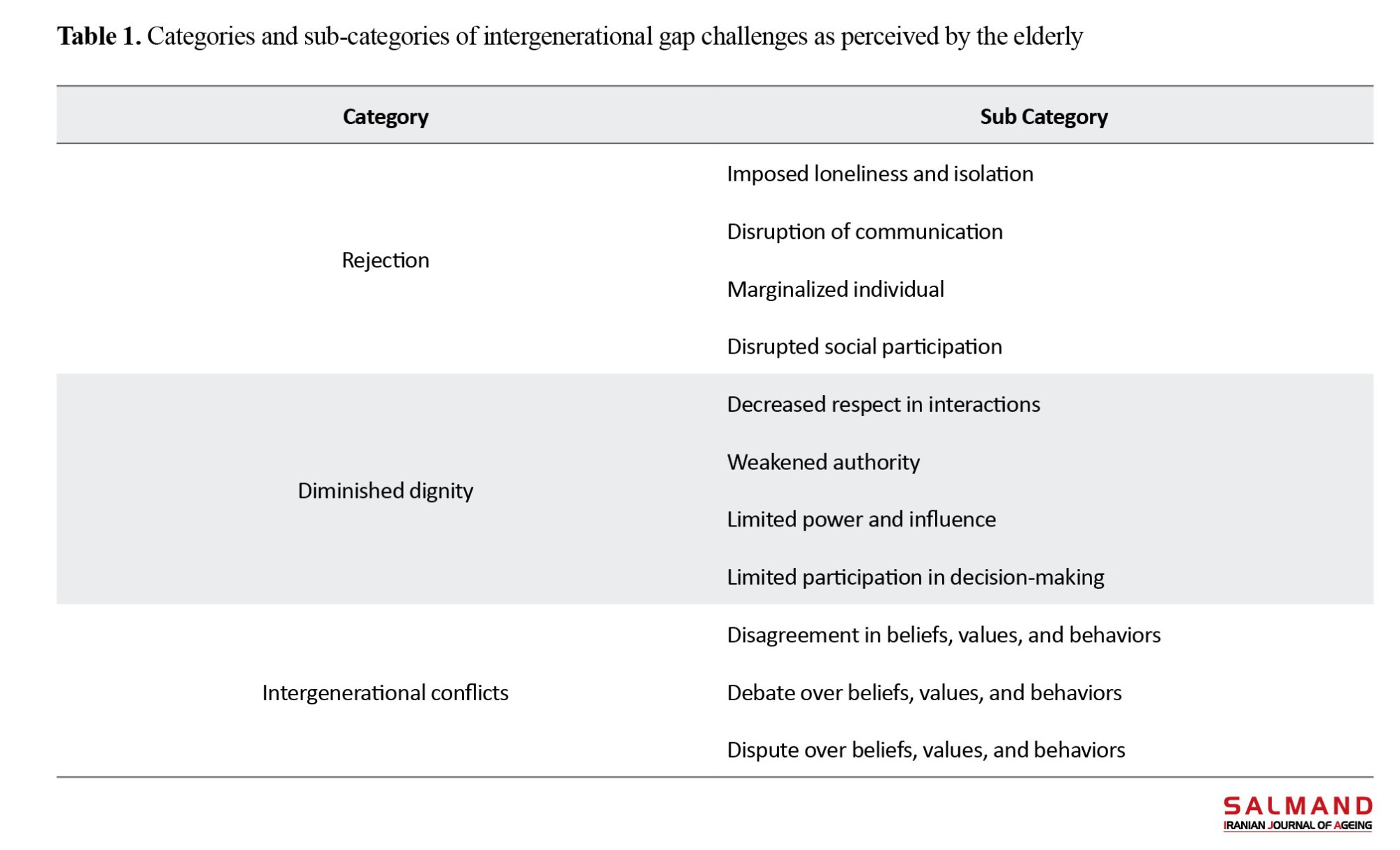
The analysis of the interviews led to the emergence of eleven sub-categories and 3 categories, which are presented in Table 1.
Rejection
This concept refers to a state in which an elderly individual feels excluded from social groups, the community, and their surrounding environment. Through their interactions with younger generations in various settings, older adults form a self-concept characterized by negative dimensions, such as imposed loneliness and isolation, disruption of communication, and marginalized individual and disrupted social participation.
Diminished dignity
Old age is perceived by individuals as a phase of life during which they expect to be treated with dignity and respect by others. However, the experiences of the elderly indicate that the generational gap, by influencing the culture and values of the younger generation, has weakened their regard for the elderly, thereby undermining the elders’ social status and standing. This sense of diminished status is marked by decreased respect in interactions, weakened authority, limitations in power and influence, and limited participation in decision-making.
Intergenerational Conflicts
Different time periods are characterized by unique conditions and features. People living in a particular era tend to develop significant differences in beliefs, values, and behaviors compared to those from other generations due to the influence of their specific social contexts. In recent years, modernization has profoundly shaped societal changes. Generations that have grown up during this transformation possess fundamental differences from their predecessors. Moreover, the rapid pace of societal change has made it difficult for the elderly to adapt and keep up, leading to the emergence of intergenerational conflicts. These conflicts manifest in various forms and dimensions, with older adults reporting diverse experiences of disagreement, debate, and dispute in their personal, familial, and social interactions with the younger generation.
Conclusion
The intergenerational gap between older adults and the younger generation constitutes a complex and multidimensional social phenomenon with potentially significant consequences for the psychological well-being, social functioning, and quality of life of the elderly. The findings of this study, consistent with prior research, suggest that older adults perceive this gap as a profound challenge encompassing various dimensions. This challenge manifests in social exclusion, diminished dignity, and intergenerational conflicts, which can generate adverse outcomes for the elderly, negatively affecting their health and overall quality of life. The insights derived from this study highlight the necessity of designing, implementing, and promoting targeted interventions to address the challenges faced by older adults due to the generational divide.
Ethical Considerations
Compliance with ethical guidelines
This study was approved by the Ethics Committee of Shahid Beheshti University of Medical Sciences, Tehran, Iran (Code:IR.SBMU.PHARMACY.REC.1402.012). Prior to the study, the study objectives and methods were explained to the participants, and they signed a written informed consent form.
Funding
This article was extended from the PhD thesis of Afsaneh Pourmollamirza, funded by the Shahid Beheshti University of Medical Sciences.
Authors' contributions
Conceptualization: Afsaneh Pourmollamirza, Vahid Zamanzadeh, Leila Valizadeh; Editing and review: Vahid Zamanzadeh, Leila Valizadeh, Elham Navab, Hossein Matlabi; Methodology, initial draft preparation, and date analysis: All authors.
Conflicts of interest
The authors declared no conflicts of interest.
Acknowledgments
The authors would like to thank Vice Chancellor for Research of Shahid Beheshti University of Medical Sciences and, all participants in this study for their cooperation.
References
The generation gap refers to the mutual lack of understanding between older and younger generations regarding each other’s values and attitudes, which has become a significant social challenge in many societies, particularly in Asian countries, such as Iran. This gap often arises from the conflict between tradition and modernity. The changes brought about by modernization manifested in family structures, individual attitudes, culture, and technology contribute to the emergence of intergenerational disparities. The generation gap, by fostering intergenerational conflict, can pose challenges for societies and different age groups. Studies conducted in various countries indicate that older adults, influenced by this gap, may face fundamental difficulties. Given the scarcity of localized research in Iran, the present study aimed to explore the perceived challenges of older adults regarding the generation gap.
Methods and Materials
This qualitative study employed the conventional content analysis method. The study population included older adults, who were selected through purposive sampling from among older adults living in Tehran, Iran. The study included 21 older adults (11 women and 10 men), aged between 65 and 80 years. Data were collected through in-depth, semi-structured, face-to-face individual interviews. The time and location of the interviews were chosen by the participants. An interview guide was developed by the research team to conduct the interviews. The interviews were conducted by a researcher with prior experience in qualitative research interviewing, from September 2023 to September 2024. The interviews continued until theoretical date saturation. All interviews were audio-recorded and transcribed verbatim. The transcribed texts were used as the primary data for the study. Both the audio recordings and transcripts were reviewed multiple times by the researcher to gain a comprehensive understanding. Data collection and analysis were carried out simultaneously. For data analysis, the conventional content analysis method developed by Graneheim and Lundman (2004) [22]was used. During the analysis process, meaning units—such as words, sentences, or paragraphs relevant to the interview questions—were identified and extracted from the transcripts. These units were then coded. Codes with similar content were grouped into subcategories, which were then merged to form categories. Data management was facilitated using MAXQDA software, version 11. To evaluate the trustworthiness of the study, criteria introduced by Lincoln and Guba (credibility, transferability, dependability and confirmability) were used. This article was reported according to the Standards for Reporting Qualitative Research (SRQR) checklist.
Results
The analysis of the interviews led to the emergence of eleven sub-categories and 3 categories, which are presented in Table 1.
Rejection
This concept refers to a state in which an elderly individual feels excluded from social groups, the community, and their surrounding environment. Through their interactions with younger generations in various settings, older adults form a self-concept characterized by negative dimensions, such as imposed loneliness and isolation, disruption of communication, and marginalized individual and disrupted social participation.
Diminished dignity
Old age is perceived by individuals as a phase of life during which they expect to be treated with dignity and respect by others. However, the experiences of the elderly indicate that the generational gap, by influencing the culture and values of the younger generation, has weakened their regard for the elderly, thereby undermining the elders’ social status and standing. This sense of diminished status is marked by decreased respect in interactions, weakened authority, limitations in power and influence, and limited participation in decision-making.
Intergenerational Conflicts
Different time periods are characterized by unique conditions and features. People living in a particular era tend to develop significant differences in beliefs, values, and behaviors compared to those from other generations due to the influence of their specific social contexts. In recent years, modernization has profoundly shaped societal changes. Generations that have grown up during this transformation possess fundamental differences from their predecessors. Moreover, the rapid pace of societal change has made it difficult for the elderly to adapt and keep up, leading to the emergence of intergenerational conflicts. These conflicts manifest in various forms and dimensions, with older adults reporting diverse experiences of disagreement, debate, and dispute in their personal, familial, and social interactions with the younger generation.
Conclusion
The intergenerational gap between older adults and the younger generation constitutes a complex and multidimensional social phenomenon with potentially significant consequences for the psychological well-being, social functioning, and quality of life of the elderly. The findings of this study, consistent with prior research, suggest that older adults perceive this gap as a profound challenge encompassing various dimensions. This challenge manifests in social exclusion, diminished dignity, and intergenerational conflicts, which can generate adverse outcomes for the elderly, negatively affecting their health and overall quality of life. The insights derived from this study highlight the necessity of designing, implementing, and promoting targeted interventions to address the challenges faced by older adults due to the generational divide.
Ethical Considerations
Compliance with ethical guidelines
This study was approved by the Ethics Committee of Shahid Beheshti University of Medical Sciences, Tehran, Iran (Code:IR.SBMU.PHARMACY.REC.1402.012). Prior to the study, the study objectives and methods were explained to the participants, and they signed a written informed consent form.
Funding
This article was extended from the PhD thesis of Afsaneh Pourmollamirza, funded by the Shahid Beheshti University of Medical Sciences.
Authors' contributions
Conceptualization: Afsaneh Pourmollamirza, Vahid Zamanzadeh, Leila Valizadeh; Editing and review: Vahid Zamanzadeh, Leila Valizadeh, Elham Navab, Hossein Matlabi; Methodology, initial draft preparation, and date analysis: All authors.
Conflicts of interest
The authors declared no conflicts of interest.
Acknowledgments
The authors would like to thank Vice Chancellor for Research of Shahid Beheshti University of Medical Sciences and, all participants in this study for their cooperation.
References
- Najafiasl Z. Intergenerational gap: An emerging phenomenon in Iran. International Journal of Social Sciences. 2015; 5(1):59-70. [Link]
- Chou WH, Li YC, Chen YF, Ohsuga M, Inoue T. Empirical study of virtual reality to promote intergenerational communication: taiwan traditional glove puppetry as example. Sustainability. 2022; 14(6):3213. [DOI:10.3390/su14063213]
- Segal UA. Cultural variables in Asian Indian families. Families in Society. 1991;72(4):233-42. [DOI:10.1177/104438949107200406]
- Panahi M, Alavyyun SH. [Generational distance in Iran: meta-analysis and criticism of previous research (Persian)]. Intercultural Studies Quarterly. 2018; 13(36):147-71. [Link]
- Ashrafi Habibabadi Z, Ezzatzadeh M. The influence of utilizing social networks on the generation gap in families in 5th district of Tehran. IAU International Journal of Social Sciences. 2020; 10(3):49-62. [Link]
- Pásztor J, Bak G. Digital divide: A technological generation gap. Management, Enterprise and Benchmarking in the 21st Century. 2020; 158-68. [Link]
- Inglehart RF. Cultural evolution: people›s motivations are changing, and reshaping the world. Cambridge: Cambridge University Press; 2018. [DOI:10.1017/9781108613880]
- Mushtaq F, Saeed S. Transition in spouse selection: A study of Pakistani graduates and their parents. Elementary Education Online. 2021; 20(5):1193. [Link]
- Nauck B, Steinbach A. Intergenerational relationships. RatSWD Working Paper, 2009. [DOI:10.2139/ssrn.1462084]
- Chang Y, Huang J. Impacts of intergenerational care for grandchildren and intergenerational support on the psychological well-being of the elderly in China. Revista Argentina de Clinica Psicologica. 2020; 29(1):57-64. [Link]
- Mo W. Successful Aging Among Older People: How Social Support Contributes to Psychological Health. 2021 3rd International Conference on Literature, Art and Human Development (ICLAHD 2021). 2021; 185-89. [DOI:10.2991/assehr.k.211120.035]
- Yan Y. Intergenerational intimacy and descending familism in rural north China. American Anthropologist. 2016; 118(2):244-57. [DOI:10.1111/aman.12527]
- Aoki T, Yamamoto Y, Ikenoue T, Urushibara-Miyachi Y, Kise M, Fujinuma Y, et al. Social isolation and patient experience in older adults. The Annals of Family Medicine. 2018; 16(5):393-8. [DOI:10.1370/afm.2257] [PMID]
- Rehman I, Mohyuddin A. Social issues of senior citizens. The Explorer Islamabad. 2015; 8(1):301-6. [Link]
- Jeong H, Yim HW, Nam BW. Independent predictors of depressive symptoms and social isolation on 2-year all-cause mortality among the Korean elderly in a population-based cohort study: Gender differences. Epidemiology and Health. 2022; 44:1-8. [DOI:10.4178/epih.e2022012] [PMID]
- Barbero C, Hafeedh Bin Abdullah A, Wiggins N, Garrettson M, Jones DS. Guinn A, et al. Community health worker activities in public health programs to prevent violence: Coding roles and scope. American Journal of Public Health. 2022; 112(8):1191-201. [DOI:10.2105/AJPH.2022.306865] [PMID]
- Sohrabzade M, Parnian L, Niazi M, Khajenouri B, Sadeghidehcheshme S. Qualitative studies generation gap among girls (case study: Kermanshah city). Quarterly Journal of Women and Society. 2019; 10(37):1-28. [Link]
- Ratnapalan S. Qualitative approaches: Variations of grounded theory methodology. Canadian Family Physician Medecin De Famille Canadien. 2019; 65(9):667-8. [PMID]
- Kleinheksel AJ, Rockich-Winston N, Tawfik H, Wyatt TR. Demystifying content analysis. American Journal of Pharmaceutical Education. 2020; 84(1):7113. [DOI:10.5688/ajpe7113] [PMID]
- Lindgren BM, Lundman B, Graneheim UH. Abstraction and interpretation during the qualitative content analysis process. International Journal of Nursing Studies. 2020; 108:103632. [DOI:10.1016/j.ijnurstu.2020.103632] [PMID]
- O›Brien BC, Harris IB, Beckman TJ, Reed DA, Cook DA. Standards for reporting qualitative research: A synthesis of recommendations. Academic Medicine. 2014; 89(9):1245-51. [DOI:10.1097/ACM.0000000000000388] [PMID]
- Graneheim UH, Lundman B. Qualitative content analysis in nursing research: Concepts, procedures and measures to achieve trustworthiness. Nurse Education Today. 2004; 24(2):105-12. [DOI:10.1016/j.nedt.2003.10.001] [PMID]
- Lincoln YS, Guba EG. But is it rigorous? Trustworthiness and authenticity in naturalistic evaluation. New Directions for Program Evaluation. 1986; 1986(30):73-84. [DOI:10.1002/ev.1427]
- Wu X, Yuan Z. Understanding the socio-cultural resilience of rural areas through the intergenerational relationship in transitional China: Case studies from Guangdong. Journal of Rural Studies. 2023; 97:303-13. [DOI:10.1016/j.jrurstud.2022.12.001]
- Awad R, Shamay-Tsoory S, Palgi Y. Fluctuations in loneliness due to changes in frequency of social interactions among older adults: A weekly based diary study. International Psychogeriatrics. 2023; 35(6):293-303. [DOI:10.1017/S1041610223000133] [PMID]
- Butler RN. Ageism: A foreword. Journal of Social Issues. 1980; 36(2):8-11. [DOI:10.1111/j.1540-4560.1980.tb02018.x]
- Kabelenga I. Zambian elders experiences and perceptions of the generation gap. Anthropological Researches and Studies. 2017; 1(7):3-15. [DOI:10.26758/7.1.1]
- Łukaszewski B, Szot L, Kalinowski M, Niewiadomska I. Marginalisation and stereotypes relating to the elderly in the context of social changes and family problems. Generation gap and methods of prevention in Poland. Journal of Modern Science. 2024; 60(6):568-91. [DOI:10.13166/jms/196899]
- Halim AA, Anas N, Mohamed AK, Said WM, Sabri MAA, Nazr ASDA. Islamic traditions on elderly care. International Journal of Academic Research in Business and Social Sciences. 2024; 14(5):758-66. [DOI:10.6007/IJARBSS/v14-i5/21150]
- Hangsub C. A sociological study on the disgust of the young generation toward the elderly in Korean Society: Social causes. Korean Journal. 2021; 61(2):1-28. [Link]
- Mannheim K, Kecskemeti P. Essays on the Sociology of Knowledge. Philosophy. 1953; 28(106):278-9. [Link]
- Urick MJ, Hollensbe EC, Masterson SS, Lyons ST. Understanding and managing intergenerational conflict: An examination of influences and strategies. Work, Aging and Retirement. 2017; 3(2):166-85. [DOI:10.1093/workar/waw009]
- Dere B, Başıbüyük HH. Traversing intergenerational conflict: a phenomenological exploration across three generations grounded in solidarity. Educational Gerontology. 2024; 1-15. [DOI:10.1080/03601277.2024.2402852]
- Ali N, Faruqui A. To Study the Conflict between three Generations of Men and Women. Indian Journal of Physiotherapy & Occupational Therapy. 2022; 16(2):1. [DOI:10.37506/ijpot.v16i2.18044]
Type of Study: Research |
Subject:
Social
Received: 2025/04/14 | Accepted: 2025/07/22 | Published: 2026/03/30
Received: 2025/04/14 | Accepted: 2025/07/22 | Published: 2026/03/30
Send email to the article author
| Rights and permissions | |
 |
This work is licensed under a Creative Commons Attribution-NonCommercial 4.0 International License. |

Copyright © The Author(s);
This is an open access article distributed under the terms of the Creative Commons Attribution-NonCommercial 4.0 (CC-By-NC 4.0), which permits use, distribution, and reproduction in any medium, provided the original work is properly cited and is not used for commercial purposes.
Contact Information