Volume 21, Issue 3 (Autumn 2026)
Salmand: Iranian Journal of Ageing 2026, 21(3): 364-379 |
Back to browse issues page


Download citation:
BibTeX | RIS | EndNote | Medlars | ProCite | Reference Manager | RefWorks
Send citation to:


BibTeX | RIS | EndNote | Medlars | ProCite | Reference Manager | RefWorks
Send citation to:
Janjani P, Momeni K, Shini A, Daniali S, Majzoobi M R, Nosrati P. Relationship of Perceived Social Support and Self-Compassion With Treatment Adherence Mediated by Coping Strategies in Older Adults With Cardiovascular Diseases. , Salmand: Iranian Journal of Ageing. 2026; 21 (3) :364-379
URL: http://salmandj.uswr.ac.ir/article-1-3146-en.html
URL: http://salmandj.uswr.ac.ir/article-1-3146-en.html
Parisa Janjani1 

 , Khodamorad Momeni2 , Amir Shini3 , Sarira Daniali4 , Mohammad Reza Majzoobi5 , Parisa Nosrati *6
1- Cardiovascular Research Center, Health Policy and Promotion Institute, Imam Ali Hospital, Kermanshah University of Medical Sciences, Kermanshah, Iran. & Department of Rehabilitation Sciences, School of Rehabilitation Sciences, Kermanshah University of Medical Sciences, Kermanshah, Iran.
2- Department of Psychology, Faculty of Social Sciences, Razi University, Kermanshah, Iran.
3- Department of Speech Therapy, School of Rehabilitation Sciences, Kermanshah University of Medical Sciences, Kermanshah, Iran.
4- Cardiovascular Research Center, Health Policy and Promotion Institute, Imam Ali Hospital, Kermanshah University of Medical Sciences, Kermanshah, Iran.
5- Department of Psychology, Developmental Psychology and Clinical Psychology of the Lifespan, University of Siegen, Siegen, Germany.
6- Department of Psychology, Faculty of Social Sciences, Razi University, Kermanshah, Iran. ,parisanosrati77@yahoo.com
2- Department of Psychology, Faculty of Social Sciences, Razi University, Kermanshah, Iran.
3- Department of Speech Therapy, School of Rehabilitation Sciences, Kermanshah University of Medical Sciences, Kermanshah, Iran.
4- Cardiovascular Research Center, Health Policy and Promotion Institute, Imam Ali Hospital, Kermanshah University of Medical Sciences, Kermanshah, Iran.
5- Department of Psychology, Developmental Psychology and Clinical Psychology of the Lifespan, University of Siegen, Siegen, Germany.
6- Department of Psychology, Faculty of Social Sciences, Razi University, Kermanshah, Iran. ,
Keywords: Coping skills, Social support, Self-Compassion, Treatment adherence, Cardiovascular disease, Aged
Full-Text [PDF 8402 kb]
(828 Downloads)
| Abstract (HTML) (2351 Views)
References
Full-Text: (174 Views)
Introduction
Given the high prevalence of cardiovascular diseases (CVDs) as one of the leading causes of mortality worldwide and in Iran, as well as the serious consequences of non-adherence to treatment regimens observed in more than half of patients, the necessity of examining psychological and social factors associated with treatment adherence in CVD patients becomes increasingly evident. Previous studies have demonstrated that perceived social support and self-compassion can play a significant role in enhancing adherence to treatment. Moreover, coping strategies have been identified as mediating variables in managing psychological stress and facilitating patients’ adjustment to illness conditions. Accordingly, the present study aims to investigate the direct and indirect (through coping strategies) relationships of perceived social support and self-compassion with treatment adherence among elderly patients with CVDs in Iran. This study seeks to provide a structural model that addresses the existing gap in prior research and offers a foundation for designing effective interventions to improve CVD patients’ adherence to treatment.
Methods and Materials
This is analytical correlational study using structural equation modeling (SEM). The study population consisted of elderly patients with CVDs hospitalized or referred to the cardiology outpatient clinic of Imam Ali Hospital in Kermanshah, Iran, in 2024. Based on Loehlin’s (2004) recommendation (at least 200 samples needed for multi-factor models), and considering a 10% attrition rate, a sample size of 220 was determined. Participants were selected using convenience sampling. Inclusion criteria were willingness to participate in the study and having a diagnosed CVD, while exclusion criteria were a history of open-heart surgery, heart failure, recent myocardial infarction (within the past six months), severe psychiatric disorders (e.g., psychosis, major depression, bipolar disorder, substance abuse), cancer, pregnancy, and congenital heart disease.
The instruments included: the 12-item Multidimensional Scale of Perceived Social Support (MSPSS) developed by Zimet et al. (1988) [30]; the Self-Compassion Scale – Short Form (SCS-SF) by Raes et al. (2011) [32]; the 21-item Coping Inventory for Stressful Situations (CISS) by Endler and Parker (1990) [34]; and the 40-item Treatment Adherence Questionnaire developed by Fatemi (2018)[36]. Trained interviewers explained the study objectives to eligible patients, obtained their written informed consent, and administered the questionnaires. Data collection was scheduled at times convenient for participants. A total of 260 questionnaires were collected, of which 18 were excluded due to incomplete responses, leaving 242 valid cases for analysis. Data were analyzed in SPSS software, version 26 and AMOS software, version 24. Descriptive statistics were first reported, followed by conducting Pearson’s correlation test and SEM with maximum likelihood estimation. Model fit indices were calculated, with statistical significance set at 0.05.
Results
Among the 242 participants, 105 (43.3%) were female and 137 (56.6%) were male. Regarding marital status, 215 (88.8%) were married, 8 (3.3%) were single, 10 (4.1%) were divorced, and 9 (3.7%) were widow/widowed. Prior to testing the conceptual model, the assumptions of SEM—including normality, independence of errors, and multicollinearity—were examined. The values of skewness and kurtosis indicated that the distribution of variables was within the normal range. The Durbin–Watson statistic was 1.75, which falls within the acceptable range (1.5–2.5), confirming independence of errors. In addition, variance inflation factors and tolerance indices showed no evidence of multicollinearity among the variables.
Pearson’s correlation test results revealed that perceived social support, self-compassion, and problem-focused coping strategies were positively and significantly associated with treatment adherence, whereas emotion-focused and avoidance coping strategies were negatively and significantly related to adherence. These findings provided the basis for conducting path analysis. The obtained model fit indices included χ²/df=1.92, GFI=0.903, AGFI=0.910, CFI=0.940, TLI=0.950, and RMSEA=0.062, all of which were within acceptable or ideal ranges. Therefore, the conceptual model demonstrated satisfactory fit.
The final model showed that self-compassion (β=0.38) had a stronger predictive effect on treatment adherence compared to perceived social support (β=0.19). Problem-focused coping strategies exerted a positive effect (β=0.10), while emotion-focused (β=−0.31) and avoidance coping strategies (β=−0.46) had negative and significant effects on adherence. Direct path coefficients indicated that all relationships were significant at P<0.001.
In addition to direct effects, Sobel’s test was conducted to examine indirect effects. The results (Table 1) demonstrated that coping strategies significantly mediated the relationships between perceived social support, self-compassion, and treatment adherence.
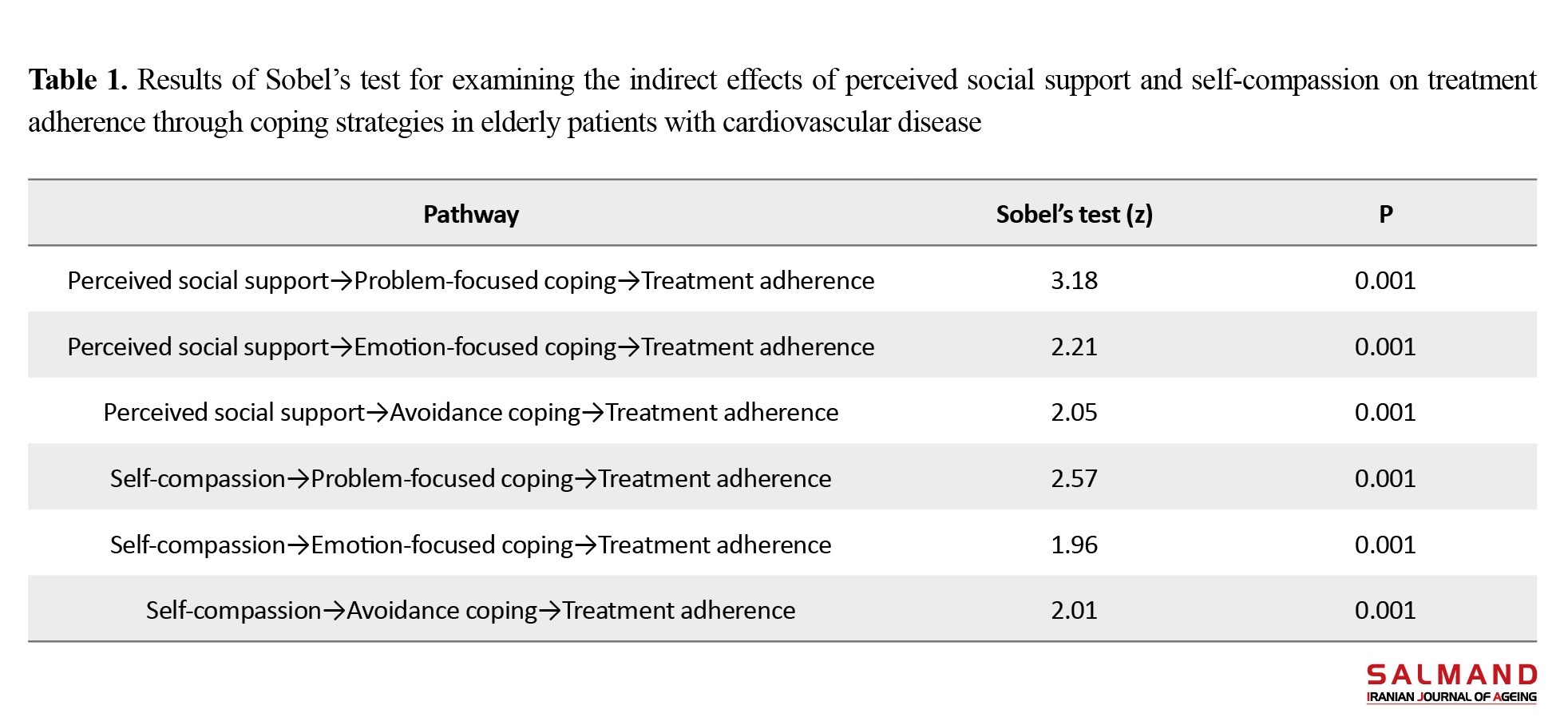
Specifically, indirect pathways through problem-focused, emotion-focused, and avoidance coping strategies were all statistically significant.
Conclusion
The findings of the present study indicated that perceived social support and self-compassion play a significant role in predicting treatment adherence among elderly patients with CVDs in Iran. The results further demonstrated that problem-focused coping strategies exert a positive effect on treatment adherence, whereas emotion-focused and avoidance coping styles have negative effects. In addition, perceived social support, by increasing feelings of belonging and psychological security, strengthens patients’ motivation to adhere to treatment regimens and indirectly influences adherence through reducing maladaptive coping strategies. The structural model underscores the importance of combining internal psychological resources with external social support in promoting treatment adherence among elderly patients with CVDs.
Data Availability
The data generated from this study are available solely for scientific and research purposes. Upon reasonable request from qualified researchers, the data can be provided by the corresponding author, subject to ethical principles and confidentiality of participants’ information.
Ethical Considerations
Compliance with ethical guidelines
This study received ethical approval from the Ethics Committee of Kermanshah University of Medical Sciences (Code: IR.KUMS.REC.1402.620). All participants signed informed consent forms after receiving full explanations regarding the study objectives. Confidentiality of information, anonymity, and the right to withdraw at any stage of the study were guaranteed.
Funding
This study was funded by Kermanshah University of Medical Sciences.
Authors' contributions
The authors contributed equally to the preparation of this article. All authors read and approved the final version of the manuscript.
Conflicts of interest
The authors declare no conflict of interest.
Acknowledgments
The authors would like to thank the manager and staff of Imam Ali Hospital in Kermanshah for their kind cooperation during data collection, as well as all participants for their time and cooperation.
Given the high prevalence of cardiovascular diseases (CVDs) as one of the leading causes of mortality worldwide and in Iran, as well as the serious consequences of non-adherence to treatment regimens observed in more than half of patients, the necessity of examining psychological and social factors associated with treatment adherence in CVD patients becomes increasingly evident. Previous studies have demonstrated that perceived social support and self-compassion can play a significant role in enhancing adherence to treatment. Moreover, coping strategies have been identified as mediating variables in managing psychological stress and facilitating patients’ adjustment to illness conditions. Accordingly, the present study aims to investigate the direct and indirect (through coping strategies) relationships of perceived social support and self-compassion with treatment adherence among elderly patients with CVDs in Iran. This study seeks to provide a structural model that addresses the existing gap in prior research and offers a foundation for designing effective interventions to improve CVD patients’ adherence to treatment.
Methods and Materials
This is analytical correlational study using structural equation modeling (SEM). The study population consisted of elderly patients with CVDs hospitalized or referred to the cardiology outpatient clinic of Imam Ali Hospital in Kermanshah, Iran, in 2024. Based on Loehlin’s (2004) recommendation (at least 200 samples needed for multi-factor models), and considering a 10% attrition rate, a sample size of 220 was determined. Participants were selected using convenience sampling. Inclusion criteria were willingness to participate in the study and having a diagnosed CVD, while exclusion criteria were a history of open-heart surgery, heart failure, recent myocardial infarction (within the past six months), severe psychiatric disorders (e.g., psychosis, major depression, bipolar disorder, substance abuse), cancer, pregnancy, and congenital heart disease.
The instruments included: the 12-item Multidimensional Scale of Perceived Social Support (MSPSS) developed by Zimet et al. (1988) [30]; the Self-Compassion Scale – Short Form (SCS-SF) by Raes et al. (2011) [32]; the 21-item Coping Inventory for Stressful Situations (CISS) by Endler and Parker (1990) [34]; and the 40-item Treatment Adherence Questionnaire developed by Fatemi (2018)[36]. Trained interviewers explained the study objectives to eligible patients, obtained their written informed consent, and administered the questionnaires. Data collection was scheduled at times convenient for participants. A total of 260 questionnaires were collected, of which 18 were excluded due to incomplete responses, leaving 242 valid cases for analysis. Data were analyzed in SPSS software, version 26 and AMOS software, version 24. Descriptive statistics were first reported, followed by conducting Pearson’s correlation test and SEM with maximum likelihood estimation. Model fit indices were calculated, with statistical significance set at 0.05.
Results
Among the 242 participants, 105 (43.3%) were female and 137 (56.6%) were male. Regarding marital status, 215 (88.8%) were married, 8 (3.3%) were single, 10 (4.1%) were divorced, and 9 (3.7%) were widow/widowed. Prior to testing the conceptual model, the assumptions of SEM—including normality, independence of errors, and multicollinearity—were examined. The values of skewness and kurtosis indicated that the distribution of variables was within the normal range. The Durbin–Watson statistic was 1.75, which falls within the acceptable range (1.5–2.5), confirming independence of errors. In addition, variance inflation factors and tolerance indices showed no evidence of multicollinearity among the variables.
Pearson’s correlation test results revealed that perceived social support, self-compassion, and problem-focused coping strategies were positively and significantly associated with treatment adherence, whereas emotion-focused and avoidance coping strategies were negatively and significantly related to adherence. These findings provided the basis for conducting path analysis. The obtained model fit indices included χ²/df=1.92, GFI=0.903, AGFI=0.910, CFI=0.940, TLI=0.950, and RMSEA=0.062, all of which were within acceptable or ideal ranges. Therefore, the conceptual model demonstrated satisfactory fit.
The final model showed that self-compassion (β=0.38) had a stronger predictive effect on treatment adherence compared to perceived social support (β=0.19). Problem-focused coping strategies exerted a positive effect (β=0.10), while emotion-focused (β=−0.31) and avoidance coping strategies (β=−0.46) had negative and significant effects on adherence. Direct path coefficients indicated that all relationships were significant at P<0.001.
In addition to direct effects, Sobel’s test was conducted to examine indirect effects. The results (Table 1) demonstrated that coping strategies significantly mediated the relationships between perceived social support, self-compassion, and treatment adherence.
Specifically, indirect pathways through problem-focused, emotion-focused, and avoidance coping strategies were all statistically significant.
Conclusion
The findings of the present study indicated that perceived social support and self-compassion play a significant role in predicting treatment adherence among elderly patients with CVDs in Iran. The results further demonstrated that problem-focused coping strategies exert a positive effect on treatment adherence, whereas emotion-focused and avoidance coping styles have negative effects. In addition, perceived social support, by increasing feelings of belonging and psychological security, strengthens patients’ motivation to adhere to treatment regimens and indirectly influences adherence through reducing maladaptive coping strategies. The structural model underscores the importance of combining internal psychological resources with external social support in promoting treatment adherence among elderly patients with CVDs.
Data Availability
The data generated from this study are available solely for scientific and research purposes. Upon reasonable request from qualified researchers, the data can be provided by the corresponding author, subject to ethical principles and confidentiality of participants’ information.
Ethical Considerations
Compliance with ethical guidelines
This study received ethical approval from the Ethics Committee of Kermanshah University of Medical Sciences (Code: IR.KUMS.REC.1402.620). All participants signed informed consent forms after receiving full explanations regarding the study objectives. Confidentiality of information, anonymity, and the right to withdraw at any stage of the study were guaranteed.
Funding
This study was funded by Kermanshah University of Medical Sciences.
Authors' contributions
The authors contributed equally to the preparation of this article. All authors read and approved the final version of the manuscript.
Conflicts of interest
The authors declare no conflict of interest.
Acknowledgments
The authors would like to thank the manager and staff of Imam Ali Hospital in Kermanshah for their kind cooperation during data collection, as well as all participants for their time and cooperation.
References
- World Health Organization. Cardiovascular Diseases (CVDs) Factsheet. Detail. The top 10 causes of death. Geneva: World Health Organization; 2021. [Link]
- Emamian MH, Hashemi H, Fotouhi A. Predicted 10-year risk of cardiovascular disease in the Islamic Republic of Iran and the body mass index paradox. Eastern Mediterranean Health Journal. 2020; 26(12):1465-72. [DOI:10.26719/emhj.20.012] [PMID]
- Fahimfar N, Khalili D, Sepanlou SG, Malekzadeh R, Azizi F, Mansournia MA, et al. Cardiovascular mortality in a Western Asian country: Results from the Iran Cohort Consortium. BMJ Open. 2018; 8(7):e020303. [DOI:10.1136/bmjopen-2017-020303] [PMID]
- Fernandez-Lazaro CI, García-González JM, Adams DP, Fernandez-Lazaro D, Mielgo-Ayuso J, Caballero-Garcia A, et al. Adherence to treatment and related factors among patients with chronic conditions in primary care: A cross-sectional study. BMC Family Practice. 2019; 20(1):132. [DOI:10.1186/s12875-019-1019-3] [PMID]
- Zyryanov SK, Fitilev SB, Vozzhaev AV, Shkrebniova II, Shindryaeva NN, Klyuev DA, et al. Medication adherence in patients with stable coronary artery disease in primary care. Research Results in Pharmacology. 2020; 6(2):97–103. [DOI:10.3897/rrpharmacology.6.54130]
- Tan CS. The Need of Patient Education to Improve Medication Adherence Among Hypertensive Patients. Malaysian Journal of Pharmacy. 2020; 6(1):1-5. [DOI:10.52494/MOEL1486]
- Burton A, Walters K, Marston L, Osborn D. Is there an association between perceived social support and cardiovascular health behaviours in people with severe mental illnesses? Social Psychiatry and Psychiatric Epidemiology. 2020; 55(12):1659-69. [DOI:10.1007/s00127-020-01879-9] [PMID]
- Reid KM, Taylor MG. Social support, stress, and maternal postpartum depression: A comparison of supportive relationships. Social Science Research. 2015; 54:246-62. [DOI:10.1016/j.ssresearch.2015.08.009] [PMID]
- Liu Y, Wei M, Guo L, Guo Y, Zhu Y, He Y. Association between illness perception and health behaviour among stroke patients: The mediation effect of coping style. Journal of Advanced Nursing. 2021; 77(5):2307-18. [DOI:10.1111/jan.14761] [PMID]
- Agbaria Q, Mokh AA. Coping with Stress During the Coronavirus Outbreak: The Contribution of Big Five Personality Traits and Social Support. International Journal of Mental Health and Addiction. 2022; 20(3):1854-72. [DOI:10.1007/s11469-021-00486-2] [PMID]
- Zhang X, Liu Y, Zou J. Perceived Stress, Resilience, Perceived Social Support and Self-Management Behaviour in Young- and Middle-Aged Patients With Multiple Chronic Conditions: A Structural Equation Modelling. Journal of Clinical Nursing. 2026; 35(1):305-16. [DOI:10.1111/jocn.17843] [PMID]
- Gruszczyńska M, Bąk-Sosnowska M, Szemik S. Selected psychological aspects and medication adherence in oncological patients. Cancer Medicine. 2020; 9(3):943-50. [DOI:10.1002/cam4.2691] [PMID]
- Zolfaghari F, Babaei S, Nazari F, Momeni-Ghaleghasemi T. The Relationship Between Self-compassion and Mood in Iranian Patients with Heart Failure: A Cross-sectional Study. Journal of Nursing and Midwifery Sciences. 2025; 12(3):e157439. [DOI:10.5812/jnms-157439]
- Neff K. Self-Compassion: An alternative conceptualization of a healthy attitude toward oneself. Self and Identity. 2003; 2(2):85-101. [DOI:10.1080/15298860309032]
- Austin J, Drossaert CHC, Schroevers MJ, Sanderman R, Kirby JN, Bohlmeijer ET. Compassion-based interventions for people with long-term physical conditions: A mixed methods systematic review. Psychology & Health. 2021; 36(1):16-42. [DOI:10.1080/08870446.2019.1699090] [PMID]
- Al-Refae M, Al-Refae A, Munroe M, Sardella NA, Ferrari M. A Self-Compassion and Mindfulness-Based Cognitive Mobile Intervention (Serene) for Depression, Anxiety, and Stress: Promoting Adaptive Emotional Regulation and Wisdom. Frontiers in Psychology. 2021; 12:648087. [DOI:10.3389/fpsyg.2021.648087] [PMID]
- Afshari A. [Prediction of diabetic patients’ treatment adherence by self compassion, emotional regulation and spritual welbeing (Persian)]. Journal of Research in Behavioural Sciences. 2018; 16(4):466-75. [DOI:10.52547/rbs.16.4.466]
- Jalil MF, Ali A, Ahmed Z, Kamarulzaman R. The Mediating Effect of Coping Strategies Between Psychological Capital and Small Tourism Organization Resilience: Insights From the COVID-19 Pandemic, Malaysia. Frontiers in Psychology. 2021; 12:766528. [DOI:10.3389/fpsyg.2021.766528] [PMID]
- Stanisławski K. The Coping Circumplex Model: An Integrative Model of the Structure of Coping With Stress. Frontiers in Psychology. 2019; 10:694. [DOI:10.3389/fpsyg.2019.00694] [PMID]
- Compas BE, Jaser SS, Bettis AH, Watson KH, Gruhn MA, Dunbar JP, et al. Coping, emotion regulation, and psychopathology in childhood and adolescence: A meta-analysis and narrative review. Psychological Bulletin. 2017; 143(9):939-91. [DOI:10.1037/bul0000110] [PMID]
- Iqbal K, Irshad Y, Ali Gilani SR, Hussain S, Ahmad M, Khan UA, et al. Quality of Life in Patients Undergoing Cardiac Surgery: Role of Coping Strategies. Cureus. 2021; 13(7):e16435. [DOI:10.7759/cureus.16435]
- Hoekstra T, Wilming L, Sjobbema C, Brouwer S. Exploring treatment adherence in long-term sick-listed workers and the impact of coping strategies, illness perceptions and perceived health. BMC Public Health. 2022; 22(1):259. [DOI:10.1186/s12889-022-12676-1] [PMID]
- Khiyali Z, Javidi Z, Banaei E, Ghasemi A, Dehghan A. [Relationship between perception of aging and social support with treatment adherence in the aged with type 2 diabetes in Fasa, 2018 (Persian)]. Journal of Gerontology. 2021; 5(4):54-65. [Link]
- Badrizadeh A, Rezaii Jamaloi H, Khanzadeh M, Foroughi S, Saki M. [Adherence to Treatment Based on Social Support and Coping Strategies in Patients with Type 2 Diabetes (Persian)]. Yafteh. 2021; 23(3):13-24. [DOI:10.32592/Yafteh.2021.23.3.2]
- Maghsoodi S, Salehinejad Z. Relationship Between Social Support and Coping Strategies and Disease Among the Cancer Patients of the City of Kerman. Journal of Research and Health. 2020; 10(6):375-82. [DOI:10.32598/JRH.10.6.1401.1]
- Kleinsinger F. The Unmet Challenge of Medication Nonadherence. The Permanente Journal. 2018; 22(3):18-033. [DOI:10.7812/TPP/18-033] [PMID]
- Rosen OZ, Fridman R, Rosen BT, Shane R, Pevnick JM. Medication adherence as a predictor of 30-day hospital readmissions. Patient Preference and Adherence. 2017; 11:801-10. [DOI:10.2147/PPA.S125672] [PMID]
- Hooman HA. [Structural Equation Modeling With LISREL Application (Persian)]. Thran: SAMT; 2012. [Link]
- Loehlin JC. Latent Variable Models: An Introduction to Factor, Path, and Structural Equation Analysis. (4th ed.). New York: Psychology Press; 2004. [DOI:10.4324/9781410609823]
- Zimet GD, Dahlem NW, Zimet SG, Farley GK. The Multidimensional Scale of Perceived Social Support. Journal of Personality Assessment. 1988; 52(1):30-41. [DOI:10.1207/s15327752jpa5201_2]
- Salimi A, Joukar B, Nikpour R. [Internet and communication: Perceived social support and loneliness as antecedent variables (Persian)]. Psychological Studies. 2009; 5(3):81-102. [Link]
- Raes F, Pommier E, Neff KD, Van Gucht D. Construction and factorial validation of a short form of the Self-Compassion Scale. Clinical Psychology & Psychotherapy. 2011; 18(3):250-5. [DOI:10.1002/cpp.702] [PMID]
- Shahbazi M, Rajabi Gh, Maghami E, Jolodari A. [Confirmatory Factor Analysis of the Persian Version of the Self-Compassion Rating Scale-Revised (Persian)]. Journal of Psychological Models and Methods. 2015; 6(19):31-46. [Link]
- Endler NS, Parker JD. Multidimensional assessment of coping: A critical evaluation. Journal of Personality and Social Psychology. 1990; 58(5):844-54. [DOI:10.1037/0022-3514.58.5.844] [PMID]
- Mohebi S, Shokri O, Khodaei A. [Psychometric Analysis of the Coping Inventory for Stressful Situations-Short Form (CISS-SF) among Students (Persian)]. Quarterly of Educational Measurement. 2020; 11(40):87-113. [DOI:10.22054/jem.2020.40240.2025]
- Fatemi N, Rafii F, Hajizadeh E, Modanloo M. [Psychometric properties of the adherence questionnaire in patients with chronic disease: A mix method study (Persian)]. Koomesh. 2018; 20(2):179-91. [Link]
- Miller JJ, Lee J, Niu C, Grise-Owens E, Bode M. Self-Compassion as a Predictor of Self-Care: A Study of Social Work Clinicians. Clinical Social Work Journal. 2019; 47:321-31. [DOI:10.1007/s10615-019-00710-6]
- Pérez-Aranda A, García-Campayo J, Gude F, Luciano JV, Feliu-Soler A, González-Quintela A, et al. Impact of mindfulness and self-compassion on anxiety and depression: The mediating role of resilience. International Journal of Clinical and Health Psychology. 2021; 21(2):100229. [DOI:10.1016/j.ijchp.2021.100229] [PMID]
- Sirois FM, Hirsch JK. Self-Compassion and Adherence in Five Medical Samples: The Role of Stress. Mindfulness. 2019; 10(1):46-54. [DOI:10.1007/s12671-018-0945-9] [PMID]
- Muris P, Simon E, Lijphart H, Bos A, Hale W 3rd, Schmeitz K, et al. The Youth anxiety measure for DSM-5 (YAM-5): Development and first psychometric evidence of a new scale for assessing anxiety disorders symptoms of children and adolescents. Child Psychiatry and Human Development. 2017; 48(1):1-17. [DOI:10.1007/s10578-016-0648-1] [PMID]
- Ewert C, Vater A, Schröder-Abé M. Self-Compassion and Coping: A Meta-Analysis. Mindfulness. 2021; 12(5):1063-77. [DOI:10.1007/s12671-020-01563-8]
- Corallo F, Bonanno L, Di Cara M, Rifici C, Sessa E, D’Aleo G, et al. Therapeutic adherence and coping strategies in patients with multiple sclerosis: An observational study. Medicine (Baltimore). 2019; 98(29):e16532. [DOI:10.1097/MD.0000000000016532] [PMID]
- Uzer-Kremers L, Bralet MC, Angerville B, Jeanblanc J, Pierrefiche O, Martinetti MP, et al. Is Self-compassion linked to treatment adherence in schizophrenia? Schizophrenia Research. 2020; 222:493-5. [DOI:10.1016/j.schres.2020.05.058] [PMID]
- Ceccarelli LA, Giuliano RJ, Glazebrook CM, Strachan SM. Self-Compassion and Psycho-Physiological Recovery From Recalled Sport Failure. Frontiers in Psychology. 2019; 10:1564. [DOI:10.3389/fpsyg.2019.01564] [PMID]
- Khalili N, Bahrami M, Ashouri E. Self-Compassion and Adherence to Treatment in Patients with Cancer. Iranian Journal of Nursing and Midwifery Research. 2021; 26(5):406-10. [DOI:10.4103/ijnmr.IJNMR_174_20] [PMID]
- Zhang JW, Chen S. Self-Compassion Promotes Personal Improvement From Regret Experiences via Acceptance. Personality & Social Psychology Bulletin. 2016; 42(2):244-58. [DOI:10.1177/0146167215623271] [PMID]
Type of Study: Research |
Subject:
gerontology
Received: 2025/10/10 | Accepted: 2026/02/28 | Published: 2026/10/02
Received: 2025/10/10 | Accepted: 2026/02/28 | Published: 2026/10/02
Send email to the article author
| Rights and permissions | |
 |
This work is licensed under a Creative Commons Attribution-NonCommercial 4.0 International License. |

Copyright © The Author(s);
This is an open access article distributed under the terms of the Creative Commons Attribution-NonCommercial 4.0 (CC-By-NC 4.0), which permits use, distribution, and reproduction in any medium, provided the original work is properly cited and is not used for commercial purposes.
Contact Information