Volume 21, Issue 1 (Spring 2026)
Salmand: Iranian Journal of Ageing 2026, 21(1): 78-93 |
Back to browse issues page




Download citation:
BibTeX | RIS | EndNote | Medlars | ProCite | Reference Manager | RefWorks
Send citation to:


BibTeX | RIS | EndNote | Medlars | ProCite | Reference Manager | RefWorks
Send citation to:
Zendegani A, Papi S, Moosazadeh M, Gharib M, Aliari Z. Comparison of Personality Disorders Among Elderly Offenders in Tehran Prisons Based on Crime Type in 2023. Salmand: Iranian Journal of Ageing 2026; 21 (1) :78-93
URL: http://salmandj.uswr.ac.ir/article-1-2865-en.html
URL: http://salmandj.uswr.ac.ir/article-1-2865-en.html


1- Department of Geriatric Health, School of Health, Mazandaran University of Medical Sciences, Sari, Iran.
2- Social Determinants of Health Research Center, Lorestan University of Medical Sciences, Khorramabad, Iran. ,shahabpapi@yahoo.com
3- Department of Gerontology, School of Health, Mazandaran University of Medical Sciences, Sari, Iran.
4- Department of Psychology, Islamic Azad University, SR. C., Tehran, Iran.
2- Social Determinants of Health Research Center, Lorestan University of Medical Sciences, Khorramabad, Iran. ,
3- Department of Gerontology, School of Health, Mazandaran University of Medical Sciences, Sari, Iran.
4- Department of Psychology, Islamic Azad University, SR. C., Tehran, Iran.
Full-Text [PDF 5696 kb]
(924 Downloads)
| Abstract (HTML) (3647 Views)
Full-Text: (375 Views)
Introduction
Crime has a historical record as old as humanity, and issues related to criminals and prisoners, especially their connection with psychiatric problems, represent one of the most challenging and widely researched fields. It seems that the basis of social problems that drive individuals toward committing crimes is directly or indirectly closely related to their personality. Today, a primary goal of judicial and prison authorities is the correction and rehabilitation of prisoners to reduce recidivism and re-incarceration [1]. The prevalence of psychological problems in the prison population is higher compared to the general population, with nearly 87% related to one of the personality disorder types [2]. Furthermore, because research on prisoners has focused more on younger individuals than on the elderly, there is limited information regarding the needs and required services for this vulnerable group [3].
Methods & Materials
The present study is a cross-sectional descriptive-analytical study. The statistical population consisted of elderly incarcerated offenders in Tehran city prisons. The estimated required sample size was 274 individuals. Inclusion criteria were being 60 years of age or older, literacy or the ability to speak, willingness and consent to participate in the study, and the absence of cognitive impairment as assessed by the abbreviated mental test (AMT). Exclusion criteria included participant withdrawal and incomplete or incorrect questionnaire completion. Questionnaires were completed in person, individually, and in two sessions for elderly individuals who met the inclusion criteria. The questionnaires used in this study included a demographic characteristics questionnaire and the Millon clinical multiaxial inventory-III (MCMI-III).
The demographic questionnaire included age, gender (male, female), type of crime (murderer/fraudster/financial (debtor)/thief/rapist/trafficker), education (illiterate/diploma and below/associate degree/bachelor’s degree and above), marital status (married/single/divorced/widowed), income status (income equal to expenses/income less than expenses/income more than expenses), and addiction. The MCMI-III consists of 175 items with a yes/no response scale. This scale assesses 14 clinical personality patterns and is used for adults aged 18 and above.
The clinical personality patterns in the MCMI-III include 14 scales: schizoid, avoidant, depressive, dependent, antisocial, borderline, narcissistic, sadistic (aggressive), self-defeating, compulsive, histrionic, schizotypal, negativistic (passive-aggressive), and paranoid personality disorders. Descriptive statistics, such as mean, standard deviation, frequency, and percentage were used to describe the demographic characteristics of participants and research variables. The Kolmogorov-Smirnov test was used to assess the normality of data. Comparisons between qualitative variables were performed using the chi-square test or Fisher’s exact test.
Results
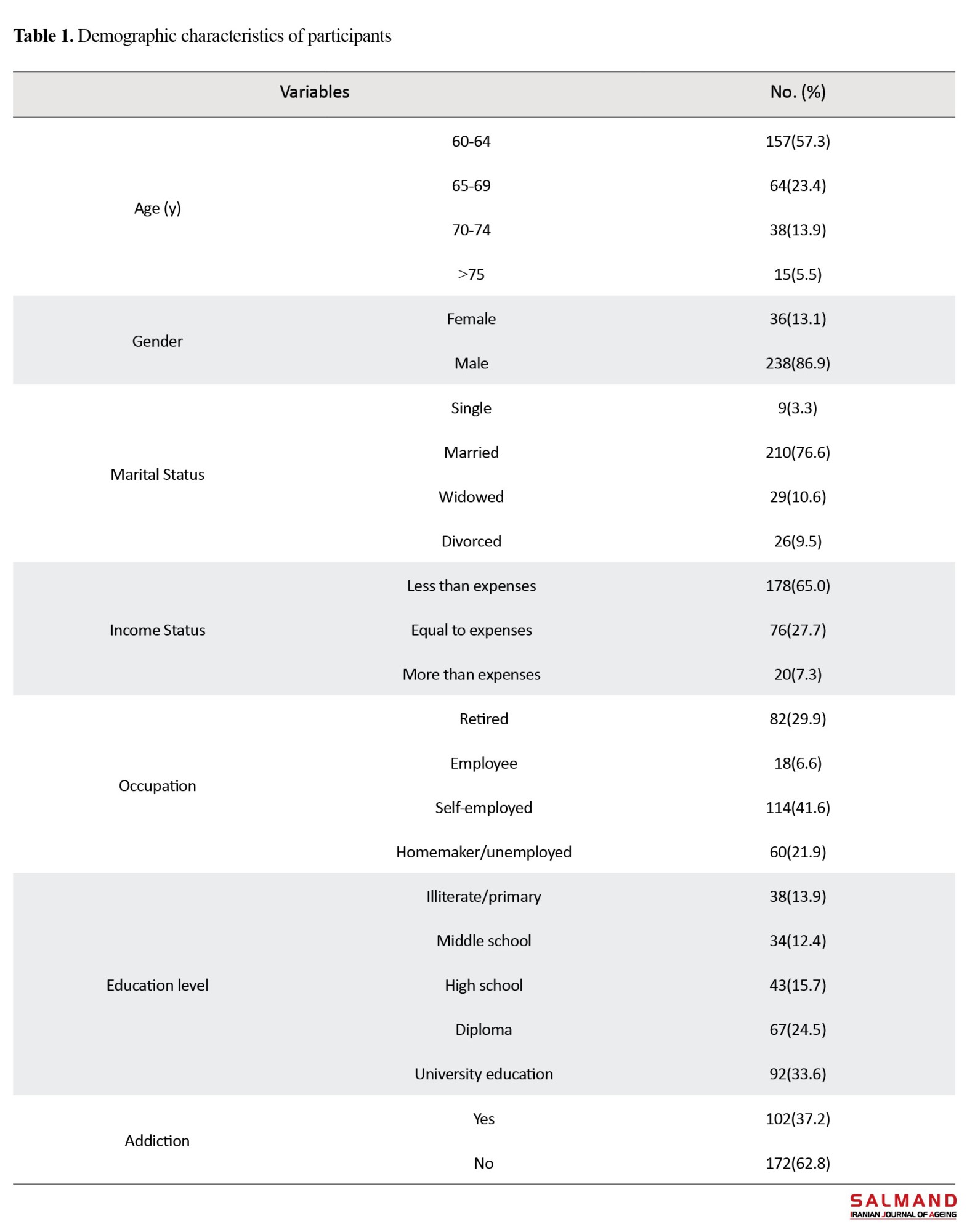
The mean age of all participants was 65.03±5.163 years. The overall prevalence of personality disorder among the 274 participants was 199 individuals (72.6%) who were diagnosed with at least one personality disorder. The prevalence of specific personality disorders ranged from 0.4% (Sadistic personality disorder) to 31% (histrionic personality disorder). Given that statistical comparison and analysis of disorders with low prevalence lack statistical value, only those personality disorders with a prevalence exceeding 10% were included in the statistical analysis (Table 1).
The chi-square test was used to compare the frequency of histrionic personality disorder prevalence based on crime type. Analytical comparison of the results indicated that the difference in the frequency of histrionic personality disorder prevalence among participants based on crime type was statistically significant. Furthermore, the percentage of histrionic personality disorder was higher among debtors and fraud offenders compared to other offenders.
Based on the chi-square test, the difference in the prevalence of obsessive-compulsive personality disorder among participants based on crime type was statistically significant. In other words, the percentage of obsessive-compulsive personality disorder was higher among debtors and fraud offenders compared to other offenders.
The chi-square and Fisher’s exact tests were used to determine the prevalence of personality disorders based on gender. The prevalence of histrionic, obsessive-compulsive, and narcissistic personality disorders among participants was not statistically significant based on gender, while the prevalence of depressive personality disorder was significant. In other words, the rates of narcissistic, obsessive-compulsive, and histrionic personality disorders were approximately similar among women and men, but the rate of depressive personality disorder was higher among women compared to men.
The prevalence of personality disorders based on age groups for histrionic, depressive, obsessive-compulsive, and narcissistic personality disorders was not statistically significant. In other words, the rates of these personality disorders were approximately similar across all age groups among the studied elderly individuals.
The Chi-square and Fisher’s exact tests were used to determine the prevalence of personality disorders based on educational groups. Accordingly, the difference in frequency of histrionic, depressive, obsessive-compulsive, and narcissistic personality disorders among participants based on educational groups was statistically significant. In other words, the rates of narcissistic, obsessive-compulsive, and histrionic personality disorders were higher among individuals with a diploma or higher education compared to those with education below a diploma, while the rate of depressive personality disorder was higher among individuals with education below a diploma compared to those with a diploma or higher.
Conclusion
The results obtained from the present study indicate an association between certain personality disorders and the type of crime in the studied group. Considering the high prevalence of this type of disorder among the elderly, based on the findings of this study, it is suggested that educational measures, early identification of these disorders, and counseling to modify inappropriate behaviors in these individuals—which lay the groundwork for future crimes and may lead to recidivism and re-incarceration after release—be planned and implemented. Prisons are not suitable environments for the elderly; even with environmental modifications for the elderly within prisons, they still suffer significant harm due to their specific physical and psychological conditions and will not have a desirable quality of life.
Ethical Considerations
Compliance with ethical guidelines
This study was approved by the Ethics Committee of Mazandaran University of Medical Sciences, Sari, Iran (Code: IR.MAZUMS.REC.1402.18439). After explaining the study objectives to participants and ensuring the confidentiality of their personal information, written informed consent was obtained from all of them.
Funding
This research was extractd from Master thesis of Ali Zandegani at Mazandaran University of Medical Sciences, School of Health. This research was financially supported by Mazandaran University of Medical Sciences Sari, Iran.
Authors' contributions
Data analysis: Mahmoud Moosazadeh; Conceptualization, writing of the original draft, methodology, investigation, review, editing, resources and project administration: Ali Zandegani , Shahab Papi, Masoud Gharib and, Zahra Aliari.
Conflicts of interest
The authors declared no conflict of interest.
Acknowledgments
The authors thank the Vice Chancellor for Research of Mazandaran University of Medical Sciences and all the elderly participants in this study.
References
Crime has a historical record as old as humanity, and issues related to criminals and prisoners, especially their connection with psychiatric problems, represent one of the most challenging and widely researched fields. It seems that the basis of social problems that drive individuals toward committing crimes is directly or indirectly closely related to their personality. Today, a primary goal of judicial and prison authorities is the correction and rehabilitation of prisoners to reduce recidivism and re-incarceration [1]. The prevalence of psychological problems in the prison population is higher compared to the general population, with nearly 87% related to one of the personality disorder types [2]. Furthermore, because research on prisoners has focused more on younger individuals than on the elderly, there is limited information regarding the needs and required services for this vulnerable group [3].
Methods & Materials
The present study is a cross-sectional descriptive-analytical study. The statistical population consisted of elderly incarcerated offenders in Tehran city prisons. The estimated required sample size was 274 individuals. Inclusion criteria were being 60 years of age or older, literacy or the ability to speak, willingness and consent to participate in the study, and the absence of cognitive impairment as assessed by the abbreviated mental test (AMT). Exclusion criteria included participant withdrawal and incomplete or incorrect questionnaire completion. Questionnaires were completed in person, individually, and in two sessions for elderly individuals who met the inclusion criteria. The questionnaires used in this study included a demographic characteristics questionnaire and the Millon clinical multiaxial inventory-III (MCMI-III).
The demographic questionnaire included age, gender (male, female), type of crime (murderer/fraudster/financial (debtor)/thief/rapist/trafficker), education (illiterate/diploma and below/associate degree/bachelor’s degree and above), marital status (married/single/divorced/widowed), income status (income equal to expenses/income less than expenses/income more than expenses), and addiction. The MCMI-III consists of 175 items with a yes/no response scale. This scale assesses 14 clinical personality patterns and is used for adults aged 18 and above.
The clinical personality patterns in the MCMI-III include 14 scales: schizoid, avoidant, depressive, dependent, antisocial, borderline, narcissistic, sadistic (aggressive), self-defeating, compulsive, histrionic, schizotypal, negativistic (passive-aggressive), and paranoid personality disorders. Descriptive statistics, such as mean, standard deviation, frequency, and percentage were used to describe the demographic characteristics of participants and research variables. The Kolmogorov-Smirnov test was used to assess the normality of data. Comparisons between qualitative variables were performed using the chi-square test or Fisher’s exact test.
Results
The mean age of all participants was 65.03±5.163 years. The overall prevalence of personality disorder among the 274 participants was 199 individuals (72.6%) who were diagnosed with at least one personality disorder. The prevalence of specific personality disorders ranged from 0.4% (Sadistic personality disorder) to 31% (histrionic personality disorder). Given that statistical comparison and analysis of disorders with low prevalence lack statistical value, only those personality disorders with a prevalence exceeding 10% were included in the statistical analysis (Table 1).
The chi-square test was used to compare the frequency of histrionic personality disorder prevalence based on crime type. Analytical comparison of the results indicated that the difference in the frequency of histrionic personality disorder prevalence among participants based on crime type was statistically significant. Furthermore, the percentage of histrionic personality disorder was higher among debtors and fraud offenders compared to other offenders.
Based on the chi-square test, the difference in the prevalence of obsessive-compulsive personality disorder among participants based on crime type was statistically significant. In other words, the percentage of obsessive-compulsive personality disorder was higher among debtors and fraud offenders compared to other offenders.
The chi-square and Fisher’s exact tests were used to determine the prevalence of personality disorders based on gender. The prevalence of histrionic, obsessive-compulsive, and narcissistic personality disorders among participants was not statistically significant based on gender, while the prevalence of depressive personality disorder was significant. In other words, the rates of narcissistic, obsessive-compulsive, and histrionic personality disorders were approximately similar among women and men, but the rate of depressive personality disorder was higher among women compared to men.
The prevalence of personality disorders based on age groups for histrionic, depressive, obsessive-compulsive, and narcissistic personality disorders was not statistically significant. In other words, the rates of these personality disorders were approximately similar across all age groups among the studied elderly individuals.
The Chi-square and Fisher’s exact tests were used to determine the prevalence of personality disorders based on educational groups. Accordingly, the difference in frequency of histrionic, depressive, obsessive-compulsive, and narcissistic personality disorders among participants based on educational groups was statistically significant. In other words, the rates of narcissistic, obsessive-compulsive, and histrionic personality disorders were higher among individuals with a diploma or higher education compared to those with education below a diploma, while the rate of depressive personality disorder was higher among individuals with education below a diploma compared to those with a diploma or higher.
Conclusion
The results obtained from the present study indicate an association between certain personality disorders and the type of crime in the studied group. Considering the high prevalence of this type of disorder among the elderly, based on the findings of this study, it is suggested that educational measures, early identification of these disorders, and counseling to modify inappropriate behaviors in these individuals—which lay the groundwork for future crimes and may lead to recidivism and re-incarceration after release—be planned and implemented. Prisons are not suitable environments for the elderly; even with environmental modifications for the elderly within prisons, they still suffer significant harm due to their specific physical and psychological conditions and will not have a desirable quality of life.
Ethical Considerations
Compliance with ethical guidelines
This study was approved by the Ethics Committee of Mazandaran University of Medical Sciences, Sari, Iran (Code: IR.MAZUMS.REC.1402.18439). After explaining the study objectives to participants and ensuring the confidentiality of their personal information, written informed consent was obtained from all of them.
Funding
This research was extractd from Master thesis of Ali Zandegani at Mazandaran University of Medical Sciences, School of Health. This research was financially supported by Mazandaran University of Medical Sciences Sari, Iran.
Authors' contributions
Data analysis: Mahmoud Moosazadeh; Conceptualization, writing of the original draft, methodology, investigation, review, editing, resources and project administration: Ali Zandegani , Shahab Papi, Masoud Gharib and, Zahra Aliari.
Conflicts of interest
The authors declared no conflict of interest.
Acknowledgments
The authors thank the Vice Chancellor for Research of Mazandaran University of Medical Sciences and all the elderly participants in this study.
References
- Zareipour MA, Javadi MH, Narmayoun N, Ghelichi Ghojogh M. The relation between the type of crime committed and the mental health status of the female prisoners in Urmia. Social Behavior Research & Health. 2017; 1(1):18-26. [Link]
- Abhari M. Social harms: Occurrences and prevention and counter measures. Tehran: Pashootan; 2011. [Link]
- Fazel S, Hope T, O’Donnell I, Jacoby R. Hidden psychiatric morbidity in elderly prisoners. The British Journal of Psychiatry. 2001; 179(6):535-9. [DOI:10.1192/bjp.179.6.535] [PMID]
- Palahang H, Vakilzadeh B, Deris F. [The prevalence of personality disorders in male prisoners of Shahr-e-Kord prison (Persian)]. Iranian Journal of Psychiatry and Clinical Psychology. 2003; 8(3):57-64. [Link]
- Ginn S. Elderly prisoners. British Medical Journal. 2012; 345e6263. [DOI:10.1136/bmj.e6263] [PMID]
- Fovet T, Geoffroy PA, Vaiva G, Adins C, Thomas P, Amad A. [Psychiatry in elderly prisoners]. Encephale. 2016; 42(2):177-82. [DOI:10.1016/j.encep.2015.11.002] [PMID]
- Sharifi AA, Moulavi H, Namdari K. pThe validity of MCMI-III (Millon,) scales (Persian)]. Knowledge & Research in Applied Psychology. 2008; 9(34):27-38. [Link]
- Brazão N, Motta Cd, Rijo D, Pinto-Gouveia J. The prevalence of personality disorders in Portuguese male prison inmates: Implications for penitentiary treatment. Análise Psicológica. 2015; 33(3):279-90. [DOI:10.14417/ap.975]
- Fakhrzadegan S, Gholami-Doon H, Shamloo B, Shokouhi-Moqhaddam S. The Relationship between Personality Disorders and the Type of Crime Committed and Substance Used among Prisoners. Addiction & Health. 2017; 9(2):64-71. [PMID]
- Apostolopoulos A, Michopoulos I, Zachos I, Rizos E, Tzeferakos G, Manthou V, et al. Association of Schizoid and Schizotypal Personality disorder with violent crimes and homicides in Greek prisons. Annals of General Psychiatry. 2018; 17:1-9. [DOI:10.1186/s12991-018-0204-4] [PMID]
- Naderyan S, Sahaf R, Akbari Kamrani AA, Abolfathi Momtaz Y, Ghasemzadeh H, Papi S. Physical activity among Iranian former sportsmen and athletes as possible evidence for continuity theory of aging. Iranian Rehabilitation Journal. 2019; 17(2):141-8. [DOI:10.32598/irj.17.2.141]
- Zhang X, Lin H. Disengagement theory. Encyclopedia of gerontology and population aging. New York: Springer; 2022. [DOI:10.1007/978-3-030-22009-9_645]
- Papi S, Zanjari N, Karimi Z, Motamedi SV, Fadayevatan R. The role of health-promoting lifestyle in predicting cognitive status of older clergymen. Iranian Journal of Ageing. 2021; 15(4):472-83. [DOI:10.32598/sija.15.4.1393.3]
- Cervone D, Pervin LA. Personality: Theory and research. New York: John Wiley & Sons; 2022. [Link]
- Costello BJ, Laub JH. Social control theory: The legacy of travis hirschi’s causes of delinquency. Annual Review of Criminology. 2020; 3(1):21-41. [DOI:10.1146/annurev-criminol-011419-041527]
- Mohamadi Foroud H, Mirhashemi M. [The relationship between personality disorder and crime in imprisoned criminals (Persian)]. Journal of Behavior in Clinical Psychology. 2008; 2(7):21-30. [Link]
- Chang J. The effect of different personality disorders on criminal behavior. Journal of Education, Humanities and Social Sciences. 2023; 22:552-6. [DOI:10.54097/ehss.v22i.13053]
- Shakeri J, Hosseini M, Sadeghi K, Rashidi A, Mehdinia A, Ahannavard M. [Epidemiology of Personality Disorders in opioid substance-traffic -prisoners in Kermanshah Central Prison (2004) (Persian)]. Iranian Journal of Forensic Medicine. 2007; 13(3):158-62.[Link]
- Auolad Abdolhadi B, Foroghan M, Dadkhah A, Delavar A. [The frequency of personality disorders in the women prisoners of Tehran and Karaj 2003 (Persian)]. Social Welfare Quarterly. 2004; 3(12):301-8. [Link]
- Larsen RJ, Buss DM, Wismeijer A, Song J, Van den Berg S. Personality psychology: Domains of knowledge about human nature. 2nd ed. New York: McGraw-Hill Education (UK) Ltd; 2017. [Link]
- Yousefi F, Talib MA. Predictors of personality disorders in prisoners. Journal of Medicine and Life. 2022; 15(4):454. [DOI:10.25122/jml-2021-0317] [PMID]
- Modaber A, Sharifi B. [Prevalence of psychiatry disorders among prisoners of Sanandaj Central Jail, Western Part of Iran (Persian)]. Journal of Fundamentals of Mental Health. 2008; 10(40):311-6. [Link]
- Ghaderi D, Fakhari A, Farvareshi M. [Relationship between demographic characteristics and type of crime with psychopathic personality disorder in male prisoners in Mahabad (Persian)]. Medical Journal of Mashhad university of Medical Sciences. 2022; 65(3):1222-32. [Link]
Type of Study: Research |
Subject:
gerontology
Received: 2024/07/03 | Accepted: 2025/01/01 | Published: 2026/04/01
Received: 2024/07/03 | Accepted: 2025/01/01 | Published: 2026/04/01
Send email to the article author
| Rights and permissions | |
 |
This work is licensed under a Creative Commons Attribution-NonCommercial 4.0 International License. |

Copyright © The Author(s);
This is an open access article distributed under the terms of the Creative Commons Attribution-NonCommercial 4.0 (CC-By-NC 4.0), which permits use, distribution, and reproduction in any medium, provided the original work is properly cited and is not used for commercial purposes.
Contact Information