Volume 21, Issue 2 (Summer 2026)
Salmand: Iranian Journal of Ageing 2026, 21(2): 186-201 |
Back to browse issues page




Download citation:
BibTeX | RIS | EndNote | Medlars | ProCite | Reference Manager | RefWorks
Send citation to:


BibTeX | RIS | EndNote | Medlars | ProCite | Reference Manager | RefWorks
Send citation to:
fakhri M, pouladi S, Motamed N, Vahedparast H. Assessment of Compliance With Age-friendly Criteria in Teaching Hospitals Affiliated to Bushehr University of Medical Sciences, Bushehr, Iran, 2023. Salmand: Iranian Journal of Ageing 2026; 21 (2) :186-201
URL: http://salmandj.uswr.ac.ir/article-1-2980-en.html
URL: http://salmandj.uswr.ac.ir/article-1-2980-en.html


1- Student Research Committee, Faculty of Nursing and Midwifery, Bushehr University of Medical Sciences, Bushehr, Iran
2- Department of Medical-Surgical Nursing, Faculty of Nursing and Midwifery, Bushehr University of Medical Sciences, Bushehr, Iran.
3- Department of Community Medicine, School of Medicine Bushehr University of Medical Sciences, Bushehr, Iran.
4- Department of Medical-Surgical Nursing, Faculty of Nursing and Midwifery, Bushehr University of Medical Sciences, Bushehr, Iran. ,h.vahedparast@bpums.ac.ir
2- Department of Medical-Surgical Nursing, Faculty of Nursing and Midwifery, Bushehr University of Medical Sciences, Bushehr, Iran.
3- Department of Community Medicine, School of Medicine Bushehr University of Medical Sciences, Bushehr, Iran.
4- Department of Medical-Surgical Nursing, Faculty of Nursing and Midwifery, Bushehr University of Medical Sciences, Bushehr, Iran. ,
Full-Text [PDF 7969 kb]
(1038 Downloads)
| Abstract (HTML) (2930 Views)
Full-Text: (35 Views)
Introduction
Iran is experiencing an increase in its aged population and is expected to become one of the oldest countries in the world by 2050. This demographic shift poses considerable challenges for the healthcare system. Older adults are the largest and most frequent users of hospital services. However, healthcare systems have historically been designed to provide care for patients with acute clinical conditions and are often not well-suited to meet the needs of older people, who typically suffer from chronic diseases and complex health issues. It is imperative to consider specific measures, such as modifications to physical and human infrastructure in healthcare facilities, to be tailored to the capabilities and limitations of older adults. These challenges have resulted in the development of the concept of “age-friendly hospital”.
In 2008, the World Health Organization (WHO) introduced an age-friendly primary health care centers toolkit to assess the status of healthcare centers and hospitals and provided recommendations for identifying existing shortcomings. The findings of numerous national and international studies suggest that a significant proportion of healthcare centers have inadequate compliance with age-friendly standards.
The evaluation of hospitals’ compliance with age-friendly principles and standards can a fundamental step in equipping, redesigning, and preparing these centers. The present study therefore aimed to assess the extent to which hospitals in Bushehr, south of Iran, complied with age-friendly criteria to inform evidence-based planning and improve the quality of care for the elderly.
Materials and Methods
This descriptive observational study was conducted in 2023. The study population comprised eight teaching hospitals affiliated with Bushehr University of Medical Sciences in Bushehr province. The selection of hospitals was based on the census method. The data collection instrument was the Age-Friendly Hospitals Checklist, a toolkit developed by Ahmadi et al. [11] based on the WHO’s age-friendly primary health care centers toolkit and the checklist proposed by Rashmi et al. [19]. The checklist consisted of 50 items. The response options were Yes (2 points), To some extent (1 point), and No (0 points). The total score is measured on a scale from 0 to 100 points, with higher scores indicating greater compliance with the age-friendly criteria. The researcher collected data on the physical environment (hospital access, toilets and sanitary facilities, physical space, signboards) through direct observation. The head of each department was responsible for compiling data on other areas. To ensure the accuracy of the information collected, a10% sample of all observational data was re-examined and corrected where necessary. The data were analyzed in SPSS software, version 26.
Results
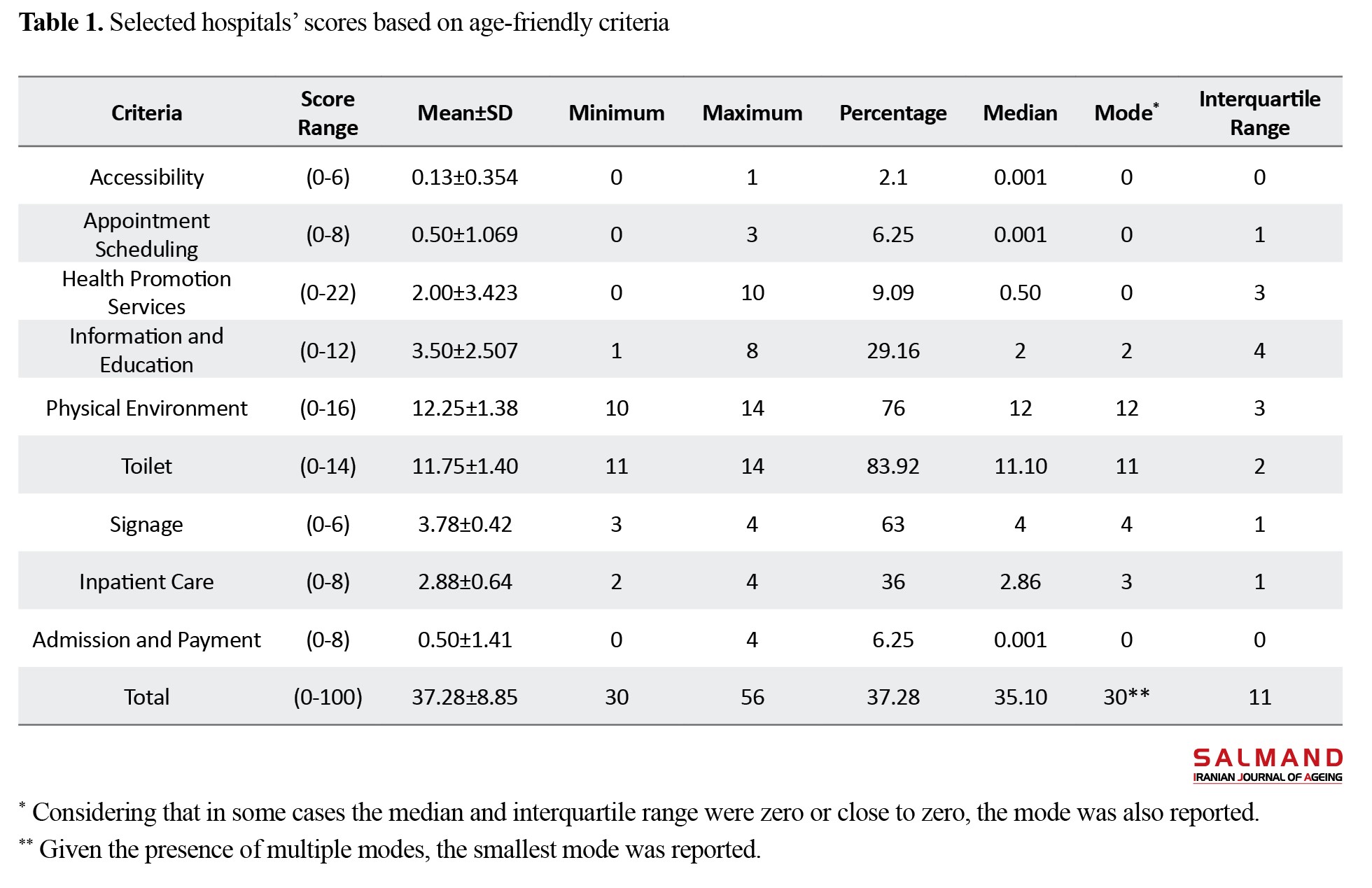
The mean compliance score was 37.28±8.85 out of 100, below the average level. The criteria pertaining to toilets and sanitary facilities received the highest scores (11.75±1.4 out of 14), followed by physical environment criteria (12.25±1.38 out of 16), while the admission and payment criteria (0.50±1.41 out of 8) and accessibility criteria ( 0.13±0.35 out of 6 had the lowest compliance (Table 1).
 .
.
Only one hospital achieved a high level of compliance (56%), while the remaining hospitals showed lower levels. All hospitals lacked separate parking and entrances for the elderly. Moreover, only one hospital had access to public transport. It was also observed that over 90% of hospitals lacked consultation, follow-up, and screening services. None of the hospitals had a geriatric ward or a geriatrician.
Conclusion
The findings indicated that hospitals in Bushehr did not adequately meet the age-friendly criteria, particularly in terms of human resources, physical infrastructure, and welfare facilities. Moreover, the hospitals’ standards did not comply with the criteria mentioned in the WHO’s age-friendly primary health care centers toolkit. It is, therefore, recommended that the Iranian Ministry of Health & Medical Education incorporate a comprehensive and unified framework of validated standards into its accreditation programs for evaluating hospitals in accordance with the principles of age-friendly hospitals. Furthermore, hospital managers should recruit specialists in geriatric medicine and nursing to ensure specialized treatment for older adults and enhance the quality of geriatric care. To support evidence-based practice, future studies should explore the experiences and perspectives of older adults regarding accreditation programs aimed at improving geriatric care and health outcomes.
Ethical Considerations
Compliance with ethical guidelines
The procedures in this study were in accordance with the relevant ethical principles. The study was approved by the Ethics Committee of Bushehr University of Medical Sciences (Code: IR.BPUMS.REC.1402.013).
Funding
This article was extracted from a master’s thesis in the field of nursing at Bushehr University of Medical Sciences. This research received no specific grant from any funding agency in the public, commercial, or not-for-profit sectors.
Authors' contributions
All authors contributed equally to the conception and design of the study, data collection and analysis, interpretation of the results, and drafting of the manuscript. Each author approved the final version of the manuscript for submission.
Conflicts of interest
The authors declare no conflict of interest.
Acknowledgments
The authors would like to thank the managers and staff of selected hospitals in Bushehr for their cooperation during data collection.
Iran is experiencing an increase in its aged population and is expected to become one of the oldest countries in the world by 2050. This demographic shift poses considerable challenges for the healthcare system. Older adults are the largest and most frequent users of hospital services. However, healthcare systems have historically been designed to provide care for patients with acute clinical conditions and are often not well-suited to meet the needs of older people, who typically suffer from chronic diseases and complex health issues. It is imperative to consider specific measures, such as modifications to physical and human infrastructure in healthcare facilities, to be tailored to the capabilities and limitations of older adults. These challenges have resulted in the development of the concept of “age-friendly hospital”.
In 2008, the World Health Organization (WHO) introduced an age-friendly primary health care centers toolkit to assess the status of healthcare centers and hospitals and provided recommendations for identifying existing shortcomings. The findings of numerous national and international studies suggest that a significant proportion of healthcare centers have inadequate compliance with age-friendly standards.
The evaluation of hospitals’ compliance with age-friendly principles and standards can a fundamental step in equipping, redesigning, and preparing these centers. The present study therefore aimed to assess the extent to which hospitals in Bushehr, south of Iran, complied with age-friendly criteria to inform evidence-based planning and improve the quality of care for the elderly.
Materials and Methods
This descriptive observational study was conducted in 2023. The study population comprised eight teaching hospitals affiliated with Bushehr University of Medical Sciences in Bushehr province. The selection of hospitals was based on the census method. The data collection instrument was the Age-Friendly Hospitals Checklist, a toolkit developed by Ahmadi et al. [11] based on the WHO’s age-friendly primary health care centers toolkit and the checklist proposed by Rashmi et al. [19]. The checklist consisted of 50 items. The response options were Yes (2 points), To some extent (1 point), and No (0 points). The total score is measured on a scale from 0 to 100 points, with higher scores indicating greater compliance with the age-friendly criteria. The researcher collected data on the physical environment (hospital access, toilets and sanitary facilities, physical space, signboards) through direct observation. The head of each department was responsible for compiling data on other areas. To ensure the accuracy of the information collected, a10% sample of all observational data was re-examined and corrected where necessary. The data were analyzed in SPSS software, version 26.
Results
The mean compliance score was 37.28±8.85 out of 100, below the average level. The criteria pertaining to toilets and sanitary facilities received the highest scores (11.75±1.4 out of 14), followed by physical environment criteria (12.25±1.38 out of 16), while the admission and payment criteria (0.50±1.41 out of 8) and accessibility criteria ( 0.13±0.35 out of 6 had the lowest compliance (Table 1).
.Only one hospital achieved a high level of compliance (56%), while the remaining hospitals showed lower levels. All hospitals lacked separate parking and entrances for the elderly. Moreover, only one hospital had access to public transport. It was also observed that over 90% of hospitals lacked consultation, follow-up, and screening services. None of the hospitals had a geriatric ward or a geriatrician.
Conclusion
The findings indicated that hospitals in Bushehr did not adequately meet the age-friendly criteria, particularly in terms of human resources, physical infrastructure, and welfare facilities. Moreover, the hospitals’ standards did not comply with the criteria mentioned in the WHO’s age-friendly primary health care centers toolkit. It is, therefore, recommended that the Iranian Ministry of Health & Medical Education incorporate a comprehensive and unified framework of validated standards into its accreditation programs for evaluating hospitals in accordance with the principles of age-friendly hospitals. Furthermore, hospital managers should recruit specialists in geriatric medicine and nursing to ensure specialized treatment for older adults and enhance the quality of geriatric care. To support evidence-based practice, future studies should explore the experiences and perspectives of older adults regarding accreditation programs aimed at improving geriatric care and health outcomes.
Ethical Considerations
Compliance with ethical guidelines
The procedures in this study were in accordance with the relevant ethical principles. The study was approved by the Ethics Committee of Bushehr University of Medical Sciences (Code: IR.BPUMS.REC.1402.013).
Funding
This article was extracted from a master’s thesis in the field of nursing at Bushehr University of Medical Sciences. This research received no specific grant from any funding agency in the public, commercial, or not-for-profit sectors.
Authors' contributions
All authors contributed equally to the conception and design of the study, data collection and analysis, interpretation of the results, and drafting of the manuscript. Each author approved the final version of the manuscript for submission.
Conflicts of interest
The authors declare no conflict of interest.
Acknowledgments
The authors would like to thank the managers and staff of selected hospitals in Bushehr for their cooperation during data collection.
References
- Karami B, Ostad-Taghizadeh A, Rashidian A, Tajvar M. Developing a conceptual framework for an age-friendly health system: a scoping review. International Journal of Health Policy and Management. 2023; 12:7342. [DOI:10.34172/ijhpm.2023.7342] [PMID] [PMCID]
- Dindar Farokhsh J, Kazemipour Sabet Sh, Ansari H. [Foresight of the aging trend of the Iranian population in different regions and population groups until 1420 (Persian)]. Journal of Future Studies Management. 2022; 33(1):103-22. [Link]
- Jannat Alipour Z, Momenzade M, Ahmadi H, Alizadehrisni A, Fotoukian Z. [Elderly-friendly hospitals, a step towards improving the health of the elderly-A review study (Persian)]. Caspian Journal of Health and Aging. 2021; 6(2):22-41. [Link]
- Abasian S, Shareinia H, Zare NV, Sadeghmoghadam L, Gonabad I. [The compliance of educational hospitals of Razavi Khorasan province with the criteria of the elderly-friendly hospital in 2022 (Persian)]. Iranian Journal of Ageing. 2023: 18(3):348-61. [DOI:10.32598/sija.2023.972.5]
- Yahyavi Dizaj J, Emamgholipour S, Pourreza A, Nommani F, Molemi S. [Effect of aging on catastrophic health expenditure in Iran during the period 2007-2016 (Persian)]. Journal of School of Public Health and Institute of Public Health Research. 2018; 16(3):216-27. [Link]
- Tavares J, Santinha G, Rocha NP. Age-friendly health care: a systematic review. Healthcare. 2021; 9(1):83. [DOI:10.3390/healthcare9010083] [PMID] [PMCID]
- Warnier RMJ, van Rossum E, Du Moulin MFMT, van Lottum M, Schols JMGA, Kempen GIJM. The opinions and experiences of nurses on frailty screening among older hospitalized patients. An exploratory study. BMC Geriatrics. 2021; 21(1):624. [DOI:10.1186/s12877-021-02586-z] [PMID] [PMCID]
- Rahmanpour MS, Tirgar A, Ebadi A, Sum S, Nikpour M. [Determining the components of the structural characteristics assessment tool for the age-friendly hospitals (Persian)]. Journal of gerontology. 2019; 4(2):1-10. [DOI:10.29252/joge.4.1.1]
- Tanyi PL, Pelser A. Towards an “age-friendly-hospital”: Older persons’ perceptions of an age-friendly hospital environment in Nigeria. Cogent Medicine. 2020; 7(1):1853895. [DOI:10.1080/2331205X.2020.1853895]
- WHO. Age-friendly primary health care centres toolkit. Geneva: World Health Organization; 2008. [Link]
- Ahmadi Teymourlouy AA, Seyyedin H, Fadaye-Vatan R, Omrani A. Assessing the suitability of the design, safety and physical environment of hospitals for the elderly: A case study in Iran. Iranian Journal of Health, Safety and Environment. 2019; 6(1):1213-20. [Link]
- Tajvar M, Torabi M, Dargahi H, Atashbahar O, Sajadi HS. [Assessing the Isfahan hospitals based on the World Health Organization's Age-Friendly Hospital Model: A mixed method study (Persian)]. Iranian Journal of Ageing. 2023; 18(2):234-51. [DOI:10.32598/sija.2023.3536.1]
- Tavares J, Grácio J, Nunes L. Assessment of hospital environments and policies: seeking an age-friendly hospital. Revista Brasileira de Geriatria e Gerontologia. 2017; 20(02):254-8. [DOI:10.1590/1981-22562017020.160095]
- Ssensamba JT, Mukuru M, Nakafeero M, Ssenyonga R, Kiwanuka SN. Health systems readiness to provide geriatric friendly care services in Uganda: A cross-sectional study. BMC Geriatrics. 2019; 19(1):256. [DOI:10.1186/s12877-019-1272-2] [PMID] [PMCID]
- Izadi-Avanji FS, Fotovati A, Taghaddosi M, Taghdisi A. [Elderly satisfaction and related factors from the physical structure of Kashan hospitals (Persian)]. Journal of Zabol Medical School. 2024; 6(4):156-64. [DOI:10.18502/jzms.v6i4.15494]
- Tariq E, Lafta R. A profile on health-care services for old in Baghdad. Mustansiriya Medical Journal. 2018; 17(1):52-6. [DOI:10.4103/MJ.MJ_13_18]
- El-Gilany AH, El-Bastawesy S, Ibrahim AM. Internal physical environment of health care facilities and services provided for elderly in Port Said, Egypt. International Journal of Nursing Didactics. 2018; 8(11):17-22. [Link]
- Meleis AI. Theoretical nursing: Development and progress. 5th ed. Philadelphia, PA: Lippincott Williams & Wilkins; 2012. [Link]
- Rashmi M, Kasthuri A, Rodrigues RJ. Senior friendly hospitals: Development and application of criteria: A descriptive study. Indian Journal of Community Medicine. 2016; 41(4):256-62. [DOI:10.4103/0970-0218.193334] [PMID] [PMCID]
- Karki S, Bhatta DN, Aryal UR. Older people’s perspectives on an elderly-friendly hospital environment: An exploratory study. Risk Management and Healthcare Policy. 2015; 13(8):81-9. [DOI:10.2147/RMHP.S83008] [PMID] [PMCID]
- Verhoef MJ, Casebeer AL. Broadening horizons: Integrating quantitative and qualitative research. The Canadian Journal of Infectious Diseases. 1997; 8(2):65-6. [DOI:10.1155/1997/349145] [PMID] [PMCID]
- Lee SJ, Sanford J, Calkins M, Melgen S, Endicott S, Phillips A. Beyond ADA accessibility requirements: Meeting seniors’ needs for toilet transfers. HERD: Health Environments Research & Design Journal. 2018; 11(2):32-44. [DOI:10.1177/1937586717730338] [PMID]
- Bernhardt J, Lipson-Smith R, Davis A, White M, Zeeman H, Pitt N, et al. Why hospital design matters: A narrative review of built environments research relevant to stroke care. International Journal of Stroke. 2022; 17(4):370-7. [DOI:10.1177/17474930211042485] [PMID] [PMCID]
- Andrade CC, Devlin AS. Stress reduction in the hospital room: Applying Ulrich’s theory of supportive design. Journal of Environmental Psychology. 2015; 41:125-34. [DOI:10.1016/j.jenvp.2014.12.001]
- Wahlroos N, Narsakka N, Stolt M, Suhonen R. Physical environment maintaining independence and self-management of older people in long-term care settings-An integrative literature review. Journal of Aging and Environment. 2023; 37(3):295-313. [DOI:10.1080/26892618.2022.2092927]
- Pakzamir F, Lotfi G, Tahmasebi F. [Comparing mental health between elderly male athletes, active and passive groups (Persian)]. Iranian Journal of Ageing. 2015; 10(2):138-45. [Link]
- Rose G, Decalf V, Everaert K, Bower WF. Toileting‐related falls at night in hospitalised patients: The role of nocturia. Australasian Journal on Ageing. 2020; 39(1):e70-6. [DOI:10.1111/ajag.12696] [PMID]
- Ghosh M, O’Connell B, Afrifa-Yamoah E, Kitchen S, Coventry L. A retrospective cohort study of factors associated with severity of falls in hospital patients. Scientific reports. 2022; 12(1):12266. [DOI:10.1038/s41598-022-16403-z] [PMID] [PMCID]
- Alhamdan AA, Alshammari SA, Al-Amoud MM, Hameed TA, Al-Muammar MN, Bindawas SM, et al. Evaluation of health care services provided for older adults in primary health care centers and its internal environment: A step towards age-friendly health centers. Saudi Medical Journal. 2015; 36(9):1091. [DOI:10.15537/smj.2015.9.11789] [PMID] [PMCID]
- Goharinezhad S, Maleki M, Baradaran HR, Ravaghi H. A qualitative study of the current situation of elderly care in Iran: what can we do for the future? Global Health Action. 2016; 9(1):32156. [DOI:10.3402/gha.v9.32156] [PMID] [PMCID]
- Kyani F, Mahmoudi Majdabadi Farahani M, Hajinabi K. [Factors affecting on development of age_friendly hospital in Iran: Factor analysis (Persian)]. Journal of Clinical Nursing and Midwifery. 2019; 8(2):355-67. [Link]
- Alizadeh M, Sharifi F, Mohamadiazar M, Nazari N. [Analytical performance of administrations in charge of ageing program in Iran (Persian)]. Iranian Journal of Diabetes and Metabolism. 2014; 13(1):74-81. [Link]
- Mohammadi M, Moghaddam G, Ilkhani M, Soltanpour R, Khadem Z, Poorrahimi A. [Socio-demographic characteristics and referral status of elderly patients in emergency departments in Sabzevar, Iran (Persian)]. Journal of Geriatric Nursing. 2018; 3(4):101-11. [Link]
- Kim YS, Han SH, Hwang JH, Park JM, Lee J, Choi J, et al. Development of the Korean framework for senior-friendly hospitals: A Delphi study. BMC Health Services Research. 2017; 17(1):528. [DOI:10.1186/s12913-017-2480-0] [PMID] [PMCID]
- Woo J, Mak B, Yeung F. Age-friendly primary health care: an assessment of current service provision for older adults in Hong Kong. Health Services Insights. 2013; 6:69-77. [DOI:10.4137/HSI.S12434] [PMID] [PMCID]
- Tajvar M, Yaseri M, Karami B, Mohammadi M. [Pattern of outpatient health service utilization by older people in Iran (Persian)]. Iranian Journal of Ageing. 2021; 15(4):410-27. [DOI:10.32598/sija.15.4.2921.1]
- Mate KS, Berman A, Laderman M, Kabcenell A, Fulmer T. Creating age-friendly health systems-a vision for better care of older adults. Healthcare. 2018; 6(1):4-6. [DOI:10.1016/j.hjdsi.2017.05.005] [PMID]
- Abdanipour A, Ramezani‐Badr F, Norouzi A, Ghaemi M. [Implementation of an institutional accreditation program at medical universities and faculties in the sixth macro-region of Iran in 2019 (Persian)]. Development Strategies in Medical Education. 2023; 10(2):114-27. [Link]
- Aghakhani N, Alizadeh F, Baghaei R, Alinezhad V. [Study of nurses’practice about elderly patients safety care hospitalized in medical wards of treatment & educational centers in urmia, Iran om 2016 (Persian)]. Nursing and Midwifery Journal. 2019; 17(1):71-81. [Link]
- Fita F, Mekonnen HS, Endalew HL, Azagew AW. Knowledge, attitude, and associated factors towards older people care among nurses working at public hospitals in West Shoa zone, Oromia region, Ethiopia. BMC nursing. 2021; 20(1):248. [DOI:10.1186/s12912-021-00774-1] [PMID] [PMCID]
Type of Study: Research |
Subject:
Geriatric
Received: 2024/11/28 | Accepted: 2025/07/27 | Published: 2026/07/01
Received: 2024/11/28 | Accepted: 2025/07/27 | Published: 2026/07/01
Send email to the article author
| Rights and permissions | |
 |
This work is licensed under a Creative Commons Attribution-NonCommercial 4.0 International License. |

Copyright © The Author(s);
This is an open access article distributed under the terms of the Creative Commons Attribution-NonCommercial 4.0 (CC-By-NC 4.0), which permits use, distribution, and reproduction in any medium, provided the original work is properly cited and is not used for commercial purposes.
Contact Information