Volume 21, Issue 2 (Summer 2026)
Salmand: Iranian Journal of Ageing 2026, 21(2): 240-253 |
Back to browse issues page




Download citation:
BibTeX | RIS | EndNote | Medlars | ProCite | Reference Manager | RefWorks
Send citation to:


BibTeX | RIS | EndNote | Medlars | ProCite | Reference Manager | RefWorks
Send citation to:
Davoudi H, Imani Malayeri K S. Impact of Coping Strategies Training on Alexithymia and Resilience of Family Caregivers of Older Adults With Alzheimer’s/Dementia. Salmand: Iranian Journal of Ageing 2026; 21 (2) :240-253
URL: http://salmandj.uswr.ac.ir/article-1-3074-en.html
URL: http://salmandj.uswr.ac.ir/article-1-3074-en.html


1- Department of Counseling , Khom.C., Islamic Azad University, Khomein, Iran. , mohammad.410@yahoo.com
2- Department of Counseling , Khom.C., Islamic Azad University, Khomein, Iran.
2- Department of Counseling , Khom.C., Islamic Azad University, Khomein, Iran.
Full-Text [PDF 6089 kb]
(811 Downloads)
| Abstract (HTML) (3366 Views)
Full-Text: (46 Views)
Introduction
caregiving to older patients with chronic diseases such as Alzheimer’s is a stressful job. These caregivers often suffer from alexithymia, a risk factor for psychological disorders such as anxiety, depression, and stress, which can reduce their quality of life. They can overcome these conditions and maintain their own health when they are resilient. Factors such as caregiving pressure, family dysfunction, stigma, and patient dependency negatively affect caregivers’ resilience. The present study aims to assess whether training in coping strategies is effective in reducing alexithymia and improving the resilience of family caregivers of older people with Alzheimer’s/dementia.
Materials & Methods
This is a quasi-experimental study with a pretest-posttest design. The study population consists of all family caregivers of patients with Alzheimer’s/dementia from the Arak Alzheimer’s Association in the Central Province of Iran in 2024. Using purposive and convenience sampling, 30 participants were selected and randomly divided into two groups of 15. Inclusion criteria were age 25-50 years, at least a high school diploma, willingness to participate in the study, and caring for an elderly person with Alzheimer’s/dementia for more than a year. Participation in other psychoeducational sessions, absence from more than 3 training sessions, and lack of cooperation were considered exclusion criteria. To collect data, two questionnaires were used: the Toronto Alexithymia Scale (20 items) and the Connor-Davidson Resilience Scale (25 items). The intervention program emphasized an adaptive coping strategy and was provided in 10 sessions. To analyze the collected data, descriptive and inferential statistics, including multivariate and univariate analyses of covariance, were used.
Results
Table 1 presents the mean scores of the study variables for the two groups.
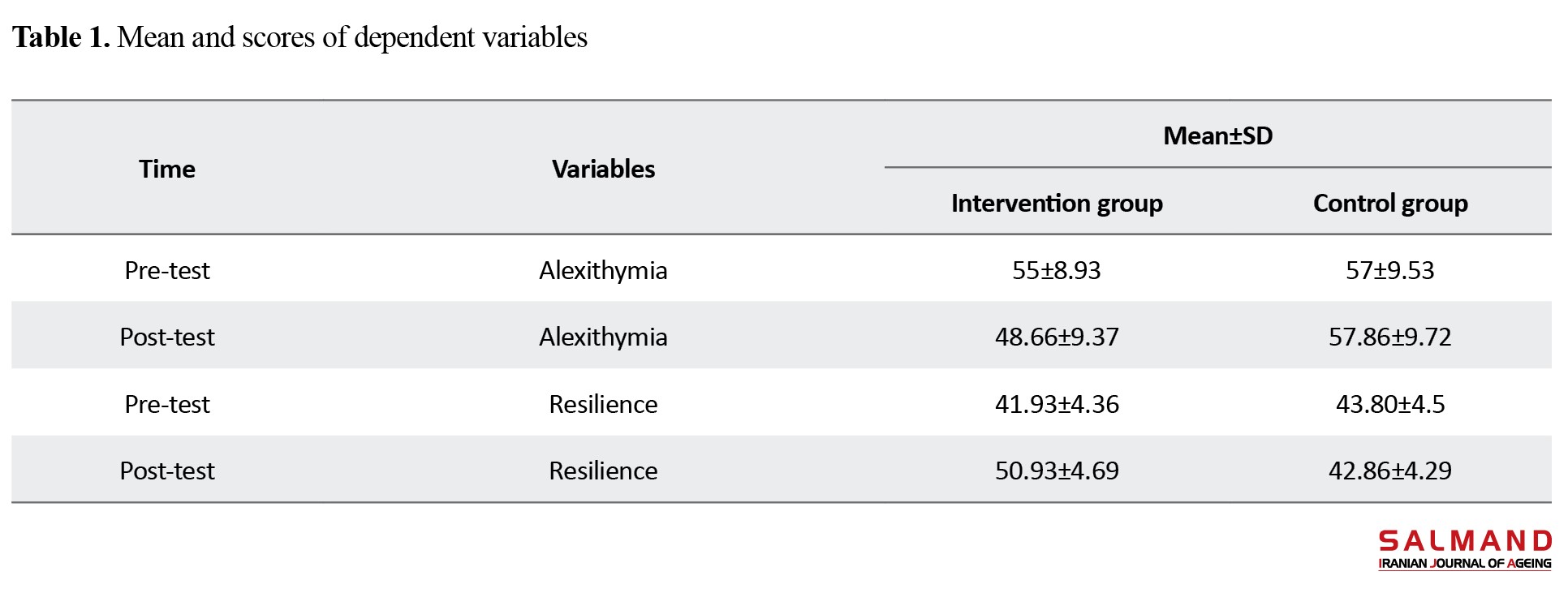
The results of ANCOVA showed a significant difference in mean alexithymia score between the intervention and control groups (F=59.97, Eta squared=0.70, P=0.001). There was also a significant difference in the mean resilience score between the two groups (F=31.72, Eta squared=0.55, P=0.001).
Conclusion
According to the results, training in coping strategies was 70% effective in reducing alexithymia and 55% effective in improving resilience among family caregivers of patients with Alzheimer’s/dementia. It is recommended that nursing educators and managers of elderly care centers provide training in coping strategies to clinical geriatric nurses in the form of a pamphlet or booklet, to be used as a guide to help and educate families and caregivers of patients with Alzheimer’s/dementia. The samples in this study were limited to family caregivers from one city in Iran (Arak); therefore, caution should be exercised in generalizing the results to formal caregivers or all family caregivers in Iran. Future studies are recommended to compare the effects of coping strategies training on alexithymia and resilience between formal and informal caregivers of older adults with Alzheimer’s/dementia in Iran.
Ethical Considerations
Compliance with ethical guidelines
All ethical principles were considered in this study. Ethical approval was obtained from the Research Ethics Committee of the Islamic Azad University, Arak Branch (Code: IR.IAU.ARAK.REC.1403.251).
Funding
This article was extracted from the master’s thesis of Kimyasadat Imani Malayeri in the field of clinical psychology at Islamic Azad University, Khomein Branch. This research did not receive any specific grant from funding agencies in the public, commercial, or not-for profit sectors.
Authors' contributions
All authors contributed equally to the conception and design of the study, data collection and analysis, interpretation of the results, and drafting of the manuscript. Each author approved the final version of the manuscript for submission.
Conflicts of interest
The authors declare no conflicts of interest.
Acknowledgments
The authors would like to thank the Arak Alzheimer’s Association and the family caregivers who participated in the study for their cooperation and time.
caregiving to older patients with chronic diseases such as Alzheimer’s is a stressful job. These caregivers often suffer from alexithymia, a risk factor for psychological disorders such as anxiety, depression, and stress, which can reduce their quality of life. They can overcome these conditions and maintain their own health when they are resilient. Factors such as caregiving pressure, family dysfunction, stigma, and patient dependency negatively affect caregivers’ resilience. The present study aims to assess whether training in coping strategies is effective in reducing alexithymia and improving the resilience of family caregivers of older people with Alzheimer’s/dementia.
Materials & Methods
This is a quasi-experimental study with a pretest-posttest design. The study population consists of all family caregivers of patients with Alzheimer’s/dementia from the Arak Alzheimer’s Association in the Central Province of Iran in 2024. Using purposive and convenience sampling, 30 participants were selected and randomly divided into two groups of 15. Inclusion criteria were age 25-50 years, at least a high school diploma, willingness to participate in the study, and caring for an elderly person with Alzheimer’s/dementia for more than a year. Participation in other psychoeducational sessions, absence from more than 3 training sessions, and lack of cooperation were considered exclusion criteria. To collect data, two questionnaires were used: the Toronto Alexithymia Scale (20 items) and the Connor-Davidson Resilience Scale (25 items). The intervention program emphasized an adaptive coping strategy and was provided in 10 sessions. To analyze the collected data, descriptive and inferential statistics, including multivariate and univariate analyses of covariance, were used.
Results
Table 1 presents the mean scores of the study variables for the two groups.
The results of ANCOVA showed a significant difference in mean alexithymia score between the intervention and control groups (F=59.97, Eta squared=0.70, P=0.001). There was also a significant difference in the mean resilience score between the two groups (F=31.72, Eta squared=0.55, P=0.001).
Conclusion
According to the results, training in coping strategies was 70% effective in reducing alexithymia and 55% effective in improving resilience among family caregivers of patients with Alzheimer’s/dementia. It is recommended that nursing educators and managers of elderly care centers provide training in coping strategies to clinical geriatric nurses in the form of a pamphlet or booklet, to be used as a guide to help and educate families and caregivers of patients with Alzheimer’s/dementia. The samples in this study were limited to family caregivers from one city in Iran (Arak); therefore, caution should be exercised in generalizing the results to formal caregivers or all family caregivers in Iran. Future studies are recommended to compare the effects of coping strategies training on alexithymia and resilience between formal and informal caregivers of older adults with Alzheimer’s/dementia in Iran.
Ethical Considerations
Compliance with ethical guidelines
All ethical principles were considered in this study. Ethical approval was obtained from the Research Ethics Committee of the Islamic Azad University, Arak Branch (Code: IR.IAU.ARAK.REC.1403.251).
Funding
This article was extracted from the master’s thesis of Kimyasadat Imani Malayeri in the field of clinical psychology at Islamic Azad University, Khomein Branch. This research did not receive any specific grant from funding agencies in the public, commercial, or not-for profit sectors.
Authors' contributions
All authors contributed equally to the conception and design of the study, data collection and analysis, interpretation of the results, and drafting of the manuscript. Each author approved the final version of the manuscript for submission.
Conflicts of interest
The authors declare no conflicts of interest.
Acknowledgments
The authors would like to thank the Arak Alzheimer’s Association and the family caregivers who participated in the study for their cooperation and time.
References
- Gilbertson EL, Krishnasamy R, Foote C, Kennard AL, Jardine MJ, Gray NA. Burden of care and quality of life among caregivers for adults receiving maintenance dialysis: A systematic review. American Journal of Kidney Diseases. 2019; 73(3):332-43. [DOI:10.1053/j.ajkd.2018.09.006] [PMID]
- Yu S, Qian L, Ma J. The influence of gender and wealth inequality on Alzheimer's disease among the elderly: A global study. Heliyon. 2023; 9(4):e14677. [DOI:10.1016/j.heliyon.2023.e14677]
- Spatuzzi R, Vespa A, Fabbietti P, Ricciuti M, Rosati G, Guariniello L, et al. Elderly helping other elderly: a comparative study of family caregiver burden between patients with dementia or cancer at the end of life. Journal of Social Work in End-of-Life & Palliative Care. 2022; 18(1):96-108. [DOI:10.1080/15524256.2022.2042459]
- Yang Z, Jia H, Lu Y, Liu S, Dai M, Zhang H. Prevalence and related factors of depression and anxiety in a cohort of Chinese elderly caregivers in the nursing home. Journal of Affective Disorders. 2021; 295:1456-61. [DOI:10.1016/j.jad.2021.09.026] [PMID]
- Salehi M. [CEO of the Iranian Alzheimer’s Association (Persian)] [Internet]. 2023. available from: [Link]
- Islamic Republic News Agency. [Markazi province among the top five provinces in the country in Alzheimer’s disease (Persian)] [Internet]. 2012. available from: [Link]
- Afshari A, Rezai R. [The relationship between social support and coping styles with the psychological well-being of the elderly: The Mediating role of self-worth (Persian)]. Aging Psychology. 2023; 8(4):401-18. [DOI:10.22126/jap.2022.8625.1679]
- Majidi Khameneh F. [The effect of religion and spiritual beliefs on self-efficacy resilience burden of children of elderly parents with Alzheimer's (Persian)]. Religious Culture Approach. 2020; 3(10):44-62. [Link]
- Khastar SM, Arsalani N, Nourozi K, Nourozi M, Rahim khani M. [The relationship between caregiver's fatigue and burden of the elderly with Alzheimer's disease in Birjand: A cross-sectional study (Persian)]. Journal of Gerontology. 2023; 8(3):71-9. [Link]
- Ghezelsefloo M, Saadati N, Yousefi Z, Zamanpour M. [Study the Effect of Resilience Training on Reducing Stress and Communication Problems in the Primary Caregivers of the Elderly With Alzheimer Disease (Persian)]. Salmand: Iranian Journal of Ageing. 2019; 14(3):284-97. [DOI:10.32598/sija.13.10.250]
- Epstein-Lubow G, Gaudiano B, Darling E, Hinckley M, Tremont G, Kohn R, et al. Differences in depression severity in family caregivers of hospitalized individuals with dementia and family caregivers of outpatients with dementia. American Journal of Geriatric Psychiatry. 2012; 20(9):815-9. [DOI:10.1097/JGP.0b013e318235b62f] [PMID] [PMCID]
- Mahoney R, Regan C, Katona C, Livingston G. Anxiety and depression in family caregivers of people with Alzheimer disease: the LASER-AD study. American Journal of Geriatric Psychiatry. 2005; 13(9):795-801. [DOI:10.1176/appi.ajgp.13.9.795] [PMID]
- Aguglia E, Onor ML, Trevisiol M, Negro C, Saina M, Maso E. Stress in the caregivers of Alzheimer’s patients: An experimental investigation in Italy. American Journal of Alzheimer's Disease and other Dementias. 2004; 19(4):248-52. [DOI:10.1177/153331750401900403] [PMID] [PMCID]
- Vitaliano PP, Russo J, Bailey SL, Young HM, McCann BS. Psychosocial factors associated with cardiovascular reactivity in older adults. Psychosomatic Medicine. 1993; 55(2):164-77. [DOI:10.1097/00006842-199303000-00005] [PMID]
- Masoudi F, Nezhad Mohammad Nameghi A, Ghodsi P. [Efficacy of psychological capital training on the perceived stress and psychological coherence in elderly caregivers (Persian)]. Journal of Modern Psychological Researches. 2024; 19(74):88-97. [DOI:10.22034/jmpr.2023.57446.5707]
- Sadeghi A, Jahangiri MM, Taghvaei D. [The effectiveness of self-compassion-focused therapy on depression, caregiving stress, and alexithymia in caregivers of elderly people with Alzheimer's disease (Persian)]. Research in Psychological Health. 2026; 18(2):91-105. [Link]
- Ali Asgari Rizi M, manshaee G. [The effectiveness of mindfulness training on caring pressure and compassion fatigue in caregivers of heart transplant candidates (Persian)]. Iranian Journal of Psychiatric Nursing. 2024; 12(3):80-90. [DOI:10.22034/IJPN.12.3.80]
- Gaugler JE, Baier RR, Baker ZG, Boltz M, Fortinsky RH, Gustavson AM, et al. Using hybrid effectiveness studies to facilitate implementation in community-based settings: Three case studies in dementia care research. Journal of the American Medical Directors Association. 2024; 25(1):27-33. [DOI:10.1016/j.jamda.2023.07.025] [PMID] [PMCID]
- Thomann P, Rousseau A, Valette S, Martin-Hunyadi C, Vogel T, Michel B. [Psychotropic medication use by informal caregivers of elderly patients with dementia: A French observational study (french)]. NPG: Neurologie-Psychiatrie-Gériatrie. 2021; 22(128):107-12. [DOI:10.1016/j.npg.2021.08.007]
- Akgun-Citak E, Attepe-Ozden S, Vaskelyte A, van Bruchem-Visser RL, Pompili S, Kav S, et al. Challenges and needs of informal caregivers in elderly care: Qualitative research in four European countries, the TRACE project. Archives of Gerontology and Geriatrics. 2020; 87:103971. [DOI:10.1016/j.archger.2019.103971] [PMID]
- Moadeb Kazerouni S, Hatami M, Seifaddini R. [Comparison of the effectiveness of self-care training and regulation of the emotional process on the quality of life of caregivers (Persian)]. Rooyesh-e-Ravanshenasi Journal (RRJ). 2023; 12(7):133-42. [Link]
- Safara M, Salmabadi M. [Psychological well-being in the elderly: the role of self-compassion and alexithymia (Persian)]. Journal of Aging Psychology. 2021; 7(1):83-92. [Link]
- Zehtab S, Tabatabaeinejad FT. [The effectiveness of mindfulness-based cognitive therapy on psychological well-being and quality of life in caregivers of the elderly with alzheimer's disease in isfahan city: A quasi-experimental study (Persian)]. Journal of Rafsanjan University of Medical Sciences. 2022; 21(2):187-206. [DOI:10.52547/jrums.21.2.187]
- Bagheri M, Nematollah Zadeh Mahani K, Pour Amrollahi M. [The mediating role of alexithymia in the relationship of coping strategies and personality traits with obsessive-compulsive disorder (Persian)]. Internal Medicine Today. 2020; 27(1):62-81. [DOI:10.32598/hms.27.1.3355.1]
- American Psychology Association. The Road to resilience. Washington: American Psychology Association; 2019. [Link]
- Sadidi M, Yamini M. [Prediction of psychological well-being based on coping strategies and alexithymia (Persian)]. Journal of Psychological Studies. 2018; 14(2):125-41. [DOI:10.22051/psy.2018.16823.1472]
- Dědová M, Baník G, Vargová L. Coping with cancer: the role of different sources of psychosocial support and the personality of patients with cancer in (mal)adaptive coping strategies. Supportive Care in Cancer. 2022; 31(1):27. [DOI:10.1007/s00520-022-07454-z] [PMID]
- Sheikholeslami ّF, Khalatbary J, Ghorbanshiroudi S. [Effectiveness of stress coping skills training with psycho-educational approach among caregiversof schizophrenic patients on family function and psychological wellbeing (Persian)]. Journal of Holistic Nursing And Midwifery. 2016; 26(3):46-54.[Link]
- Ahmadi S, Bolghan-Abadi M. [The effect of emotional regulation instruction on alexithymia of high school students (Persian)]. Journal of Research in Behavioural Sciences. 2019; 17(3):359-66. [DOI:10.52547/rbs.17.3.359]
- Franken IH, Hendriks VM, Haffmans PM, van der Meer CW. Coping style of substance-abuse patients: effects of anxiety and mood disorders on coping change. Journal of Clinical Psychology. 2001; 57(3):299-306. [DOI:10.1002/jclp.1013] [PMID]
- Wilks SE, Little KG, Gough HR, Spurlock WJ. Alzheimer’s aggression: influences on caregiver coping and resilience. Journal of Gerontological Social Work. 2011; 54(3):260-75. [DOI:10.1080/01634372.2010.544531] [PMID]
- Ghadampour E, Nosratabadi M, Pourabadei P, Mirdrikund F. [The effectiveness of compassion-focused therapy on improving the quality of life and increasing resilience of caregivers of dementia patients (Persian)]. Journal of New Advances in Behavioral Sciences. 2020; 5(43):43-55. [Link]
- Vespa A, Spatuzzi R, Fabbietti P, Penna M, Giulietti MV. Association between care burden, depression and personality traits in Alzheimer's caregiver: A pilot study. PLoS One. 2021; 16(9):e0251813.[DOI:10.1371/journal.pone.0251813] [PMID] [PMCID]
- Ghaffari F, Fotokian Z, Rostami M, meskini L. [Analytical on effect of Resilience interventions on Mental Health in Family Caregivers of Elderlies with Alzheimer's disease: A review literature (Persian)]. Clinical Excellence. 2017; 7(1):13-35. [Link]
- Pereira MG, Abreu AR, Rego D, Ferreira G, Lima S. Contributors and moderators of quality of life in caregivers of alzheimer´ s disease patients. Experimental Aging Research. 2021; 47(4):357-72. [DOI:10.1080/0361073X.2021.1895594] [PMID]
- Tsaur SH, Hsu FS, Lin H. Workplace fun and work engagement in tourism and hospitality: The role of psychological capital. International journal of Hospitality Management. 2019; 81:131-40. [DOI:10.1016/j.ijhm.2019.03.016]
- Shang B, Chen R, Luo C, Lv F, Wu J, Shao X, et al. The relationship between alexithymia, depression, anxiety, and stress in elderly with multiple chronic conditions in China: a network analysis. Frontiers in psychiatry. 2023; 14:1209936. [DOI:10.3389/fpsyt.2023.1209936] [PMID] [PMCID]
- Kor PPK, Liu JYW, Chien WT. Effects of a modified mindfulness-based cognitive therapy for family caregivers of people with dementia: A pilot randomized controlled trial. International Journal of Nursing Studies. 2019; 98:107-17. [DOI:10.1016/j.ijnurstu.2019.02.020] [PMID]
Type of Study: Research |
Subject:
Psychology
Received: 2025/05/26 | Accepted: 2025/09/06 | Published: 2026/07/01
Received: 2025/05/26 | Accepted: 2025/09/06 | Published: 2026/07/01
Send email to the article author
| Rights and permissions | |
 |
This work is licensed under a Creative Commons Attribution-NonCommercial 4.0 International License. |

Copyright © The Author(s);
This is an open access article distributed under the terms of the Creative Commons Attribution-NonCommercial 4.0 (CC-By-NC 4.0), which permits use, distribution, and reproduction in any medium, provided the original work is properly cited and is not used for commercial purposes.
Contact Information