Volume 21, Issue 2 (Summer 2026)
Salmand: Iranian Journal of Ageing 2026, 21(2): 282-303 |
Back to browse issues page




Download citation:
BibTeX | RIS | EndNote | Medlars | ProCite | Reference Manager | RefWorks
Send citation to:


BibTeX | RIS | EndNote | Medlars | ProCite | Reference Manager | RefWorks
Send citation to:
Abdoljabari M, Hamzezadeh H, Hamedanchi A, Shameli R. Exploring Iranian Female Family Caregivers’ Lived Experiences of the End-of-Life Stage and Death of Older Adults: A Qualitative Study. Salmand: Iranian Journal of Ageing 2026; 21 (2) :282-303
URL: http://salmandj.uswr.ac.ir/article-1-3101-en.html
URL: http://salmandj.uswr.ac.ir/article-1-3101-en.html


1- Religion and Health Studies Center, Shahid Beheshti University of Medical Sciences, Tehran, Iran.
2- Shahid Beheshti University of Medical Sciences Branch, Academic Center for Education, Culture and Research (ACECR), Tehran, Iran. & School of Medical Education & Learning Technologies, Shahid Beheshti University of Medical Sciences, Tehran, Iran.
3- Shahid Beheshti University of Medical Sciences Branch, Academic Center for Education, Culture and Research (ACECR), Tehran, Iran.
4- Shahid Beheshti University of Medical Sciences Branch, Academic Center for Education, Culture and Research (ACECR), Tehran, Iran. ,r.shameli87@gmail.com
2- Shahid Beheshti University of Medical Sciences Branch, Academic Center for Education, Culture and Research (ACECR), Tehran, Iran. & School of Medical Education & Learning Technologies, Shahid Beheshti University of Medical Sciences, Tehran, Iran.
3- Shahid Beheshti University of Medical Sciences Branch, Academic Center for Education, Culture and Research (ACECR), Tehran, Iran.
4- Shahid Beheshti University of Medical Sciences Branch, Academic Center for Education, Culture and Research (ACECR), Tehran, Iran. ,
Full-Text [PDF 10608 kb]
(686 Downloads)
| Abstract (HTML) (2733 Views)
References
Full-Text: (40 Views)
Introduction
A In recent decades, due to scientific and technological advances and improved socio-economic conditions, the growth of the aging population has intensified. Therefore, for various reasons, including chronic diseases, the elderly may need specialized and emotional care. In 2017, 29% of people in need of care were elderly people over 60. In this situation, family caregivers play a vital role; In addition to providing physical and health care, they provide emotional support and help older patients cope better with the stresses and limitations of end-of-life. However, caregivers, who are mostly female, often face a variety of pressures. This study aimed to investigate the lived experience of informal female caregivers of older patients in Iran to provide a deeper understanding of this phenomenon and provide the basis for effective policymaking for this group.
Methods & Materials
This study was conducted in Tehran, Iran, from March 2023 to November 2024. The study population consists of informal female caregivers of the elderly at the end stage of life (wife, daughter, or daughter-in-law). Participants were selected through purposive sampling. Inclusion criteria were age ≥18 years, caring for an elderly person in the final stages of life (due to chronic disease or severe inability to care for themselves) for at least 3 months, and at least 2 months having passed since the elderly person’s death. Exclusion criteria were receiving payment for providing care or unwillingness to participate in or continue participation in the study. Caregivers of different ages and education levels were selected. They underwent interviews. They were first asked: “Tell me about your experience of caring for an older patient. How was it? How did it go?” Then, based on their answers, we asked probing questions about three time points: before the death, at the time of death, and after the death of the elderly person. The interviews were recorded and transcribed. The collected data were analyzed using Colaizzi’s seven-step method. The trustworthiness of the data was assessed using Guba’s four criteria: Credibility, Transferability, Dependability, and Confirmability.
Results
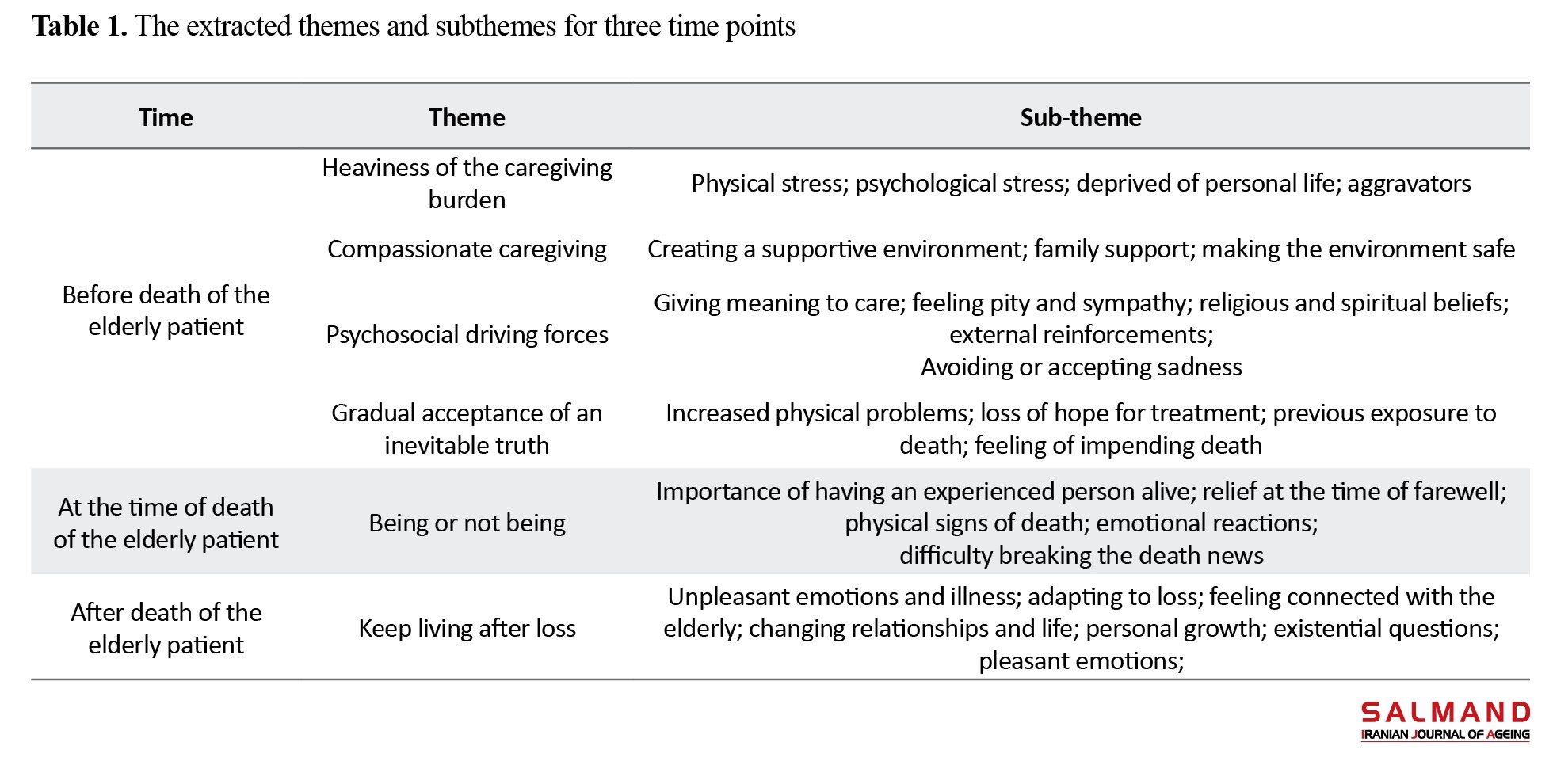
This study involved 10 informal female caregivers aged 29-77 years and their elderly patients aged 60-93 years. Data analysis extracted 6 main themes and 28 subthemes (Table 1).
Before death experiences
Heaviness of the caregiving burden
This theme addresses the physical, psychological, and social pressures of caregiving. Insomnia, fatigue, seeing the elderly suffer, anxiety, financial difficulties, lack of equipment, and inattention from medical staff (during the COVID-19 pandemic) were the most important pressures. Caregiver No.5 said: “Imagine that he suddenly falls and cries. It hurts to see a person cry, especially if he is your father.”
Compassionate caregiving
Caregivers created a supportive atmosphere by being positive and hopeful, maintaining the elderly’s connections with loved ones, and ensuring a safe environment. The family’s cooperation and financial support also reduced the burden. Caregiver No.6 stated: “Manner and giving hope are very important... Hope keeps you alive.”
Psychosocial driving forces
This theme addresses the semantic, cognitive, and social resources that reinforce the caregiving role. These resources included gratitude, conscientiousness, compassion, religious/spiritual beliefs, external reinforcements, and coping strategies for grief. Caregiver No. 1 stated: “He had no one here. We stepped forward to take care of him... It’s our duty... It was God’s will.”
Gradual acceptance of an inevitable truth
Caregivers accepted death by observing the elderly’s increasing problems, the disappointment of doctors, and the experience of others’ death. The caregiver’s or the elderly person’s premonition of approaching death was also a facilitating factor. Caregiver No.10 said: “Dad was very ill that night. It was as if he was telling me this is the last night!”
At the time of death experiences
Being or not being
This theme refers to the experiences of caregivers during and immediately after the death of an elderly person. The presence of an experienced person, praying, and the use of last-minute opportunities with the elderly person were comforting. Sadness, regret, anger, and gratitude for the provision of good care were among the emotional responses. Breaking the news of death to distant relatives (during the COVID-19 pandemic) also seemed challenging. Caregiver No. 3 talked about giving the news of his father’s death to his brother (who was living outside Iran): “The kid broke down. He picked up his pieces so that he could see his father through video call and say farewell.”
After death experiences
Keep living after loss
Despite experiencing loneliness, longing, and illness, caregivers adapted to the loss by changing their environment, seeking solitude, working more, and imagining the presence of the elderly. The loss of the elderly gave caregivers a deeper understanding of themselves, others, life, and death, including surrender to divine will and sometimes a sense of emptiness. Feelings of contentment and pleasant nostalgia were also reported. Caregiver No.2 said: “I kept myself busy with work.... so, I could gradually get along with it.”
Conclusion
Based on the results of the present study, female family caregivers of the elderly at the end stage of life in Iran face a heavy burden of care, but despite this pressure, they try to provide a supportive and safe environment for the elderly. They also find motivation to follow this path by giving their care meaning through love and duty. Although some caregivers struggle with feelings of emptiness, depression, and longing after the death of their elderly person, these experiences can ultimately lead to a deeper understanding of life and death, greater respect for oneself and others, and a less important focus on material things.
It is recommended that effective planning be carried out to support family caregivers, such as identifying and registering caregivers’ profiles in relevant local systems. It is also necessary to consider short-term programs and services to quickly meet basic needs and teach caregiving and self-care skills, as well as long-term programs and services to create lasting, continuous effects on the health of family caregivers.
Ethical Considerations
Compliance with ethical guidelines
This study was approved by the Ethics Committee of Shahid Beheshti University of Medical Sciences (Code: IR.SBMU.RETECH.REC.1401.486). Before the interviews, necessary information about the study objectives, audio recording, and confidentiality of personal data was explained to the caregivers, and their written informed consent was obtained. They were free to leave the study at any time.
Funding
This study was funded by the Religion and Health Studies Center, Shahid Beheshti University of Medical Sciences.
Authors' contributions
The authors contributed equally to the preparation of the manuscript. All authors read and approved the final version of the manuscript for submission.
Conflicts of interest
The authors declared no conflict of interest.
Acknowledgements
The authors would like to thank all participants for their cooperation and time in this research. We also acknowledge the assistance of Dr. Mahnaz Khalafeh-Nilsaz, Dr. Rozina Rahman, Dr. Fereshteh Rezaei, Ms. Marzieh Karamkhani, and Dr. Mohammad Reza Lakpour and Dr. Ayub Nafei, in this study.
A In recent decades, due to scientific and technological advances and improved socio-economic conditions, the growth of the aging population has intensified. Therefore, for various reasons, including chronic diseases, the elderly may need specialized and emotional care. In 2017, 29% of people in need of care were elderly people over 60. In this situation, family caregivers play a vital role; In addition to providing physical and health care, they provide emotional support and help older patients cope better with the stresses and limitations of end-of-life. However, caregivers, who are mostly female, often face a variety of pressures. This study aimed to investigate the lived experience of informal female caregivers of older patients in Iran to provide a deeper understanding of this phenomenon and provide the basis for effective policymaking for this group.
Methods & Materials
This study was conducted in Tehran, Iran, from March 2023 to November 2024. The study population consists of informal female caregivers of the elderly at the end stage of life (wife, daughter, or daughter-in-law). Participants were selected through purposive sampling. Inclusion criteria were age ≥18 years, caring for an elderly person in the final stages of life (due to chronic disease or severe inability to care for themselves) for at least 3 months, and at least 2 months having passed since the elderly person’s death. Exclusion criteria were receiving payment for providing care or unwillingness to participate in or continue participation in the study. Caregivers of different ages and education levels were selected. They underwent interviews. They were first asked: “Tell me about your experience of caring for an older patient. How was it? How did it go?” Then, based on their answers, we asked probing questions about three time points: before the death, at the time of death, and after the death of the elderly person. The interviews were recorded and transcribed. The collected data were analyzed using Colaizzi’s seven-step method. The trustworthiness of the data was assessed using Guba’s four criteria: Credibility, Transferability, Dependability, and Confirmability.
Results
This study involved 10 informal female caregivers aged 29-77 years and their elderly patients aged 60-93 years. Data analysis extracted 6 main themes and 28 subthemes (Table 1).
Before death experiences
Heaviness of the caregiving burden
This theme addresses the physical, psychological, and social pressures of caregiving. Insomnia, fatigue, seeing the elderly suffer, anxiety, financial difficulties, lack of equipment, and inattention from medical staff (during the COVID-19 pandemic) were the most important pressures. Caregiver No.5 said: “Imagine that he suddenly falls and cries. It hurts to see a person cry, especially if he is your father.”
Compassionate caregiving
Caregivers created a supportive atmosphere by being positive and hopeful, maintaining the elderly’s connections with loved ones, and ensuring a safe environment. The family’s cooperation and financial support also reduced the burden. Caregiver No.6 stated: “Manner and giving hope are very important... Hope keeps you alive.”
Psychosocial driving forces
This theme addresses the semantic, cognitive, and social resources that reinforce the caregiving role. These resources included gratitude, conscientiousness, compassion, religious/spiritual beliefs, external reinforcements, and coping strategies for grief. Caregiver No. 1 stated: “He had no one here. We stepped forward to take care of him... It’s our duty... It was God’s will.”
Gradual acceptance of an inevitable truth
Caregivers accepted death by observing the elderly’s increasing problems, the disappointment of doctors, and the experience of others’ death. The caregiver’s or the elderly person’s premonition of approaching death was also a facilitating factor. Caregiver No.10 said: “Dad was very ill that night. It was as if he was telling me this is the last night!”
At the time of death experiences
Being or not being
This theme refers to the experiences of caregivers during and immediately after the death of an elderly person. The presence of an experienced person, praying, and the use of last-minute opportunities with the elderly person were comforting. Sadness, regret, anger, and gratitude for the provision of good care were among the emotional responses. Breaking the news of death to distant relatives (during the COVID-19 pandemic) also seemed challenging. Caregiver No. 3 talked about giving the news of his father’s death to his brother (who was living outside Iran): “The kid broke down. He picked up his pieces so that he could see his father through video call and say farewell.”
After death experiences
Keep living after loss
Despite experiencing loneliness, longing, and illness, caregivers adapted to the loss by changing their environment, seeking solitude, working more, and imagining the presence of the elderly. The loss of the elderly gave caregivers a deeper understanding of themselves, others, life, and death, including surrender to divine will and sometimes a sense of emptiness. Feelings of contentment and pleasant nostalgia were also reported. Caregiver No.2 said: “I kept myself busy with work.... so, I could gradually get along with it.”
Conclusion
Based on the results of the present study, female family caregivers of the elderly at the end stage of life in Iran face a heavy burden of care, but despite this pressure, they try to provide a supportive and safe environment for the elderly. They also find motivation to follow this path by giving their care meaning through love and duty. Although some caregivers struggle with feelings of emptiness, depression, and longing after the death of their elderly person, these experiences can ultimately lead to a deeper understanding of life and death, greater respect for oneself and others, and a less important focus on material things.
It is recommended that effective planning be carried out to support family caregivers, such as identifying and registering caregivers’ profiles in relevant local systems. It is also necessary to consider short-term programs and services to quickly meet basic needs and teach caregiving and self-care skills, as well as long-term programs and services to create lasting, continuous effects on the health of family caregivers.
Ethical Considerations
Compliance with ethical guidelines
This study was approved by the Ethics Committee of Shahid Beheshti University of Medical Sciences (Code: IR.SBMU.RETECH.REC.1401.486). Before the interviews, necessary information about the study objectives, audio recording, and confidentiality of personal data was explained to the caregivers, and their written informed consent was obtained. They were free to leave the study at any time.
Funding
This study was funded by the Religion and Health Studies Center, Shahid Beheshti University of Medical Sciences.
Authors' contributions
The authors contributed equally to the preparation of the manuscript. All authors read and approved the final version of the manuscript for submission.
Conflicts of interest
The authors declared no conflict of interest.
Acknowledgements
The authors would like to thank all participants for their cooperation and time in this research. We also acknowledge the assistance of Dr. Mahnaz Khalafeh-Nilsaz, Dr. Rozina Rahman, Dr. Fereshteh Rezaei, Ms. Marzieh Karamkhani, and Dr. Mohammad Reza Lakpour and Dr. Ayub Nafei, in this study.
References
- United Nations Department of Economic and Social Affairs, Population Division.World Population Ageing 2020 Highlights: Living arrangements of older persons. New York: United Nations; 2020. [Link]
- WHO. Ageing and health. Geneva: World Health Organization; 2025. [Link]
- WHO. Data: Iran (Islamic Republic of) [Internet]. Accessed on 27 June 2025. Available from: [Link]
- National Council of the Elderly. [National document for the elderly (Persian)]. Tehran: National Council of the Elderly; 2020. [Link]
- Li R, Cheng X, Yang Y, Schwebel DC, Ning P, Li L, et al. Global deaths associated with population aging—1990–2019. China CDC Weekly. 2023; 5(51):1150-4. [DOI:10.46234/ccdcw2023.216] [PMID] [PMCID]
- Hamedanchi A, Rezaie F, Nafei A, Hamzezadeh H. [Causes and trends of mortality among Iranian older adults from 2000 to 2019 (Persian)]. Iranian Journal of Ageing. 2025; 19(4):642-63. [DOI:10.32598/sija.2024.3154.3]
- Freedman VA, Spillman BC. Disability and care needs among older Americans. The Milbank Quarterly. 2014; 92(3):509-41. [DOI:10.1111/1468-0009.12076] [PMID] [PMCID]
- Alzheimer’s Association. Alzheimer’s disease facts and figures. Chicago: Alzheimer’s Association; 2026. [Link]
- WHO. Integrated care for older people: Guidelines on community-level interventions to manage declines in intrinsic capacity. Geneva: World Health Organization; 2017. [Link]
- Åvik Persson H, Sandgren A, Fürst CJ, Ahlström G, Behm L. Early and late signs that precede dying among older persons in nursing homes: the multidisciplinary team's perspective. BMC Geriatrics. 2018; 18(1):134. [DOI:10.1186/s12877-018-0825-0] [PMID] [PMCID]
- Motamedi M, Brandenburg C, Bakhit M, Michaleff ZA, Albarqouni L, Clark J, et al. Concerns and potential improvements in end-of-life care from the perspectives of older patients and informal caregivers: a scoping review. BMC geriatrics. 2021; 21(1):729. [DOI:10.1186/s12877-021-02680-2] [PMID] [PMCID]
- Adelman RD, Tmanova LL, Delgado D, Dion S, Lachs MS. Caregiver burden: A clinical review. JAMA. 2014; 311(10):1052-60. [DOI:10.1001/jama.2014.304] [PMID]
- Oliveira D, Zarit SH, Orrell M. Health-promoting self-care in family caregivers of people with dementia: the views of multiple stakeholders. The Gerontologist. 2019; 59(5):e501-11. [DOI:10.1093/geront/gnz029] [PMID]
- Nguyen H, Nguyen T, Tran D, Hinton L. "It's extremely hard but it's not a burden": A qualitative study of family caregiving for people living with dementia in Vietnam. PLoS One. 2021; 16(11):e0259788. [DOI:10.1371/journal.pone.0259788] [PMID] [PMCID]
- Lindt N, van Berkel J, Mulder BC. Determinants of overburdening among informal carers: A systematic review. BMC Geriatrics. 2020; 20(1):304. [DOI:10.1186/s12877-020-01708-3] [PMID] [PMCID]
- NIH. Support for cancer caregivers: Caring for the caregiver. Bethesda: National Institutes of Health; 2024. [Link]
- Najafi Ghezeljeh T, Rezaei M, Keyvanloo Shahrestanaki S, Sheikh Milani A. Exploring family caregiver challenges in caring for patients with COVID-19 in intensive care units. Frontiers in Public Health. 2023; 11:1057396. [DOI:10.3389/fpubh.2023.1057396] [PMID] [PMCID]
- Eisma MC, Stroebe MS, Schut HA, Stroebe W, Boelen PA, van den Bout J. Avoidance processes mediate the relationship between rumination and symptoms of complicated grief and depression following loss. Journal of Abnormal Psychology. 2013; 122(4):961-70. [DOI:10.1037/a0034051] [PMID]
- Parkes CM, Prigerson HG. Bereavement: Studies of grief in adult life. 4th ed. London: Routledge; 2010. [Link]
- Vitaliano PP, Zhang J, Scanlan JM. Is caregiving hazardous to one's physical health? A meta-analysis. Psychological bulletin. 2003; 129(6):946-72. [DOI:10.1037/0033-2909.129.6.946] [PMID]
- Levine C, Halper D, Peist A, Gould DA. Bridging troubled waters: family caregivers, transitions, and long-term care. Health affairs. 2010; 29(1):116-24. [DOI:10.1377/hlthaff.2009.0520] [PMID]
- OECD. The pursuit of gender equality: An uphill battle. Paris: OECD Publishing; 2017. [Link]
- WHO. World report on ageing and health. Geneva: World Health Organization; 2015. [Link]
- Sheikhbardsiri H, Tavan A, Afshar PJ, Salahi S, Heidari-Jamebozorgi M. Investigating the burden of disease dimensions (time-dependent, developmental, physical, social and emotional) among family caregivers with COVID-19 patients in Iran. BMC Primary Care. 2022; 23(1):165. [DOI:10.1186/s12875-022-01772-1] [PMID] [PMCID]
- Abdollahpour I, Noroozian M, Nedjat S, Majdzadeh R. Caregiver burden and its determinants among the family members of patients with dementia in Iran. International journal of preventive Medicine. 2012; 3(8):544-51. [PMID]
- Hassankhani H, Eghtedar S, Rahmani A, Ebrahimi H, Whitehead B. A qualitative study on cancer care burden: experiences of Iranian family caregivers. Holistic Nursing Practice. 2019; 33(1):17-26. [DOI:10.1097/HNP.0000000000000309] [PMID]
- Bordbar S, Shojaei P, Asadollahi A, Ravangard R, Shirazi F, Askarian M, et al. Identifying and evaluating the challenges of geriatric healthcare service provision in Iran: evidence from a mixed-methods study. Scientific Reports. 2025; 15(1):28002. [DOI:10.1038/s41598-025-13182-1] [PMID] [PMCID]
- Alves S, Paúl C, Ribeiro O. Transition to bereavement: A prospective longitudinal study of health-related quality of life in informal caregivers of oldest-old individuals. Frontiers in Medicine. 2022; 9:1031143. [DOI:10.3389/fmed.2022.1031143] [PMID] [PMCID]
- Bijnsdorp FM, Onwuteaka-Philipsen BD, Boot CRL, van der Beek AJ, Pasman HRW. Caregiver's burden at the end of life of their loved one: insights from a longitudinal qualitative study among working family caregivers. BMC Palliative Care. 2022; 21(1):142. [DOI:10.1186/s12904-022-01031-1] [PMID] [PMCID]
- Moore KJ, Davis S, Gola A, Harrington J, Kupeli N, Vickerstaff V, et al. Experiences of end of life amongst family carers of people with advanced dementia: longitudinal cohort study with mixed methods. BMC Geriatrics. 2017; 17(1):135. [DOI:10.1186/s12877-017-0523-3] [PMID] [PMCID]
- Aroogh MD, Norouzi K, Shahboulaghi FM, Negarandeh R. Families' experiences of end-of-life care at home for Iranian older adults: A qualitative study. Indian journal of palliative Care. 2020; 26(4):468-75. [DOI:10.4103/IJPC.IJPC_10_20] [PMID] [PMCID]
- Mohammadinia T, Sedaghatzadegan S, Ghajari HA, Rezaei M. [Caregivers of the elderly: A systematic review of three decades of research on the experience of family care for the elderly (Persian)]. Women's Strategic Studies. 2024; 27(105):39-72. [DOI:10.22095/jwss.2025.489581.3586]
- Ospina S. Qualitative research. In: Goethals GR, Sorenson GJ, Burns JM, editors. Encyclopedia of leadership. London: SAGE; 2004. [Link]
- Morrow R, Rodriguez A, King N. Colaizzi’s descriptive phenomenological method. The psychologist. 2015; 28(8):643-4. [Link]
- Emami Sigaroodi A, Dehghan Nayeri N, Rahnavard Z, Nori Saeed A. [Qualitative research methodology: phenomenology (Persian)]. Journal of Holistic Nursing and Midwifery. 2012; 22(2):56-63. [Link]
- Pivodic L, Van den Block L, Pardon K, Miccinesi G, Vega Alonso T, Boffin N, et al. Burden on family carers and care-related financial strain at the end of life: A cross-national population-based study. The European Journal of Public Health. 2014; 24(5):819-26. [DOI:10.1093/eurpub/cku026] [PMID] [PMCID]
- Higginson IJ, Yi D, Johnston BM, Ryan K, McQuillan R, Selman L, et al. Associations between informal care costs, care quality, carer rewards, burden and subsequent grief: The international, access, rights and empowerment mortality follow-back study of the last 3 months of life (IARE I study). BMC Medicine. 2020; 18(1):344. [DOI:10.1186/s12916-020-01768-7] [PMID] [PMCID]
- Bigi S, Ganfi V, Borelli E, Potenza L, Artioli F, Eliardo S, et al. Perceptions of hope among bereaved caregivers of cancer patients who received early palliative care: A content and lexicographic analysis. The oncologist. 2022; 27(2):e168-75. [DOI:10.1093/oncolo/oyab027] [PMID] [PMCID]
- Salehi M, Ahmadzad asl M, Seddigh R, Rashedi V, Almasi Dooghaee M, Kamalzadeh L, et al. [The relationship between spiritual well-being and care burden in unofficial caregivers of elderly patients with dementia (Persian)]. Iranian Journal of Psychiatry and Clinical Psychology. 2020; 26(1):64-75. [DOI:10.32598/ijpcp.26.1.2658.1]
- Loh J. Inquiry into issues of trustworthiness and quality in narrative studies: A perspective. The qualitative report. 2013; 18:65. [DOI:10.46743/2160-3715/2013.1477]
- Hamedanchi A, Zanjari N, Khankeh HR, Abolfathi Momtaz Y. [Hermeneutic studies: Challenges and strategies in trustworthiness (Persian)]. Nursing and Midwifery Journal. 2021; 19(2):119-27. [Link]
- Liang HJ, Xiong Q, Lin PC, Tsai JH, Preston N. 'Regrets become a lasting source of pain': A qualitative study on family caregivers' experiences leading up to a relative's death. Palliative medicine. 2025; 39(3):401-12. [DOI:10.1177/02692163251316677] [PMID] [PMCID]
- Bilić J, Skokandić L, Puljak L. Anticipatory grief and experience of providing at-home palliative care among informal caregivers of spouses in Croatia: A qualitative study. BMC Palliative Care. 2022; 21(1):199. [DOI:10.1186/s12904-022-01093-1] [PMID] [PMCID]
- Chen MC, Lin HR. The experiences of family caregivers in response to a dementia diagnosis disclosure. BMC Psychiatry. 2022; 22(1):475. [DOI:10.1186/s12888-022-04126-4] [PMID] [PMCID]
- Hwang Y, Connell LM, Rajpara AR, Hodgson NA. Impact of COVID-19 on dementia caregivers and factors associated with their anxiety symptoms. American Journal of Alzheimer's Disease & Other Dementias. 2021; 36:15333175211008768. [DOI:10.1177/15333175211008768] [PMID] [PMCID]
- Simpson R, Szigeti Z, Sheppard CL, Minezes J, Hitzig SL, Mayo AL, et al. The experiences of patients, family caregivers, healthcare providers, and health service leaders with compassionate care following hospitalization with COVID-19: A qualitative study. Disability and Rehabilitation. 2023; 45(18):2896-905. [DOI:10.1080/09638288.2022.2113564] [PMID]
- Costa AF, Lopes MC, Campanharo CR, Batista RE, Okuno MF. Quality of life and burden of caregivers of elderly people. Texto & Contexto-Enfermagem. 2020; 29:e20190043.[DOI:10.1590/1980-265x-tce-2019-0043]
- Robinson-Lane SG, Leggett AN, Johnson FU, Leonard N, Carmichael AG, Oxford G, et al. Caregiving in the COVID-19 pandemic: Family adaptations following an intensive care unit hospitalisation. Journal of Clinical Nursing. 2024; 33(1):203-14. [DOI:10.1111/jocn.16560] [PMID] [PMCID]
- PDQ Supportive and Palliative Care Editorial Board. Grief, Bereavement, and Loss (PDQ®): Patient Version. 2025. In: PDQ Cancer Information Summaries [Internet]. Bethesda (MD): National Cancer Institute (US); 2002. [PMID]
- Chang JT, Morton SC, Rubenstein LZ, Mojica WA, Maglione M, Suttorp MJ, et al. Interventions for the prevention of falls in older adults: Systematic review and meta-analysis of randomised clinical trials. BMJ. 2004; 328(7441):680. [DOI:10.1136/bmj.328.7441.680] [PMID] [PMCID]
- Greenwood N, Smith R. Motivations for being informal carers of people living with dementia: A systematic review of qualitative literature. BMC Geriatrics. 2019; 19(1):169. [DOI:10.1186/s12877-019-1185-0] [PMID] [PMCID]
- Heo SH, Kim HR. Family caregivers' perceived value of caring for older patient: A hybrid model of concept analysis. Journal of Korean Gerontological Nursing. 2023; 25(2):152-62. [DOI:10.17079/jkgn.2302.20001] [PMID] [PMCID]
- Şentürk S, Can S, Cicek SC. The effect of spiritual orientations and religious attitudes on coping with the difficulties encountered by family caregivers of people with Parkinson’s disease in Türkiye. Journal of Religion and Health. 2023; 62(6):4278-96. [DOI:10.1007/s10943-023-01941-1] [PMID]
- Monteiro AMF, Santos RL, Kimura N, Baptista MAT, Dourado MCN. Coping strategies among caregivers of people with Alzheimer disease: a systematic review. Trends in Psychiatry and Psychotherapy. 2018; 40(3):258-68. [DOI:10.1590/2237-6089-2017-0065] [PMID]
- Lin MC, Macmillan M, Brown N. A grounded theory longitudinal study of carers’ experiences of caring for people with dementia. Dementia. 2012; 11(2):181-97. [DOI:10.1177/1471301211421362]
- Zarzycki M, Morrison V. Getting back or giving back: Understanding caregiver motivations and willingness to provide informal care. Health psychology and behavioral medicine. 2021; 9(1):636-61. [DOI:10.1080/21642850.2021.1951737] [PMID] [PMCID]
- Family Caregiver Alliance, and Rabbi Jon Sommer. Grief and loss[Internet]. 2013. Available from: [Link]
- Waugh CE, Shing EZ, Furr RM. Not all disengagement coping strategies are created equal: positive distraction, but not avoidance, can be an adaptive coping strategy for chronic life stressors. Anxiety, Stress, & Coping. 2020; 33(5):511-29. [DOI:10.1080/10615806.2020.1755820] [PMID]
- Leslie-Miller CJ, Cole VT, Waugh CE. Positive distraction in daily activities as a predictor of good coping: A "day in the life" during the COVID-19 pandemic. Frontiers in Psychology. 2023; 14:1142665. [DOI:10.3389/fpsyg.2023.1142665] [PMID] [PMCID]
- Singer J, Papa A. Preparedness for the death of an elderly family member: A possible protective factor for pre-loss grief in informal caregivers. Archives of Gerontology and Geriatrics. 2021; 94:104353. [DOI:10.1016/j.archger.2021.104353] [PMID]
- Hovland-Scafe CA, Kramer BJ. Preparedness for death: how caregivers of elders with dementia define and perceive its value. Gerontologist. 2017; 57(6):1093-102. [DOI:10.1093/geront/gnw092] [PMID] [PMCID]
- Uzun U, Başar S, Saritaş A. Spiritual needs of family caregivers in palliative care. BMC Palliative Care. 2024; 23(1):256. [DOI:10.1186/s12904-024-01589-y] [PMID] [PMCID]
- Avazeri A, Bonin J, Maneval A, Vorilhon P. Announcements of death during the Covid-19 pandemic: A qualitative study of family experiences. Health Expectations. 2025; 28(2):e70221.[DOI:10.1111/hex.70221] [PMID] [PMCID]
- Eisma MC, Tamminga A. Grief before and during the COVID-19 pandemic: Multiple group comparisons. Journal of Pain and Symptom Management. 2020; 60(6):e1-4. [DOI:10.1016/j.jpainsymman.2020.10.004] [PMID] [PMCID]
- Vlachogianni A, Efthymiou A, Potamianou D, Sakka P, Orgeta V. Life after care: psychological adjustment to bereavement in family carers of people with dementia. International Psychogeriatrics. 2016; 28(5):815-23. [DOI:10.1017/S104161021500201X] [PMID]
- Stroebe M, Schut H, Stroebe W. Health outcomes of bereavement. Lancet. 2007; 370(9603):1960-73. [DOI:10.1016/S0140-6736(07)61816-9] [PMID]
- Stroebe M, Schut H. The dual process model of coping with bereavement: Rationale and description. Death Studies. 1999; 23(3):197-224. [DOI:10.1080/074811899201046] [PMID]
- Bonanno GA, Mancini AD. The human capacity to thrive in the face of potential trauma. Pediatrics. 2008; 121(2):369-75. [DOI:10.1542/peds.2007-1648] [PMID]
- Schulz R, Mendelsohn AB, Haley WE, Mahoney D, Allen RS, Zhang S, et al. End-of-life care and the effects of bereavement on family caregivers of persons with dementia. New England Journal of Medicine. 2003; 349(20):1936-42. [DOI:10.1056/NEJMsa035373] [PMID]
- Tedeschi RG, Calhoun LG. " Posttraumatic growth: Conceptual foundations and empirical evidence". Psychological Inquiry. 2004; 15(1):1-8. [DOI:10.1207/s15327965pli1501_01]
- Yalom ID. Existential psychotherapy. New York: Basic Books; 1980. [Link]
- Kübler-Ross E. On Death and Dying. London: Routledge; 1969. [DOI:10.4324/9780203010495]
Type of Study: Research |
Subject:
Psychology
Received: 2025/08/01 | Accepted: 2025/12/14 | Published: 2026/07/01
Received: 2025/08/01 | Accepted: 2025/12/14 | Published: 2026/07/01
Send email to the article author
| Rights and permissions | |
 |
This work is licensed under a Creative Commons Attribution-NonCommercial 4.0 International License. |

Copyright © The Author(s);
This is an open access article distributed under the terms of the Creative Commons Attribution-NonCommercial 4.0 (CC-By-NC 4.0), which permits use, distribution, and reproduction in any medium, provided the original work is properly cited and is not used for commercial purposes.
Contact Information