Volume 21, Issue 2 (Summer 2026)
Salmand: Iranian Journal of Ageing 2026, 21(2): 304-317 |
Back to browse issues page




Download citation:
BibTeX | RIS | EndNote | Medlars | ProCite | Reference Manager | RefWorks
Send citation to:


BibTeX | RIS | EndNote | Medlars | ProCite | Reference Manager | RefWorks
Send citation to:
Hakim M, Zahmatkeshan N, Malekzadeh M. Lifestyle of Older Adults in Yasuj, Iran, and the Associated Factors. Salmand: Iranian Journal of Ageing 2026; 21 (2) :304-317
URL: http://salmandj.uswr.ac.ir/article-1-3125-en.html
URL: http://salmandj.uswr.ac.ir/article-1-3125-en.html


1- Department of Medical, Student Research Committee, Yasuj University of Medical Sciences, Yasuj, Iran.
2- Department of Nursing Education, Faculty of Paramedical Sciences, Yasuj University of Medical Sciences, Yasuj, Iran. ,nasrin.zahmatkeshan@Yums.ac.ir
3- Department of Health Psychology, Social Determinant of Health Research Center, Yasuj University of Medical Sciences, Yasuj, Iran.
2- Department of Nursing Education, Faculty of Paramedical Sciences, Yasuj University of Medical Sciences, Yasuj, Iran. ,
3- Department of Health Psychology, Social Determinant of Health Research Center, Yasuj University of Medical Sciences, Yasuj, Iran.
Full-Text [PDF 6946 kb]
(625 Downloads)
| Abstract (HTML) (1875 Views)
Full-Text: (43 Views)
Introduction
Significant progress in medical science and living conditions has increased life expectancy, leading to a growing older population. It is estimated that by 2050, 21-25% of Iran’s population will be aged 60 and over. Among the important issues in prevention and moving towards successful aging is adopting a healthy lifestyle during this period. Studies on the lifestyles of older adults in Iran have indicated their poor lifestyle. Despite numerous studies on these people in Iran, there is little research on the specific conditions of older adults in Yasuj city, Kohgiluyeh & Boyer-Ahmad Province, and on the cultural, social, and economic characteristics of this region. Therefore, to provide a more comprehensive picture, the present study aimed to investigate the lifestyle and identify certain demographic factors related to it among older adults in Yasuj.
Materials and Methods
This is a descriptive, analytical study with a cross-sectional design conducted on 425 older people in Yasuj city in 2025. A multi-stage cluster random sampling with proportional allocation was employed. For this purpose, among the 14 bases covered by the health centers in Yasuj city, 9 bases that covered different geographical areas of the city were selected as clusters by simple random sampling. Then, for each base, a sample size of 425 was calculated, and samples were selected from each base using simple random sampling using a random number table. The inclusion criteria were age over 60 years, willingness to participate in the study, absence of psychological disorders as self-reported, and ability to perform daily activities. The exclusion criteria were incomplete information and failure to respond to more than 20% of the questionnaire items. The data collection tool included a demographic form (surveying age, gender, marital status, occupation, etc.) and a standard questionnaire for measuring healthy lifestyle in the elderly, developed and psychometrically tested by Ishaghi et al. [29] in Iran. This questionnaire has 46 items and five domains: prevention, nutrition, exercise, stress management, and relationships. After calculating the total score, a score of 76-100 indicates a desirable lifestyle; 51-75 indicates a moderate lifestyle, and a score less than 50 indicates an undesirable lifestyle.
Results
The mean age of the participants was 66.95±5.52. Most of them were male (52.2%), married (79.8%), and retired (33.4%), with a monthly income of 11-15 million Tomans. Also, 63% of the samples had a history of at least one chronic disease, the most common of which was hypertension (50.6%). The mean total lifestyle score was 61.83±15.39, indicating a moderate lifestyle. Among the different lifestyle domains, the prevention domain had the highest score (73.02±15.73), while the exercise domain had the lowest score (44.83±22.14). There was a significant difference between men and women in total lifestyle score (P<0.01) and in the domains of nutrition, exercise, stress management, and relationships (P<0.01); the difference was not significant in terms of prevention (P>0.05).
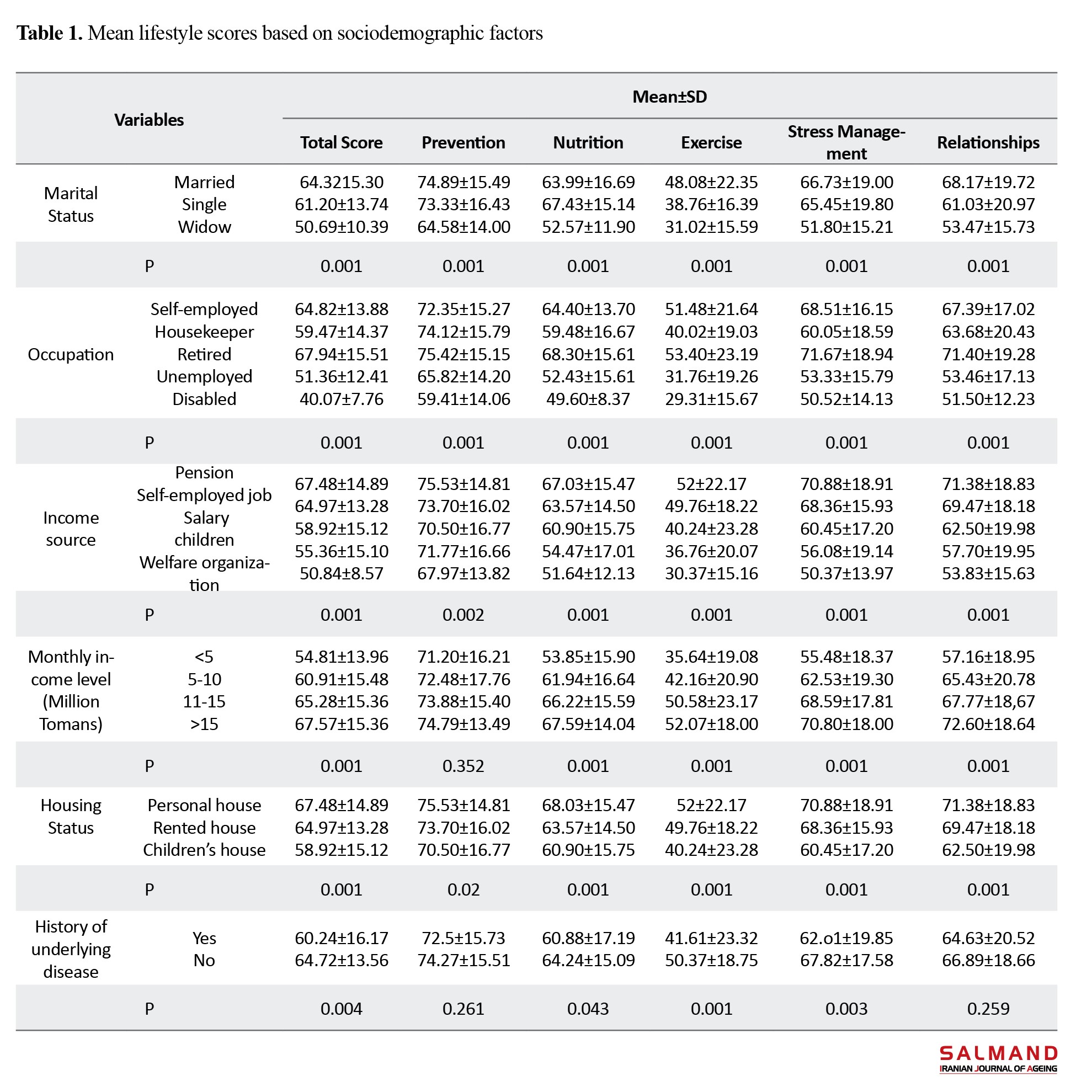
Pearson’s correlation test results indicated a statistically significant negative relationship between age and the mean total score and subscale scores of lifestyle (P<0.05). Also, the results of analysis of variance presented in Table 1 indicated statistically significant differences in the mean total score and subscale scores of lifestyle based on marital status, occupation, source of income, and monthly income, and housing status (P<0.05); married, employed or retired people, those receiving a pension and having a high monthly income, and those with a personal house had a better lifestyle. Regarding income, the results showed no statistically significant difference in the mean score of the prevention domain (P>0.05). Regarding the history of underlying disease, statistically significant differences were found in the mean scores of overall lifestyle, nutrition, exercise, and stress management domains, but not in the prevention and relationships domains (Table 1).
In the multivariate linear regression model, the variables of age, gender, marital status, occupation, monthly income, housing status, and history of underlying disease were entered. The results showed that monthly income was the strongest predictor of lifestyle, such that as income decreased, the lifestyle score decreased significantly. Age and housing status also had a significant negative effect on lifestyle; inadequate housing conditions were associated with a poorer lifestyle. Together, these three variables explained 24.1% of the variance in lifestyle (R²=0.241).
Conclusion
The lifestyle of the elderly in Yasuj is at a moderate level. Regarding the lifestyle domains, the prevention domain, they had the highest score while their exercise score was the lowest score. This pattern (high prevention and low activity) can indicate a passive lifestyle in which the elderly, despite paying attention to their health, remain inactive and adopt a more preventive approach. The predictors of the elderly’s lifestyle were monthly income, age, and housing status.
Ethical Considerations
Compliance with ethical guidelines
This research was approved by the Research Ethics Committee of Yasuj University of Medical Sciences (Code: IR.YUMS.REC.1403.161).
Funding
This article was extracted from a doctoral thesis in professional medicine funded by Yasuj University of Medical Sciences.
Authors' contributions
Conceptualization: All authors; investigation: Nasrin Zahmatkeshan and Mojtaba Hakim; editing & review: Nasrin Zahmatkeshan and Mohammad Malekzadeh
Conflicts of interest
The authors declare no conflicts of interest.
Acknowledgments
The authors would like to thank all the seniors who participated in the study, as well as the managers and staff of health centers in Yasuj for their
Significant progress in medical science and living conditions has increased life expectancy, leading to a growing older population. It is estimated that by 2050, 21-25% of Iran’s population will be aged 60 and over. Among the important issues in prevention and moving towards successful aging is adopting a healthy lifestyle during this period. Studies on the lifestyles of older adults in Iran have indicated their poor lifestyle. Despite numerous studies on these people in Iran, there is little research on the specific conditions of older adults in Yasuj city, Kohgiluyeh & Boyer-Ahmad Province, and on the cultural, social, and economic characteristics of this region. Therefore, to provide a more comprehensive picture, the present study aimed to investigate the lifestyle and identify certain demographic factors related to it among older adults in Yasuj.
Materials and Methods
This is a descriptive, analytical study with a cross-sectional design conducted on 425 older people in Yasuj city in 2025. A multi-stage cluster random sampling with proportional allocation was employed. For this purpose, among the 14 bases covered by the health centers in Yasuj city, 9 bases that covered different geographical areas of the city were selected as clusters by simple random sampling. Then, for each base, a sample size of 425 was calculated, and samples were selected from each base using simple random sampling using a random number table. The inclusion criteria were age over 60 years, willingness to participate in the study, absence of psychological disorders as self-reported, and ability to perform daily activities. The exclusion criteria were incomplete information and failure to respond to more than 20% of the questionnaire items. The data collection tool included a demographic form (surveying age, gender, marital status, occupation, etc.) and a standard questionnaire for measuring healthy lifestyle in the elderly, developed and psychometrically tested by Ishaghi et al. [29] in Iran. This questionnaire has 46 items and five domains: prevention, nutrition, exercise, stress management, and relationships. After calculating the total score, a score of 76-100 indicates a desirable lifestyle; 51-75 indicates a moderate lifestyle, and a score less than 50 indicates an undesirable lifestyle.
Results
The mean age of the participants was 66.95±5.52. Most of them were male (52.2%), married (79.8%), and retired (33.4%), with a monthly income of 11-15 million Tomans. Also, 63% of the samples had a history of at least one chronic disease, the most common of which was hypertension (50.6%). The mean total lifestyle score was 61.83±15.39, indicating a moderate lifestyle. Among the different lifestyle domains, the prevention domain had the highest score (73.02±15.73), while the exercise domain had the lowest score (44.83±22.14). There was a significant difference between men and women in total lifestyle score (P<0.01) and in the domains of nutrition, exercise, stress management, and relationships (P<0.01); the difference was not significant in terms of prevention (P>0.05).
Pearson’s correlation test results indicated a statistically significant negative relationship between age and the mean total score and subscale scores of lifestyle (P<0.05). Also, the results of analysis of variance presented in Table 1 indicated statistically significant differences in the mean total score and subscale scores of lifestyle based on marital status, occupation, source of income, and monthly income, and housing status (P<0.05); married, employed or retired people, those receiving a pension and having a high monthly income, and those with a personal house had a better lifestyle. Regarding income, the results showed no statistically significant difference in the mean score of the prevention domain (P>0.05). Regarding the history of underlying disease, statistically significant differences were found in the mean scores of overall lifestyle, nutrition, exercise, and stress management domains, but not in the prevention and relationships domains (Table 1).
In the multivariate linear regression model, the variables of age, gender, marital status, occupation, monthly income, housing status, and history of underlying disease were entered. The results showed that monthly income was the strongest predictor of lifestyle, such that as income decreased, the lifestyle score decreased significantly. Age and housing status also had a significant negative effect on lifestyle; inadequate housing conditions were associated with a poorer lifestyle. Together, these three variables explained 24.1% of the variance in lifestyle (R²=0.241).
Conclusion
The lifestyle of the elderly in Yasuj is at a moderate level. Regarding the lifestyle domains, the prevention domain, they had the highest score while their exercise score was the lowest score. This pattern (high prevention and low activity) can indicate a passive lifestyle in which the elderly, despite paying attention to their health, remain inactive and adopt a more preventive approach. The predictors of the elderly’s lifestyle were monthly income, age, and housing status.
Ethical Considerations
Compliance with ethical guidelines
This research was approved by the Research Ethics Committee of Yasuj University of Medical Sciences (Code: IR.YUMS.REC.1403.161).
Funding
This article was extracted from a doctoral thesis in professional medicine funded by Yasuj University of Medical Sciences.
Authors' contributions
Conceptualization: All authors; investigation: Nasrin Zahmatkeshan and Mojtaba Hakim; editing & review: Nasrin Zahmatkeshan and Mohammad Malekzadeh
Conflicts of interest
The authors declare no conflicts of interest.
Acknowledgments
The authors would like to thank all the seniors who participated in the study, as well as the managers and staff of health centers in Yasuj for their
References
- Sammy I, Paul JF. The global challenge of ageing population-Part I: Definitions, epidemiology and physiological changes. Caribbean Medical Journal. 2018; 2:14-22. [DOI:10.48107/CMJ.2018.11.004]
- Alcañiz M, Solé-Auró A. Feeling good in old age: Factors explaining health-related quality of life. Health and Quality of Life Outcomes. 2018; 16(1):48. [DOI:10.1186/s12955-018-0877-z] [PMID] [PMCID]
- Norrman KE. World population growth: A once and future global concern. World. 2023; 4(4):684-97. [DOI:10.3390/world4040043]
- UN. World population prospects: the 2017 revision, key findings and advance tables. New York: United Nations; 2017. [Link]
- Sasanipour M. Disparities in life expectancy at birth: A comparative study of Iran and MENA region countries. Journal of Population Association of Iran. 2024; 18(36):405-43. [DOI:10.22034/jpai.2024.2019269.1320]
- UN. World social report 2023: Leaving no one behind in an ageing world. New York: United Nations; 2023. [Link]
- Mehri N, Messkoub M, Kunkel S. Trends, determinants and the implications of population aging in Iran. Ageing International. 2020; 45:327-43. [DOI:10.1007/s12126-020-09364-z]
- Eisavi M, Ghorbani S, Moayedfard A, Alipour V, Asadi S. [Aging and Iranian health system expenditure: Evaluating and prediction (Persian)]. Journal of Health Administration. 2023; 26(2):98-117. [Link]
- Tang B, Li Z, Hu S, Xiong J. Economic implications of health care burden for elderly population. INQUIRY: The Journal of Health Care Organization, Provision, and Financing. 2022; 59:00469580221121511. [DOI:10.1177/00469580221121511] [PMID] [PMCID]
- Gong JB, Yu XW, Yi XR, Wang CH, Tuo XP. Epidemiology of chronic noncommunicable diseases and evaluation of life quality in elderly. Aging Medicine. 2018; 1(1):64-6. [DOI:10.1002/agm2.12009] [PMID] [PMCID]
- Yousefi M, Dastan I, Alinezhad F, Ranjbar M, Hamelmann C, Ostovar A, et al. Prevention and control of non-communicable diseases in iran: the case for investment. BMC Public Health. 2022; 22(1):1248. [DOI:10.1186/s12889-022-13615-w] [PMID] [PMCID]
- Doshmangir L, Doshmangir P, Mobasseri K, Khodayari-Zarnaq R, Ahmadi Teymourlouy A, Sergeevich Gordeev V. Factors affecting health policies for older people in Iran. Journal of Aging & Social Policy. 2023; 35(6):859-81. [DOI:10.1080/08959420.2023.2205330] [PMID]
- Wijayanti YT, Tira DS, Lontaan A, Suprapto S, Montolalu A. [Optimizing the health of the elderly through screening and health education (indonesian)]. Abdimas Polsaka. 2024; 3(2):75-82. [Link]
- Deng Y, Yang Q, Hao C, Wang HH, Ma T, Chen X, et al. Combined lifestyle factors and metabolic syndrome risk: A systematic review and meta-analysis. International Journal of Obesity. 2025; 49(2):226-36. [DOI:10.1038/s41366-024-01671-8] [PMID]
- Najafi A, Sharifi M, Pezhhan A. [Effect of lifestyle on health disorders among older adults in Ahvaz (Persian)]. Journal of Mazandaran University of Medical Sciences. 2022; 32(215):112-22. [Link]
- Chiu CJ, Hu JC, Lo YH, Chang EY. Health promotion and disease prevention interventions for the elderly: A scoping review from 2015-2019. International Journal of Environmental Research and Public Health. 2020; 17(15):5335. [DOI:10.3390/ijerph17155335] [PMID] [PMCID]
- Li Y, Schoufour J, Wang DD, Dhana K, Pan A, Liu X, et al. Healthy lifestyle and life expectancy free of cancer, cardiovascular disease, and type 2 diabetes: prospective cohort study. bmj. 2020; 368:l6669. [DOI:10.1136/bmj.l6669] [PMID] [PMCID]
- Seow PS, Byrne GJ, Arnold E, Pachana NA. Relationships between aging attitudes and successful aging outcomes in middle-age and older women. Clinical Gerontologist. 2025; 48(1):128-40. [DOI:10.1080/07317115.2022.2072791] [PMID]
- Hajilou F, Aghayari Hir T, Pilvari A. [Life on the Edge: Challenges to beginning successful aging (Persian)]. Strategic Research on Social Problems. 2025; 14(2):1-22. [DOI:10.22108/srspi.2025.144086.2071]
- Ferreira LK, Meireles JFF, Ferreira MEC. Evaluation of lifestyle and quality of life in the elderly: A literature review. Revista Brasileira de Geriatria e Gerontologia. 2018; 21(05):616-27. [DOI:10.1590/1981-22562018021.180028]
- Ajam M, Sajjadi M, Mansoorian MR, Ajamzibad H. [The relationship between lifestyle and chronic diseases in the elderly (Persian)]. Medical Journal of Tabriz University of Medical Sciences. 2022; 44(1):55-66. [DOI:10.34172/mj.2022.014]
- Zarei F, Mohammadi M, Aboozade Gatabi K, Ghanbari Moghaddam A. [General health and its related factors among elderly in sabzevar 2016 (Persian)]. Journal of Gerontology. 2017; 2(3):26-33. [DOI:10.29252/joge.2.2.26]
- Alineghad M, Matlabi H. [Description and analysis of health promoting behaviors among older people: Assessing healthy lifestyle (Persian)]. Journal of Geriatric Nursing. 2018; 5(1):63-72. [Link]
- Al-Gimavi SM, Bakhshi M, Ghanbari Moghaddam A, Ghavami V, Al-Khalidi H. [A comparative study of healthy lifestyle of Iranian and Iraqi elderly and its predictors (Persian)]. Iranian Journal of Ageing. 2023; 18(1):118-33. [DOI:10.32598/sija.2022.3420.1]
- Belachew A, Cherbuin N, Bagheri N, Burns R. A systematic review and meta-analysis of the socioeconomic, lifestyle, and environmental factors associated with healthy ageing in low and lower-middle-income countries. Journal of Population Ageing. 2024; 17:365-87. [DOI:10.1007/s12062-024-09444-x]
- Marino P, Mininni M, Deiana G, Marino G, Divella R, Bochicchio I, et al. Healthy lifestyle and cancer risk: modifiable risk factors to prevent cancer. Nutrients. 2024; 16(6):800. [DOI:10.3390/nu16060800] [PMID] [PMCID]
- Mafakheri S, Mansouri-Shad F, Cheraghi P, Nouri Q, Cheraghi Z. Socioeconomic inequalities in meeting the needs of the elderly in western Iran. BMC Public Health. 2025; 25(1):1798. [DOI:10.1186/s12889-025-22982-z] [PMID] [PMCID]
- Movahed M, Jahanbazian S, Abbasi Shavazi MT. The study of self-assessed health among elderly women in shiraz and Yasuj cities. Elderly Health Journal. 2016; 2(1):27-32. [Link]
- Ishaghi SR, Zamani N. [Design and evaluation of a Health Related Questionaire in Elderly (Persian)]. Journal of Isfahan Medical School. 2011; 29(160):1728-36. [Link]
- Movahedi M, Khamseh F, Ebadi A, Haji amini Z. [The impact of healthy lifestyle multimedia education on elderly life promotion (Persian)]. Journal of Gerontology. 2019; 4(2):45-52. [DOI:10.29252/joge.4.1.45]
- Ghanbari Moghadam A, Mohammadi Shahbolaghi F, Dalvandi A, Hoseinzade S. [Relationship between lifestyle and general health among elderly people in Tehran (Persian)]. Iranian Journal of Ageing. 2015; 10(3):90-9. [Link]
- Han Y, Xing F, Huang J, Wang M. Associated factors of health-promoting lifestyle of the elderly based on the theory of social ecosystem. Atención Primaria. 2023; 55(9):102679. [DOI:10.1016/j.aprim.2023.102679] [PMID] [PMCID]
- Zainab S, Khoso A, Siddiqui M, Ashraf K, Mumtaz MA, Awan M. Healthy ageing: Assessment of health-promoting lifestyle among the elderly population in Karachi Pakistan. Journal of Education and Health Promotion. 2021; 10:389. [DOI:10.4103/jehp.jehp_241_21] [PMID] [PMCID]
- Wang J, Chen C, Zhou J, Ye L, Li Y, Xu L, et al. Healthy lifestyle in late-life, longevity genes, and life expectancy among older adults: A 20-year, population-based, prospective cohort study. The Lancet Healthy Longevity. 2023; 4(10):e535-43. [DOI:10.1016/S2666-7568(23)00140-X] [PMID]
- Safavi SR, Bakhshi F, Omidi S. [Social determinants of health and lifestyle in the elderly (Persian)]. Iranian Journal of Health Education and Health Promotion. 2022; 9(4):372-82. [DOI:10.52547/ijhehp.9.4.372]
- Koyama T. Continuity, discontinuity, and atypicality in early language acquisition. Infant Behavior and Development. 2025; 80:102102. [DOI:10.1016/j.infbeh.2025.102102] [PMID]
- da Silva Rodrigues G, da Silva Sobrinho AC, Costa GP, da Silva LSL, de Lima JGR, da Silva Gonçalves L, et al. Benefits of physical exercise through multivariate analysis in sedentary adults and elderly: An analysis of physical fitness, health and anthropometrics. Experimental gerontology. 2025; 200:112669. [DOI:10.1016/j.exger.2024.112669] [PMID]
- Ge H, Yang S, Su W, Guan W, Dong S, Chang W, et al. The relationship between sarcopenia and mental health status in Chinese older adults: the mediating role of activities of daily living. BMC Geriatrics. 2025; 25(1):64. [DOI:10.1186/s12877-025-05723-0] [PMID] [PMCID]
- Alnasser SM, Babakair RA, Al Mukhlid AF, Al Hassan SSS, Nuhmani S, Muaidi Q. Effectiveness of exercise loading on bone mineral density and quality of life among people diagnosed with osteoporosis, osteopenia, and at risk of osteoporosis—a systematic review and meta-analysis. Journal of Clinical Medicine. 2025; 14(12):4109. [DOI:10.3390/jcm14124109] [PMID]
- Wei L, Hu Y, Tao Y, Hu R, Zhang L. The effects of physical exercise on the quality of life of healthy older adults in China: A systematic review. Frontiers in Psychology. 2022; 13:895373. [DOI:10.3389/fpsyg.2022.895373] [PMID] [PMCID]
- Huang F, Mok KH. Two roads successful aging model: a new paradigm. The Gerontologist. 2025; 65(9):gnaf173. [DOI:10.1093/geront/gnaf173] [PMID]
- O’G’Li ASN. The importance of social activity in old age: a key factor for psychological well-being. Eurasian Journal of Social Sciences, Philosophy and Culture. 2024; 4(10):12-6. [Link]
- Hayes BE, Maher CA. A systematic review of lifestyle-routine activity theory in the context of direct-contact sexual victimization. Trauma, Violence, & Abuse. 2024; 25(1):369-92. [DOI:10.1177/15248380231153864] [PMID]
- Zhang YB, Chen C, Pan XF, Guo J, Li Y, Franco OH, et al. Associations of healthy lifestyle and socioeconomic status with mortality and incident cardiovascular disease: two prospective cohort studies. Bmj. 2021; 373:n604. [DOI:10.1136/bmj.n604] [PMID] [PMCID]
- Roldán González E, Lerma Castaño PR, Aranda Zemanate AY, Caicedo Muñoz ÁG, Bonilla Santos G. Healthy lifestyles associated with socioeconomic determinants in the older adult population. Journal of Primary Care & Community Health. 2022; 13:21501319221112808. [DOI:10.1177/21501319221112808] [PMID] [PMCID]
- Poursadeqiyan M, Arefi MF, Pouya AB, Jafari M. Quality of life in health Iranian elderly population approach in health promotion: A systematic review. Journal of Education and Health Promotion. 2021; 10(1). [DOI:10.4103/jehp.jehp_1546_20]
- Zheng X, Xue Y, Dong F, Shi L, Xiao S, Zhang J, et al. The association between health-promoting-lifestyles, and socioeconomic, family relationships, social support, health-related quality of life among older adults in China: a cross sectional study. Health and Quality of life outcomes. 2022; 20(1):64. [DOI:10.1186/s12955-022-01968-0] [PMID] [PMCID]
- Ghafari D. [Investigating the meaning of the elderly’s social health (Persian)]. The Islamic Journal of Women and the Family. 2020; 8(1):159-86. [Link]
- Jana A, Chattopadhyay A. Prevalence and potential determinants of chronic disease among elderly in India: rural-urban perspectives. Plos one. 2022; 17(3):e0264937. [DOI:10.1371/journal.pone.0264937] [PMID] [PMCID]
- Mollaei P, Abolfathi Momtaz YA, Saboor M, Nasibeh Z. Theories and measures of adjustment to aging: Scoping review. Educational Gerontology. 2025. [DOI:10.1080/03601277.2025.2553128]
Type of Study: Research |
Subject:
gerontology
Received: 2025/07/13 | Accepted: 2025/12/08 | Published: 2026/07/01
Received: 2025/07/13 | Accepted: 2025/12/08 | Published: 2026/07/01
Send email to the article author
| Rights and permissions | |
 |
This work is licensed under a Creative Commons Attribution-NonCommercial 4.0 International License. |

Copyright © The Author(s);
This is an open access article distributed under the terms of the Creative Commons Attribution-NonCommercial 4.0 (CC-By-NC 4.0), which permits use, distribution, and reproduction in any medium, provided the original work is properly cited and is not used for commercial purposes.
Contact Information