Volume 21, Issue 1 (Spring 2026)
Salmand: Iranian Journal of Ageing 2026, 21(1): 62-77 |
Back to browse issues page




Download citation:
BibTeX | RIS | EndNote | Medlars | ProCite | Reference Manager | RefWorks
Send citation to:


BibTeX | RIS | EndNote | Medlars | ProCite | Reference Manager | RefWorks
Send citation to:
Mardani Z, Tarrahi M J, Fathian Dastgerdi Z. Effect of the Social Cognitive Theory-based Educational Program on the Level of Physical Activity of the Elderly in Isfahan City. Salmand: Iranian Journal of Ageing 2026; 21 (1) :62-77
URL: http://salmandj.uswr.ac.ir/article-1-2962-en.html
URL: http://salmandj.uswr.ac.ir/article-1-2962-en.html


1- Department of Health Education and Promotion, School of Health, Isfahan University of Medical Sciences, Iran.
2- Department of Epidemiology and Biostatistics, Anesthesiology and Critical Care Research Center, School of Health, Isfahan University of Medical Science, Iran.
3- Department of Health Education and Promotion, School of Health, Isfahan University of Medical Sciences, Iran. ,mitra_fathian@yahoo.com
2- Department of Epidemiology and Biostatistics, Anesthesiology and Critical Care Research Center, School of Health, Isfahan University of Medical Science, Iran.
3- Department of Health Education and Promotion, School of Health, Isfahan University of Medical Sciences, Iran. ,
Full-Text [PDF 5690 kb]
(746 Downloads)
| Abstract (HTML) (3135 Views)
Full-Text: (398 Views)
Introduction
Advances in modern medical science have led to a significant daily increase in the elderly population worldwide. Given the prevalence of physical and psychological problems in the elderly, it is necessary to take action. One of the most important factors in maintaining and promoting health during old age is participation in regular physical activity [21]. The importance of modifying physical activity behavior in the elderly using theory-based educational interventions has been proven [21]. The role of social cognitive function in adopting and maintaining a healthy physical activity level in the elderly has been highlighted in recent research [30]. Social cognitive theory provides a framework that is useful for organizing, understanding, and promoting physical activity [30]. Therefore, the present study aimed at determining the effect of an educational intervention based on social cognitive theory on the physical activity of elderly residents in Isfahan city in 2024.
Methods & Materials
The present quasi-experimental study was conducted on 88 elderly residents of Isfahan city in 2024. The samples were selected using a multi-stage cluster sampling method and finally were randomly assigned to two intervention and control groups. According to the inclusion criteria and after obtaining permission, elderly individuals who expressed their willingness to participate in the study were invited in person to complete the informed consent form and the pre-test questionnaire. Then, the study objectives were explained to the intervention group. The educational program was presented in the form of six 45-min sessions to the intervention group (44 individuals). Finally, 3 and 12 months after the intervention, the post-test and follow-up questionnaires were completed by inviting the elderly in the group again in person. To adhere to ethical principles, the educational package was also provided to the control group.
Data were collected using a questionnaire with three sections: The first section included 7 demographic and background information questions. The second section was the 12-item standard Physical Activity Scale for the Elderly (PASE) [23]. The third section was a researcher-developed questionnaire investigating cognitive factors affecting the physical activity of the elderly based on the social cognitive theory, comprising three parts: self-efficacy with 10 questions, social support with 9 questions, and outcome expectation and value in the form of 14 questions.
Mean, standard deviation, and frequency were used to describe the data. Data were analyzed using SPSS version 23 software. The Chi-square test was used to compare the two groups in terms of demographic variables. Additionally, to examine the effect of training in the two groups, independent t-tests, multivariate analysis of covariance (MANCOVA), repeated measures ANOVA, and the LSD post-hoc test were used.
Results
The mean age and gender distribution of participants were as follows: intervention group: 68.38±76.7, control group: 69.70±16.28; female: 44, male: 44. Most participants were married (intervention group: 77.3%, control group: 75%), retired (intervention group: 49.9%, control group: 45.5%), had a medium income (intervention group: 68.2%, control group: 54.5%), and had a university education (intervention group: 43.2%, control group: 40.9%). The independent t-test results showed no significant difference between the mean scores of the two groups in the pre-test (P>0.001). Subsequently, the MANCOVA results revealed that the mean scores for physical activity, self-efficacy, perceived social support, outcome expectation, and outcome value were significantly different between the two groups at the 3-month and 1-year follow-ups (P<0.001). The most significant changes were observed in the mean scores of physical activity at the 3-month (effect size=0.836) and 1-year (effect size=0.824) follow-ups.
Results of repeated measures ANOVA (eta-squared>0.5) indicated a significant difference in the mean scores of pre-test, post-test, and 1-year follow-up in the intervention group over time (P-time<0.001), and this difference increased significantly over time (P-intervention<0.001). The type of group membership also affected the trend of changes; changes in mean scores over time were only observable in the intervention group (P-interaction<0.001) (Table 1).
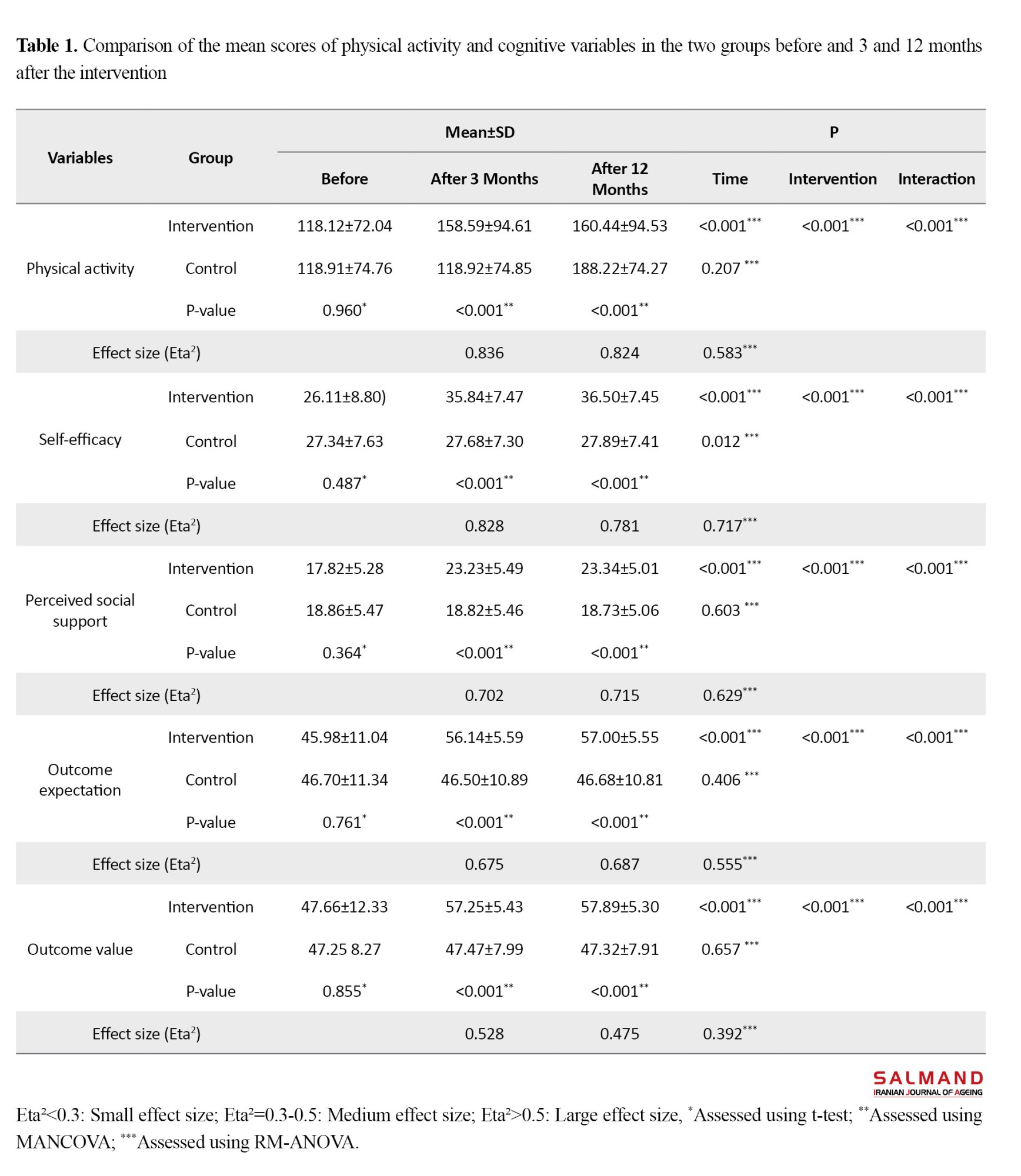
Subsequently, the LSD test was used to identify significant changes in the mean scores of the variables across the three stages (pre-test, post-test, and follow-up) in the intervention group. The results indicated a significant increase in the mean scores of physical activity, self-efficacy, outcome expectation, and outcome value between all three stages (P>0.05). These changes were not significantly observed between the post-test and follow-up stages for perceived social support (P=0.643).
Conclusion
The findings of this study, consistent with the study by Anderson-Bill et al. [30], showed that the use of cognitive strategies was effective in promoting the level of physical activity in the intervention group after the intervention. Also, the mean scores of self-efficacy, perceived social support, outcome expectation, and outcome value in the intervention group showed a significant increase in the 3- and 12-month assessments after the intervention. In this regard, Sniehotta et al. reported that increasing or modifying self-efficacy leads to higher levels of physical activity [37]. In the study by Dehghani et al., increased social support for the elderly, and in the study by Son, higher outcome expectations and outcome value were associated with higher levels of physical activity [39, 21]. Therefore, the social cognitive theory-based educational program had a positive and significant effect on the physical activity of older adults. Considering its low cost and practical nature, the application of this model appears beneficial for the elderly.
Ethical Considerations
Compliance with ethical guidelines
Completion of the questionnaires was voluntary and conducted after receiving an introduction letter from the Health Deputy to coordinate with the management of the health centers. Before completing the questionnaires, the consent form was filled out by the participants, and they were assured that the obtained information would remain confidential with the researcher. All stages of this study were conducted in accordance with the ethical standards of the 2013 Declaration of Helsinki, and were approved by the Ethics Committee of Isfahan University of Medical Sciences (Code: IR.MUI.RESEARCH.REC.1401.288).
Funding
This article was a extracted from the master’s thesis in Health Education and Health Promotion. The present research was conducted with financial support from Isfahan University of Medical Sciences.
Authors' contributions
Conceptualization and research management: Zohreh Fathian Dastjerdi; Methodology, validation, and visualization: Mohammad Javad; Design; Analysis, research, and review, sources, draft writing, and editing and finalization: Zahra Mardani.
Conflicts of interest
The authors declared no conflict of interest.
Acknowledgments
This study was carried out with the cooperation of the health centers affiliated with Isfahan healthcare centers. The authors express their gratitude to the staff and the elderly individuals who participated in this study.
References
Advances in modern medical science have led to a significant daily increase in the elderly population worldwide. Given the prevalence of physical and psychological problems in the elderly, it is necessary to take action. One of the most important factors in maintaining and promoting health during old age is participation in regular physical activity [21]. The importance of modifying physical activity behavior in the elderly using theory-based educational interventions has been proven [21]. The role of social cognitive function in adopting and maintaining a healthy physical activity level in the elderly has been highlighted in recent research [30]. Social cognitive theory provides a framework that is useful for organizing, understanding, and promoting physical activity [30]. Therefore, the present study aimed at determining the effect of an educational intervention based on social cognitive theory on the physical activity of elderly residents in Isfahan city in 2024.
Methods & Materials
The present quasi-experimental study was conducted on 88 elderly residents of Isfahan city in 2024. The samples were selected using a multi-stage cluster sampling method and finally were randomly assigned to two intervention and control groups. According to the inclusion criteria and after obtaining permission, elderly individuals who expressed their willingness to participate in the study were invited in person to complete the informed consent form and the pre-test questionnaire. Then, the study objectives were explained to the intervention group. The educational program was presented in the form of six 45-min sessions to the intervention group (44 individuals). Finally, 3 and 12 months after the intervention, the post-test and follow-up questionnaires were completed by inviting the elderly in the group again in person. To adhere to ethical principles, the educational package was also provided to the control group.
Data were collected using a questionnaire with three sections: The first section included 7 demographic and background information questions. The second section was the 12-item standard Physical Activity Scale for the Elderly (PASE) [23]. The third section was a researcher-developed questionnaire investigating cognitive factors affecting the physical activity of the elderly based on the social cognitive theory, comprising three parts: self-efficacy with 10 questions, social support with 9 questions, and outcome expectation and value in the form of 14 questions.
Mean, standard deviation, and frequency were used to describe the data. Data were analyzed using SPSS version 23 software. The Chi-square test was used to compare the two groups in terms of demographic variables. Additionally, to examine the effect of training in the two groups, independent t-tests, multivariate analysis of covariance (MANCOVA), repeated measures ANOVA, and the LSD post-hoc test were used.
Results
The mean age and gender distribution of participants were as follows: intervention group: 68.38±76.7, control group: 69.70±16.28; female: 44, male: 44. Most participants were married (intervention group: 77.3%, control group: 75%), retired (intervention group: 49.9%, control group: 45.5%), had a medium income (intervention group: 68.2%, control group: 54.5%), and had a university education (intervention group: 43.2%, control group: 40.9%). The independent t-test results showed no significant difference between the mean scores of the two groups in the pre-test (P>0.001). Subsequently, the MANCOVA results revealed that the mean scores for physical activity, self-efficacy, perceived social support, outcome expectation, and outcome value were significantly different between the two groups at the 3-month and 1-year follow-ups (P<0.001). The most significant changes were observed in the mean scores of physical activity at the 3-month (effect size=0.836) and 1-year (effect size=0.824) follow-ups.
Results of repeated measures ANOVA (eta-squared>0.5) indicated a significant difference in the mean scores of pre-test, post-test, and 1-year follow-up in the intervention group over time (P-time<0.001), and this difference increased significantly over time (P-intervention<0.001). The type of group membership also affected the trend of changes; changes in mean scores over time were only observable in the intervention group (P-interaction<0.001) (Table 1).
Subsequently, the LSD test was used to identify significant changes in the mean scores of the variables across the three stages (pre-test, post-test, and follow-up) in the intervention group. The results indicated a significant increase in the mean scores of physical activity, self-efficacy, outcome expectation, and outcome value between all three stages (P>0.05). These changes were not significantly observed between the post-test and follow-up stages for perceived social support (P=0.643).
Conclusion
The findings of this study, consistent with the study by Anderson-Bill et al. [30], showed that the use of cognitive strategies was effective in promoting the level of physical activity in the intervention group after the intervention. Also, the mean scores of self-efficacy, perceived social support, outcome expectation, and outcome value in the intervention group showed a significant increase in the 3- and 12-month assessments after the intervention. In this regard, Sniehotta et al. reported that increasing or modifying self-efficacy leads to higher levels of physical activity [37]. In the study by Dehghani et al., increased social support for the elderly, and in the study by Son, higher outcome expectations and outcome value were associated with higher levels of physical activity [39, 21]. Therefore, the social cognitive theory-based educational program had a positive and significant effect on the physical activity of older adults. Considering its low cost and practical nature, the application of this model appears beneficial for the elderly.
Ethical Considerations
Compliance with ethical guidelines
Completion of the questionnaires was voluntary and conducted after receiving an introduction letter from the Health Deputy to coordinate with the management of the health centers. Before completing the questionnaires, the consent form was filled out by the participants, and they were assured that the obtained information would remain confidential with the researcher. All stages of this study were conducted in accordance with the ethical standards of the 2013 Declaration of Helsinki, and were approved by the Ethics Committee of Isfahan University of Medical Sciences (Code: IR.MUI.RESEARCH.REC.1401.288).
Funding
This article was a extracted from the master’s thesis in Health Education and Health Promotion. The present research was conducted with financial support from Isfahan University of Medical Sciences.
Authors' contributions
Conceptualization and research management: Zohreh Fathian Dastjerdi; Methodology, validation, and visualization: Mohammad Javad; Design; Analysis, research, and review, sources, draft writing, and editing and finalization: Zahra Mardani.
Conflicts of interest
The authors declared no conflict of interest.
Acknowledgments
This study was carried out with the cooperation of the health centers affiliated with Isfahan healthcare centers. The authors express their gratitude to the staff and the elderly individuals who participated in this study.
References
- Anuar R, Imani DR, Norlinta SNO. Pengaruh latihan fisik terhadap kebugaran lansia dalam masa pandemi Covid-19: Narrative review. FISIO MU Physiother Evidences. 2021; 2(2):95-106. [DOI:10.23917/fisiomu.v2i2.13978]
- Chodzko-Zajko W, Schwingel A, Park CH. Successful Aging: The Role of Physical Activity. American Journal of Lifestyle Medicine. 2009; 3(1):20-8. [DOI:10.1177/1559827608325456]
- Gomes IC, Tavares VD de O, Oliveira Neto L, Agrícola PMD, Jenkins M, Smith L, et al. Associations between levels of physical activity and mortality in older adults: A prospective cohort study. Sport Science and Health. 2022; 18(3):1061-70. [DOI:10.1007/s11332-021-00891-z]
- Zhang J, Li B. The association between direct health costs related to non-communicable diseases and physical activity in elderly people. Journal of Prevention. 2024; 1-12. [DOI:10.1007/s10935-024-00808-9] [PMID]
- Rosenstock IM. Historical origins of the health belief model. Health Education Behavior. 1974; 2(4):328-35. [DOI:10.1177/109019817400200403]
- Ajzen I. The theory of planned behavior. Organization Behaviors Human Decision Processing. 1991; 50(2):179-211. [DOI:10.1016/0749-5978(91)90020-T]
- Prochaska JO, DiClemente CC. Transtheoretical therapy: Toward a more integrative model of change. Psychotherapy. 1982; 19(3):276-88. [DOI:10.1037/h0088437]
- Bandura A. Self-efficacy: Toward a unifying theory of behavioral change. Psychology Review. 1977; 84(2):191-215. [DOI:10.1037/h0088437]
- Netz Y, Raviv S. Age Differences in Motivational Orientation Toward Physical Activity: An Application of Social-Cognitive Theory. Journal of Psychology. 2004; 138(1):35-48. [DOI:10.3200/JRLP.138.1.35-48] [PMID]
- Anderson ES, Winett RA, Wojcik JR, Williams DM. Social cognitive mediators of change in a group randomized nutrition and physical activity intervention: Social support, self-efficacy, outcome expectations and self-regulation in the guide-to-health trial. Journal of Health Psychology. 2010; 15(1):21-32. [DOI:10.1177/1359105309342297] [PMID]
- White SM, Wójcicki TR, McAuley E. Social cognitive influences on physical activity behavior in middle-aged and older adults. Journal of Gerontology B Psychology Sciences Social Sciences. 2012; 67(1):18-26. [DOI:10.1093/geronb/gbr064] [PMID]
- Mohammadi Zeidi I, Morshedi H, Shokohi A. Predicting psychological factors affecting regular physical activity in hypertensive patients: Application of health action process approach model. Nursing Open. 2020; 8(1):442-52. [DOI:10.1002/nop2.645] [PMID]
- McAuley E, Blissmer B. Self-efficacy determinants and consequences of physical activity. Exercise and Sport Sciences Reviews. 2000; 28(2):85-8. [PMID]
- Hamrik Z, Sigmundová D, Kalman M, Pavelka J, Sigmund E. Physical activity and sedentary behaviour in Czech adults: Results from the GPAQ study. European Journal of Sport Sciences. 2014; 14(2):193-8. [DOI:10.1080/17461391.2013.822565] [PMID]
- Mudrak J, Stochl J, Slepicka P, Elavsky S. Physical activity, self-efficacy, and quality of life in older Czech adults. European Journal of Ageing. 2016; 13(1):5-14. [DOI:10.1007/s10433-015-0352-1] [PMID]
- Ulijaszek SJ, Koziel S. Nutrition transition and dietary energy availability in Eastern Europe after the collapse of communism. Economics Human Biology. 2007; 5(3):359-69. [DOI:10.1016/j.ehb.2007.08.007] [PMID]
- Suh SR, Lee JH. Effects of a physical activity program based on social cognitive theory for old-old women with knee osteoarthritis. Journal of Korean Academy Psychiatry Mental Health and Nursing. 2021; 30(3):278-92. [DOI:10.12934/jkpmhn.2021.30.3.278]
- Kazemi Karyani A, Karmi Matin B, Soltani S, Rezaei S, Soofi M, Salimi Y, et al. Socioeconomic gradient in physical activity: Findings from the PERSIAN cohort study. BMC Public Health. 2019; 19(1):1-11. [DOI:10.1186/s12889-019-7715-z0] [PMID]
- Eshaghi SR, Shahsanai A, Mellat Ardakani M. Assessment of the physical activity of elderly population of Isfahan, Iran. Journal of Isfahan Medicine School. 2011; 29(147):939-46. [Link]
- Cuschieri S. The CONSORT statement. Saudi Journal of Anaesthesia. 2019; 13(1):27-30. [DOI:10.4103/sja.SJA_559_18] [PMID]
- Dehghani A, Karami M, Rezaeipandari H, Jambarsang S, Rahmati Andani M, Professor A. Effectiveness of physical activity educational program based on self-regulatory theory on the quality of life among the elderly. Tolooebehdasht. 2022; 20(6):58-72. [DOI:10.18502/tbj.v20i6.8958l]
- Nooraie H, Shafie F. Investigating the Relationship between Socio-Economic Poverty and Physical-Functional Deprivation in Isfahan. Geographia Environmental Plan. 2020; 31(3):61-78. [DOI:10.22108/GEP.2020.118816.1194]
- Washburn RA, Smith KW, Jette AM, Janney CA. The physical activity scale for the elderly (PASE): Development and evaluation. Journal of Clinical Epidemiology. 1993; 46(2):153-62. [DOI:10.1016/0895-4356(93)90053-4] [PMID]
- Hatami O, Aghabagheri M, Kahdouei S, Nasiriani K. Psychometric properties of the Persian version of the physical activity scale for the elderly (PASE). BMC Geriatrics. 2021;21(1):1-9. [DOI:10.18502/ehj.v9i1.13107]
- Shirvani H, Sanaeinasab H, Tavakoli R, Saffari M, Khalaji k, Me’mar S. The effect of a social cognitive theory-based educational intervention on the physical activity of female adolescents. Iranian Journal of Health Education and Health Promotion. 2017; 4(4):309-18. [DOI:10.18869/acadpub.ihepsaj.4.4.309]
- Ayre C, Scally AJ. Critical values for lawshe’s content validity ratio. Measurement Evaluation Counseling Development. 2014; 47(1):79-86. [DOI:10.1177/0748175613513808]
- Yaghmale F. Content Validity And Its Estimation. Journal of Medicine and Education. 2003; 3(1):25-7. [DOI:10.22037/jme.v3i1.870]
- Cronbach LJ. Coefficient alpha and the internal structure of tests. Psychometrika. 1951; 16(3):297-334. [DOI:10.1007/BF02310555]
- Ayotte BJ, Margrett JA, Hicks-Patrick J. Physical activity in middle-aged and young-old adults: the roles of self-efficacy, barriers, outcome expectancies, self-regulatory behaviors and social support. Journal of Health and Psychology. 2010; 15(2):173-85. [DOI:10.1177/1359105309342283 ] [PMID]
- Anderson-Bill ES, Winett RA, Wojcik JR, Williams DM. Aging and the social cognitive determinants of physical activity behavior and behavior change: Evidence from the guide to health trial. Journal of Aging Research. 2011; 2011:505928. [DOI:10.4061/2011/505928] [PMID]
- Kinmonth AL, Wareham NJ, Hardeman W, Sutton S, Prevost AT, Fanshawe T, et al. Efficacy of a theory-based behavioural intervention to increase physical activity in an at-risk group in primary care (ProActive UK): A randomised trial. Lancet. 2008; 371(9606):41-8. [DOI:10.1016/S0140-6736(08)60070-7] [PMID]
- Hillsdon M, Foster C, Thorogood M, Kaur A, Wedatilake T. Interventions for promoting physical activity. Cochrane Database Systematic Review. 2005; 2005(1):CD003180. [DOI:10.1002/14651858.CD003180.pub2.] [PMID]
- Van Der Bij AK, Laurant MGH, Wensing M. Effectiveness of physical activity interventions for older adults-A review. Americal Journal of Preventive Medicine. 2002. [DOI:10.1016/S0749-3797(01)00413-5] [PMID]
- Mcauley E, Szabo A, Gothe N, Olson EA. Self-efficacy: Implications for physical activity, function, and functional limitations in older adults. American Journal of Lifestyle Medicine. 2011;5(4):361-9. [DOI:10.1177/1559827610392704] [PMID]
- Bandura A. Health promotion from the perspective of social cognitive theory. Psychology and Health. 1998; 13(4):623-49. [DOI:10.1080/08870449808407422]
- Rejeski WJ, Ettinger WH, Martin K, Morgan T. Treating disability in knee osteoarthritis with exercise therapy: A central role for self-efficacy and pain. Arthritis Care and Research. 1998; 11(2):94-101. [DOI:10.1002/art.1790110205] [PMID]
- Sniehotta FF, Scholz U, Schwarzer R, Fuhrmann B, Kiwus U, Völler H. Long-term effects of two psychological interventions on physical exercise and self-regulation following coronary rehabilitation. International Journal of Behaviors and Medine. 2005; 12(4):244-55. [DOI:10.1207/s15327558ijbm1204_5] [PMID]
- Howell BM. Interactions between diet, physical activity, and the sociocultural environment for older adult health in the urban subarctic. Journal of Community and Health. 2020; 45(2):252-63. [DOI:10.1007/s10900-019-00737-3] [PMID]
- Son JS, Kerstetter DL, Mowen AJ, Payne LL. Global self-regulation and outcome expectations: Influences on constraint self-regulation and physical activity. Journal of Aging Physics Act. 2009; 17(3):307-26. [DOI:10.1123/japa.17.3.307] [PMID]
- Wójcicki TR, White SM, McAuley E. Assessing outcome expectations in older adults: The multidimensional outcome expectations for exercise scale. Journals Gerontology Series B Psychology Science Social and Science. 2009; 64(1):33-40. [DOI:10.1093/geronb/gbn032] [PMID]
- Williams DM, Anderson ES, Winett RA. A review of the outcome expectancy construct in physical activity research. Annals Behavior and Medicine. 2005; 29(1):70-9. [DOI:10.1207/s15324796abm2901_10] [PMID]
- McAuley E, Jerome GJ, Elavsky S, Marquez DX, Ramsey SN. Predicting long-term maintenance of physical activity in older adults. Prevention and Medicine. 2003; 37(2):110-8. [DOI:10.1016/S0091-7435(03)00089-6] [PMID]
- Bandura A. Health promotion by social cognitive means. vol. 31, health education and behavior. New York: Sage Publications; 2004. [DOI:10.1177/1090198104263660] [PMID]
Type of Study: Applicable |
Subject:
gerontology
Received: 2024/11/02 | Accepted: 2025/03/03 | Published: 2026/04/01
Received: 2024/11/02 | Accepted: 2025/03/03 | Published: 2026/04/01
Send email to the article author
| Rights and permissions | |
 |
This work is licensed under a Creative Commons Attribution-NonCommercial 4.0 International License. |

Copyright © The Author(s);
This is an open access article distributed under the terms of the Creative Commons Attribution-NonCommercial 4.0 (CC-By-NC 4.0), which permits use, distribution, and reproduction in any medium, provided the original work is properly cited and is not used for commercial purposes.
Contact Information