Volume 21, Issue 1 (Spring 2026)
Salmand: Iranian Journal of Ageing 2026, 21(1): 126-139 |
Back to browse issues page




Download citation:
BibTeX | RIS | EndNote | Medlars | ProCite | Reference Manager | RefWorks
Send citation to:


BibTeX | RIS | EndNote | Medlars | ProCite | Reference Manager | RefWorks
Send citation to:
Farahbakhsh M, Fakhari A, Aghajani E, khameneh A, Harzand-Jadidi S. Assessing the Prescription Pattern of Driving-impairing Psychotropic Medications for Older Adults in Tabriz in 2022. Salmand: Iranian Journal of Ageing 2026; 21 (1) :126-139
URL: http://salmandj.uswr.ac.ir/article-1-3006-en.html
URL: http://salmandj.uswr.ac.ir/article-1-3006-en.html


1- Tabriz Health Services Management Research Center, Tabriz University of Medical Sciences, Tabriz, Iran.
2- Research Center of Psychiatry and Behavioral Sciences, Tabriz University of Medical Sciences, Tabriz, Iran.
3- Student Research Committee, Tabriz University of Medical Sciences, Tabriz, Iran.
4- Tabriz Health Services Management Research Center, Tabriz University of Medical Sciences, Tabriz, Iran. ,hrzndsepideh@gmail.com
2- Research Center of Psychiatry and Behavioral Sciences, Tabriz University of Medical Sciences, Tabriz, Iran.
3- Student Research Committee, Tabriz University of Medical Sciences, Tabriz, Iran.
4- Tabriz Health Services Management Research Center, Tabriz University of Medical Sciences, Tabriz, Iran. ,
Full-Text [PDF 6691 kb]
(879 Downloads)
| Abstract (HTML) (3316 Views)
Full-Text: (417 Views)
Introduction
With the growing elderly population in Iran and the increasing prevalence of chronic diseases and psychiatric disorders in this group, the use of psychiatric medications as a primary treatment approach has risen significantly [4, 6]. However, many of these medications have notable side effects on individuals’ cognitive, sensory, and motor abilities, potentially compromising driving safety. The heightened risk of traffic accidents due to the use of central nervous system-affecting drugs underscores the need for thorough investigation [16]. Since no study has yet been conducted in Iran on the prevalence of prescribing driving‑impairing medications among the elderly—who are considered a vulnerable group in traffic incidents—this study was designed to examine the prescription patterns of psychiatric medications affecting driving in the elderly population of Tabriz in 2022.
Methods & Materials
The present cross-sectional descriptive-analytical study was conducted in 2022 in Tabriz, East Azerbaijan Province. It examined prescriptions for psychiatric medications issued to the elderly from April 2021 to April 2022. Data were obtained from the Iranian Social Security Organization (SSO), a major non-governmental insurer covering workers, employees, and self-employed individuals. The study included all prescriptions containing at least one psychotropic drug prescribed by physicians in Tabriz. Exclusion criteria were prescriptions without psychotropic medications or incomplete data. A total of 276,612 prescriptions were reviewed, and after filtering out non-elderly cases and incomplete records, 55,285 prescriptions were analyzed.
Psychiatric medications were categorized into six groups based on Iranian pharmacopoeia and psychiatric references (Kaplan, Sadock, and Oxford): Antidepressants, antipsychotics, anxiolytics, mood stabilizers, stimulants, and unclassified drugs. The impact of these medications on driving was assessed using a classification system developed by Harzand-Jadidi et al. adapted from the DRUID system [24]. Medications were classified into four levels based on their adverse effects on driving: Level 0 (no adverse effects), level 1 (mild effects), level 2 (moderate effects), and level 3 (severe effects).
Three groups of variables were analyzed: 1) demographic variables (gender and age, categorized as young-old, middle-old, and oldest-old), 2) drug-related variables (drug name, category, and driving impact level), and 3) physician specialty, classified into seven groups (cardiologists, general practitioners, neurologists, neurosurgeons, internists, psychiatrists, and surgeons).
The dependent variable included drug-related factors, while independent variables were related to patient demographics and physician specialty. Data were analyzed using Stata software, version 17. Qualitative variables were described using frequency (percentage), and quantitative variables were presented as Mean±SD. The chi-square test was used to assess associations between independent and dependent variables.
Results
This study analyzed the prescription pattern of psychiatric drugs affecting driving in elderly individuals in Tabriz, Iran, during 2022. A total of 55,285 prescriptions were reviewed, with 64.38% prescribed to women and 35.62% to men, with an average age of 64.34 years. The study categorized the prescribed psychiatric drugs into antidepressants (35.26%), anti-anxiety drugs (22.69%), antipsychotics (12.25%), mood stabilizers (3.85%), stimulants (0.16%), and other psychiatric drugs (25.79%).
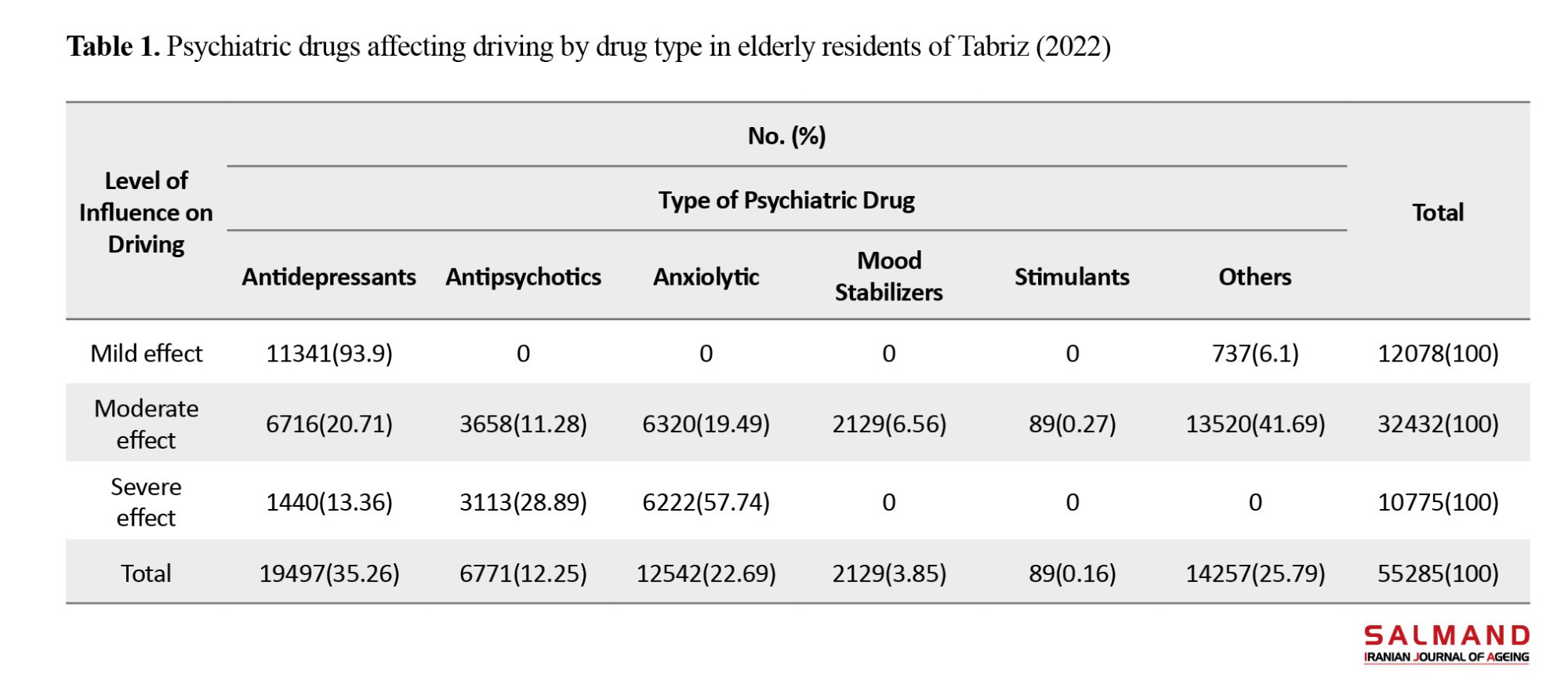
Over half of the prescribed drugs (58.66%) had a moderate adverse effect on driving, 21.85% had a mild adverse effect, and 19.49% had a severe adverse effect. Among drugs with mild effects, antidepressants were the most commonly prescribed (93.9%). For moderate effects, antidepressants (20.71%) and anti-anxiety medications (19.49%) were most common. For drugs with severe effects, anti-anxiety medications (57.74%) and antipsychotics (28.89%) were most frequent (Table 1).
The top five most prescribed drugs were gabapentin (13.65%), nortriptyline (7.09%), alprazolam (7.05%), clonazepam (6.98%), and sertraline (6.12%). After these, fluoxetine (5.36%), trifluoperazine (5.09%), chlordiazepoxide (4.45%), escitalopram (4.38%), and citalopram (3.79%) were also frequently prescribed.
Analysis of gender distribution showed that approximately 60% of prescriptions for men involved drugs with moderate effects, and 18% involved drugs with severe effects. For women, 57% of prescriptions had moderate effects, and 20% had severe effects. A statistically significant difference was observed between drug effects and gender (P<0.001).
In terms of age, younger elderly individuals (57%) received more drugs with moderate effects and 22% with mild effects, while older elderly individuals (64%) received more drugs with moderate effects and 14% with mild effects. There was a statistically significant difference between drug effects and age (P<0.001).
Among various specialties, cardiologists prescribed the highest percentage of drugs with severe adverse effects (31.15%), while general practitioners prescribed the highest percentage of drugs with mild effects (32.15%). Neurologists, general surgeons, psychiatrists, and internists predominantly prescribed drugs with moderate adverse effects.
Conclusion
The present study, which analyzed the prescription patterns of psychiatric medications affecting driving in the elderly population of Tabriz, revealed that a significant percentage of prescribed medications have adverse effects on driving. Over half of these medications had moderate adverse effects, and nearly one-fifth had severe effects on driving performance. Antidepressants and anxiolytics were the most commonly prescribed drugs with mild to moderate adverse effects, while anxiolytics and antipsychotics were most frequently associated with severe effects. The five most commonly prescribed medications were gabapentin, nortriptyline, alprazolam, clonazepam, and sertraline. The results also showed significant differences in prescribing patterns based on the gender and age of the elderly patients, as well as the specialties of the prescribing physicians.
Ethical Considerations
Compliance with ethical guidelines
This study was approved by the Ethics Committee of Tabriz University of Medical Sciences (Code: IR.TBZMED.REC.1402.284). No disclosure that could compromise the intellectual rights of the participants occurred in this study. All aspects of the Helsinki Declaration were considered during the implementation, data collection, interpretation, and publication of findings. In this study, patient data were analyzed solely for research purposes, without including any personal identifiers, such as name and surname.
Funding
This research did not receive any grant from funding agencies in the public, commercial, or non-profit sectors.
Authors' contributions
Conceptualization: Mostafa Farahbakhsh, Ali Fakhari; Investigation: Amin Khameneh, Ehsan Aghajani; Data collection: Ehsan Aghajani, Amin Khameneh; Data analysis: Sepideh Harzand-Jadidi; Manuscript writing: Sepideh Harzand-Jadidi. All authors read and approved the final draft of the manuscript.
Conflicts of interest
The authors declared no conflicts of interest.
Acknowledgments
The authors would like to express their gratitude for the support provided by the Social Security Organization.
References
With the growing elderly population in Iran and the increasing prevalence of chronic diseases and psychiatric disorders in this group, the use of psychiatric medications as a primary treatment approach has risen significantly [4, 6]. However, many of these medications have notable side effects on individuals’ cognitive, sensory, and motor abilities, potentially compromising driving safety. The heightened risk of traffic accidents due to the use of central nervous system-affecting drugs underscores the need for thorough investigation [16]. Since no study has yet been conducted in Iran on the prevalence of prescribing driving‑impairing medications among the elderly—who are considered a vulnerable group in traffic incidents—this study was designed to examine the prescription patterns of psychiatric medications affecting driving in the elderly population of Tabriz in 2022.
Methods & Materials
The present cross-sectional descriptive-analytical study was conducted in 2022 in Tabriz, East Azerbaijan Province. It examined prescriptions for psychiatric medications issued to the elderly from April 2021 to April 2022. Data were obtained from the Iranian Social Security Organization (SSO), a major non-governmental insurer covering workers, employees, and self-employed individuals. The study included all prescriptions containing at least one psychotropic drug prescribed by physicians in Tabriz. Exclusion criteria were prescriptions without psychotropic medications or incomplete data. A total of 276,612 prescriptions were reviewed, and after filtering out non-elderly cases and incomplete records, 55,285 prescriptions were analyzed.
Psychiatric medications were categorized into six groups based on Iranian pharmacopoeia and psychiatric references (Kaplan, Sadock, and Oxford): Antidepressants, antipsychotics, anxiolytics, mood stabilizers, stimulants, and unclassified drugs. The impact of these medications on driving was assessed using a classification system developed by Harzand-Jadidi et al. adapted from the DRUID system [24]. Medications were classified into four levels based on their adverse effects on driving: Level 0 (no adverse effects), level 1 (mild effects), level 2 (moderate effects), and level 3 (severe effects).
Three groups of variables were analyzed: 1) demographic variables (gender and age, categorized as young-old, middle-old, and oldest-old), 2) drug-related variables (drug name, category, and driving impact level), and 3) physician specialty, classified into seven groups (cardiologists, general practitioners, neurologists, neurosurgeons, internists, psychiatrists, and surgeons).
The dependent variable included drug-related factors, while independent variables were related to patient demographics and physician specialty. Data were analyzed using Stata software, version 17. Qualitative variables were described using frequency (percentage), and quantitative variables were presented as Mean±SD. The chi-square test was used to assess associations between independent and dependent variables.
Results
This study analyzed the prescription pattern of psychiatric drugs affecting driving in elderly individuals in Tabriz, Iran, during 2022. A total of 55,285 prescriptions were reviewed, with 64.38% prescribed to women and 35.62% to men, with an average age of 64.34 years. The study categorized the prescribed psychiatric drugs into antidepressants (35.26%), anti-anxiety drugs (22.69%), antipsychotics (12.25%), mood stabilizers (3.85%), stimulants (0.16%), and other psychiatric drugs (25.79%).
Over half of the prescribed drugs (58.66%) had a moderate adverse effect on driving, 21.85% had a mild adverse effect, and 19.49% had a severe adverse effect. Among drugs with mild effects, antidepressants were the most commonly prescribed (93.9%). For moderate effects, antidepressants (20.71%) and anti-anxiety medications (19.49%) were most common. For drugs with severe effects, anti-anxiety medications (57.74%) and antipsychotics (28.89%) were most frequent (Table 1).
The top five most prescribed drugs were gabapentin (13.65%), nortriptyline (7.09%), alprazolam (7.05%), clonazepam (6.98%), and sertraline (6.12%). After these, fluoxetine (5.36%), trifluoperazine (5.09%), chlordiazepoxide (4.45%), escitalopram (4.38%), and citalopram (3.79%) were also frequently prescribed.
Analysis of gender distribution showed that approximately 60% of prescriptions for men involved drugs with moderate effects, and 18% involved drugs with severe effects. For women, 57% of prescriptions had moderate effects, and 20% had severe effects. A statistically significant difference was observed between drug effects and gender (P<0.001).
In terms of age, younger elderly individuals (57%) received more drugs with moderate effects and 22% with mild effects, while older elderly individuals (64%) received more drugs with moderate effects and 14% with mild effects. There was a statistically significant difference between drug effects and age (P<0.001).
Among various specialties, cardiologists prescribed the highest percentage of drugs with severe adverse effects (31.15%), while general practitioners prescribed the highest percentage of drugs with mild effects (32.15%). Neurologists, general surgeons, psychiatrists, and internists predominantly prescribed drugs with moderate adverse effects.
Conclusion
The present study, which analyzed the prescription patterns of psychiatric medications affecting driving in the elderly population of Tabriz, revealed that a significant percentage of prescribed medications have adverse effects on driving. Over half of these medications had moderate adverse effects, and nearly one-fifth had severe effects on driving performance. Antidepressants and anxiolytics were the most commonly prescribed drugs with mild to moderate adverse effects, while anxiolytics and antipsychotics were most frequently associated with severe effects. The five most commonly prescribed medications were gabapentin, nortriptyline, alprazolam, clonazepam, and sertraline. The results also showed significant differences in prescribing patterns based on the gender and age of the elderly patients, as well as the specialties of the prescribing physicians.
Ethical Considerations
Compliance with ethical guidelines
This study was approved by the Ethics Committee of Tabriz University of Medical Sciences (Code: IR.TBZMED.REC.1402.284). No disclosure that could compromise the intellectual rights of the participants occurred in this study. All aspects of the Helsinki Declaration were considered during the implementation, data collection, interpretation, and publication of findings. In this study, patient data were analyzed solely for research purposes, without including any personal identifiers, such as name and surname.
Funding
This research did not receive any grant from funding agencies in the public, commercial, or non-profit sectors.
Authors' contributions
Conceptualization: Mostafa Farahbakhsh, Ali Fakhari; Investigation: Amin Khameneh, Ehsan Aghajani; Data collection: Ehsan Aghajani, Amin Khameneh; Data analysis: Sepideh Harzand-Jadidi; Manuscript writing: Sepideh Harzand-Jadidi. All authors read and approved the final draft of the manuscript.
Conflicts of interest
The authors declared no conflicts of interest.
Acknowledgments
The authors would like to express their gratitude for the support provided by the Social Security Organization.
References
- Yoshino N, Kim CJ, Sirivunnabood P. Aging population and its impacts on fiscal sustainability. Aging Societies; 2019. [Link]
- Gu D, Andreev K, Dupre ME. Major trends in population growth around the world. China CDC Weekly. 2021; 3(28):604. [DOI:10.46234/ccdcw2021.160] [PMID]
- Mehri N, Messkoub M, Kunkel S. Trends, determinants and the implications of population aging in Iran. Ageing International. 2020; 45(4):327-43. [DOI:10.1007/s12126-020-09364-z]
- Jaul E, Barron J. Age-related diseases and clinical and public health implications for the 85 years old and over population. Frontiers in Public Health. 2017; 5:335. [DOI:10.3389/fpubh.2017.00335] [PMID]
- Hosseini SR, Moslehi A, Hamidian SM, Taghian SA. The relation between chronic diseases and disability in elderly of Amirkola. Salmand. 2014; 9(2):80-7. [Link]
- Mohammadi MR, Mesgar-Pour B, Daliri-Hampa A, Sahimi-Izadian E, Adhami HR. [Consuming and prescribing psychotherapeutic medications in elderly (Persian)]. Archives of Rehabilitation. 2003; 4(2):59-66. [Link]
- Haider SI, Johnell K, Thorslund M, Fastbom J. Analysis of the association between polypharmacy and socioeconomic position among elderly aged≥77 years in Sweden. Clinical Therapeutics. 2008; 30(2):419-27. [DOI:10.1016/j.clinthera.2008.02.010] [PMID]
- Ahmadi B, Alimohamadian M, Mahmoodi M. [Polypharmacy among older adults in Tehran (Persian)]. Tehran University of Medical Sciences Journal. 2006; 64(9):65-71. [Link]
- Dianati M, Shojaegharebag GA, Mesdaghinia A, Taghadosi M, Shenasa F, Taiebi A, et al. [Polypharmacy and its related factors among the elderly population in Kashan, Iran during 2011-2012 (Persian)]. Feyz Medical Sciences Journal. 2015; 18(6):578-84. [Link]
- Saboor M. [Elderly's Medical Therapy Status (Persian)]. Salmand: Iranian Journal of Ageing. 2007; 2(1):216-22. [Link]
- Chandradasa M, Champika L, Amarasuriya M, Wijelakshman P, Bandara S, Ranaweera T, et al. A comparative study of subjective experiences related to driving among outpatient psychotropic users and controls in Ragama, Sri Lanka. 2016. [DOI:10.4038/sljpsyc.v7i1.8100]
- Yaqub M, Ismail S, Babiker S, Rao TS. Psychiatrists’ responsibilities with regards to patients’ fitness to drive. Indian Journal of Psychiatry. 2016; 58(3):287. [DOI:10.4103/0019-5545.191994] [PMID]
- Ravera S, Monteiro SP, de Gier JJ, Van der Linden T, Gómez-Talegón T, Álvarez FJ, et al. A European approach to categorizing medicines for fitness to drive: Outcomes of the DRUID project. British Journal of Clinical Pharmacology. 2012; 74(6):920-31. [DOI:10.1111/j.1365-2125.2012.04279.x] [PMID]
- Monteiro SP. Driving-impairing medicines and traffic safety. [Thesis fully internal (DIV)]. Groningen: University of Groningen; 2014. [Link]
- Brubacher JR, Chan H, Erdelyi S, Asbridge M, Mann RE, Purssell RA, et al. Police documentation of drug use in injured drivers: Implications for monitoring and preventing drug-impaired driving. Accident Analysis & Prevention. 2018; 118:200-6. [DOI:10.1016/j.aap.2018.02.018] [PMID]
- Huizinga CR, Zuiker RG, de Kam ML, Ziagkos D, Kuipers J, Mejia Y, et al. Evaluation of simulated driving in comparison to laboratory-based tests to assess the pharmacodynamics of alprazolam and alcohol. Journal of Psychopharmacology. 2019; 33(7):791-800. [DOI:10.1177/0269881119836198] [PMID]
- Verster JC, Pandi-Perumal S, Ramaekers JG, de Gier JJ. Drugs, driving and traffic safety. Berlin: Springer Science & Business Media; 2009. [DOI:10.1007/978-3-7643-9923-8]
- Ivers T, White ND. Potentially driver-impairing medications: risks and strategies for injury prevention. American Journal of Lifestyle Medicine. 2016; 10(1):17-20. [DOI:10.1177/1559827615609050] [PMID]
- Alonso F, Esteban C, Montoro L, Tortosa F. Psychotropic drugs and driving: Prevalence and types. Annals of General Psychiatry. 2014; 13(1):14. [DOI:10.1186/1744-859X-13-14] [PMID]
- Jung SY, Hwang B, Yang BR, Kim YJ, Lee J. Risk of motor vehicle collisions associated with medical conditions and medications: rationale and study protocol. Injury Prevention. 2017; 23(5):356-. [DOI:10.1136/injuryprev-2016-042177] [PMID]
- Buckley SE, Robinson K, Stapleton T. Driving and depression: Health professional’s perspectives in Ireland. Journal of Transport & Health. 2017; 7:235-46. [DOI:10.1016/j.jth.2017.09.003]
- Bezemer KD, Smink BE, van Maanen R, Verschraagen M, de Gier JJ. Prevalence of medicinal drugs in suspected impaired drivers and a comparison with the use in the general Dutch population. Forensic Science International. 2014; 241:203-11. [DOI:10.1016/j.forsciint.2014.06.004] [PMID]
- Wolff K. Different approaches to setting limits for drugs and alcohol use when driving. In: Wolff K, White J, Karch S, editors. The SAGE handbook of drug and alcohol studies: Biological approaches. Los Angeles: SAGE Publications; 2016. [DOI:10.4135/9781473922143.n27] [PMID]
- Harzand Jadidi S, Farahbakhsh M, Sadeghi-Bazargani H, Pourasghar F. Adaptation of a European categorization system for driving-impairing medicines in Iran. Traffic Injury Prevention. 2023; 24(5):387-92. [DOI:10.1080/15389588.2023.2203789] [PMID]
- Harzand-Jadidi S, Pourasghar F, Sadeghi-Bazargani H, Farahbakhsh M. Categorization and labeling systems concerning driving-impairing medicines: A scoping review. Traffic Injury Prevention. 2023; 24(4):287-92. [DOI:10.1080/15389588.2022.2150393] [PMID]
- Gutiérrez-Abejón E, Herrera-Gómez F, Criado-Espegel P, Álvarez FJ. Trends in antidepressants use in Spain between 2015 and 2018: analyses from a population-based registry study with reference to driving. Pharmaceuticals. 2020; 13(4):61. [DOI:10.3390/ph13040061] [PMID]
- Gutierrez-Abejón E, Herrera-Gómez F, Criado-Espegel P, Alvarez FJ. Use of driving-impairing medicines by a Spanish population: A population-based registry study. BMJ Open. 2017; 7(11):e017618. [DOI:10.1136/bmjopen-2017-017618] [PMID]
- Zitoun S, Baudouin E, Corruble E, Vidal J-S, Becquemont L, Duron E. Use of potentially driver-impairing drugs among older drivers. BMC Geriatrics. 2022; 22:1-10. [DOI:10.1186/s12877-021-02726-5] [PMID]
- Herrera-Gómez F, Gutierrez-Abejón E, Criado-Espegel P, Álvarez FJ. The problem of benzodiazepine use and its extent in the driver population: A population-based registry study. Frontiers in Pharmacology. 2018; 9:408. [DOI:10.3389/fphar.2018.00408] [PMID]
- Gutiérrez-Abejón E, Criado-Espegel P, Pedrosa-Naudín MA, Fernández-Lázaro D, Herrera-Gómez F, Alvarez FJ. Trends in the use of driving-impairing medicines according to the DRUID category: A population-based registry study with reference to driving in a region of Spain between 2015 and 2019. Pharmaceuticals. 2023; 16(4):508. [DOI:10.3390/ph16040508] [PMID]
- LeRoy A, Morse M, Administration UDoTNHTS. Exploratory study of the relationship between multiple medications and vehicle crashes: Analysis of databases. Washington, DC: DTNH22-02-C-05075; 2008. [DOI:10.1037/e495082008-001]
- Stone BT, Correa KA, Brown TL, Spurgin AL, Stikic M, Johnson RR, et al. Behavioral and neurophysiological signatures of benzodiazepine-related driving impairments. Frontiers in Psychology. 2015; 6:1799. [DOI:10.3389/fpsyg.2015.01799] [PMID]
- Jadidi SH, Ghorbani M, Farahbakhsh M. Evaluating knowledge and attitude of physicians regarding medicinal drugs and driving: a descriptive-analytical cross-sectional study. Medical Journal of Tabriz University of Medical Sciences. 2023; 45(3):254-65. [DOI:10.34172/mj.2023.030]
- Pourasghar F, Farahbakhsh M, Sadeghi-Bazargani H, Harzand-Jadidi S. Design, development, and evaluation of a multi-lingual web-based database for informing people regarding driving-impairing medicines. Traffic Injury Prevention. 2024; 1-9. [DOI:10.1080/15389588.2024.2386424] [PMID]
- Del Río M. Strategy for the implementation of a new categorisation system in Spain. Proceedings International Council on Alcohol, Drugs and Traffic Safety Conference. 2002; 547-52. [Link]
- Redelmeier DA, Tien HC. Medical interventions to reduce motor vehicle collisions. CMAJ. 2014; 186(2):118-24. [DOI:10.1503/cmaj.122001] [PMID]
Type of Study: Research |
Subject:
gerontology
Received: 2025/01/21 | Accepted: 2025/03/03 | Published: 2026/04/01
Received: 2025/01/21 | Accepted: 2025/03/03 | Published: 2026/04/01
Send email to the article author
| Rights and permissions | |
 |
This work is licensed under a Creative Commons Attribution-NonCommercial 4.0 International License. |

Copyright © The Author(s);
This is an open access article distributed under the terms of the Creative Commons Attribution-NonCommercial 4.0 (CC-By-NC 4.0), which permits use, distribution, and reproduction in any medium, provided the original work is properly cited and is not used for commercial purposes.
Contact Information