Volume 21, Issue 2 (Summer 2026)
Salmand: Iranian Journal of Ageing 2026, 21(2): 254-267 |
Back to browse issues page




Download citation:
BibTeX | RIS | EndNote | Medlars | ProCite | Reference Manager | RefWorks
Send citation to:


BibTeX | RIS | EndNote | Medlars | ProCite | Reference Manager | RefWorks
Send citation to:
Kooraki M, Hashemi S E. Effects of Neurobic Exercises on Cognitive Function, Quality of Life, Anxiety, and Depression in Older Adults: A Randomized Clinical Trial. Salmand: Iranian Journal of Ageing 2026; 21 (2) :254-267
URL: http://salmandj.uswr.ac.ir/article-1-3087-en.html
URL: http://salmandj.uswr.ac.ir/article-1-3087-en.html


1- PhD in Psychology, Sirjan School of Medical Sciences, Sirjan, Iran.
2- Department of Psychology, Faculty of Educational Sciences and Psychology, Shahid Chamran University of Ahvaz, Ahvaz, Iran. ,esmaeil@scu.ac.ir
2- Department of Psychology, Faculty of Educational Sciences and Psychology, Shahid Chamran University of Ahvaz, Ahvaz, Iran. ,
Keywords: Neurobic exercises, Elderly, Psychological status, Quality of life (QoL), Anxiety, Depression
Full-Text [PDF 6638 kb]
(533 Downloads)
| Abstract (HTML) (2154 Views)
Full-Text: (28 Views)
Introduction
Aging (over the age of 60 years), as one of the most important and complex periods of human life, is associated with physiological, psychological, and functional changes. It is expected that Iran’s aged population will increase to approximately 28.7 million people (31.2% of the total population) by 2050. The prevalence of cognitive problems in the elderly is about 5% in 60-year-olds and more than 40% in people over 80 years old. Common disorders in older adults, such as anxiety and depression, can directly or indirectly affect their physical health and quality of life (QoL).
Neurobic exercises can build new neural pathways, strengthening interregional connections in the brain by simultaneously engaging the five senses (sight, smell, hearing, taste, and touch) and emotional structures. They can improve short- and long-term memory, enhance attention and concentration, reduce depression and anxiety, and improve the quality of life. This study aimed to evaluate the effectiveness of a neurobic exercise program on improving cognitive functions, QoL, anxiety, and depression in older adults.
Materials & Methods
This is a randomized controlled clinical trial study with a pretest/posttest/three-month follow-up design. The study population included all older men and women aged 60–74 years who were referred to health centers in Sirjan, Iran, to receive psychological services during 2023-2024. Among these individuals, 40 were selected through convenience sampling and randomly assigned to the intervention (n=20) and control (n=20) groups using the lottery method. The inclusion criteria were informed consent to participate in the study, age 60–74 years, at least a high school education, having symptoms of anxiety and depression, not receiving medication or psychotherapy, diagnosis of mild cognitive impairment (score 21–26 on the Mini-Mental State Examination [MMSE]), low QoL (based on the LEIPAD questionnaire score), and absence of other neurological disorders (Alzheimer’s disease, Parkinson’s disease, and multiple sclerosis) according to a physician. The exclusion criteria were absence from more than two intervention sessions, lack of cooperation, and unwillingness to continue participation. The MMSE test was used to assess the cognitive status of the elderly. The QoL was assessed with the LEIPAD questionnaire. The 10-item Geriatric Anxiety Scale (GAS-10) and the 15-item Geriatric Depression Scale (GDS) were used to assess anxiety and depression in the elderly, respectively. The exercise program was based on the neurobic exercise protocol used by Sangwachang et al [22]. This program was implemented in six 60-minute sessions (twice per week) by the therapist and an assistant. The program included the stimulation of five senses of sight, smell, hearing, taste, and touch through a series of activities, as well as multisensory integration for application in daily life. Data were analyzed in SPSS software, version 22 using univariate and multivariate analyses of covariance (ANCOVA). To ensure that the research data met the underlying assumptions of ANCOVA, the normality of the data distribution, homogeneity of variances, and homogeneity of regression slopes were assessed.
Results
Participants were aged 60–71 years, with a mean age of 62.94±2.04 years in the experimental group and 64.16±3.12 years in the control group. In terms of gender, 19 (51.4%) were female and 17 (45.9%) were male. Regarding the educational level, 15 (40.5%) had a bachelor’s degree, 16 (43.2%) had a high school diploma, and 5 (13.5%) had a postgraduate degree.
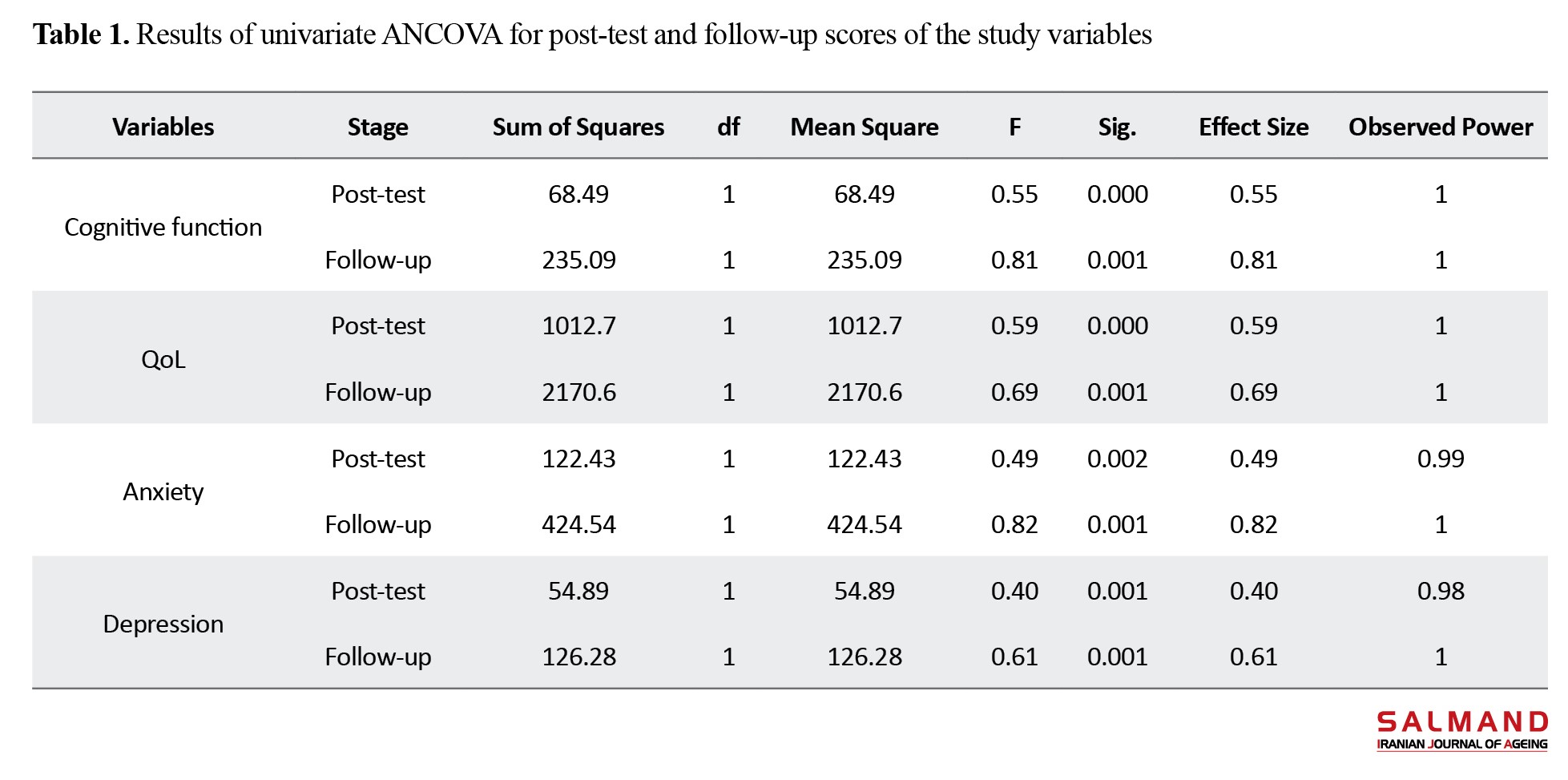
Multivariate ANCOVA was used to compare the two groups based on the post-test scores of cognitive function, quality of life, anxiety, and depression, after controlling for the pre-test scores. Neurobic exercise had a significant effect on the dependent variables (cognitive status, QoL, anxiety, and depression). The effect size was 0.96 and F=23.78 (P<0.001). To clarify how the intervention (neurobic exercises) affected each dependent variable, univariate ANCOVA was used. In the post-test and follow-up stages, there was a significant difference between the two groups in terms of dependent variables (cognitive status, quality of life, anxiety, and depression) (Table 1).
Conclusion
The results of this study showed that the neurobic exercise program improved cognitive function and QoL and reduced anxiety and depression in the elderly. This approach is thus recommended for the treatment of psychological problems in the elderly. It is recommended that neurobic training courses and workshops be held for psychologists so that they can use this approach to reduce psychological problems, especially cognitive problems in the elderly.
Ethical Considerations
Compliance with ethical guidelines
This study was approved by the Ethics Committee of Shahid Chamran University of Ahvaz (Code: IR.SCU.REC.1403.047) and was registered by the Iranian Registry of Clinical Trials (ID: IRCT20230228057557N2). Before the study, participants were informed about the research process and signed a consent form. Their information from remained confidential and they were free to withdraw from the study at any time.
Funding
This research has not received any financial support from government, private, or non-profit organizations.
Authors' contributions
Design, data collection, data analysis, project administration, editing & review: Maryam Kooraki; implementation of the intervention: Maryam Kooraki and Seyed Esmaeil Hashemi; supervision, data collection, and data analysis: Seyed Esmaeil Hashemi.
Conflicts of interest
The authors declare no conflicts of interest.
Acknowledgments
The authors sincerely thank all seniors who participated in the study as well as the staff of the comprehensive health service centers who collaborated with the research team in collecting samples.
Aging (over the age of 60 years), as one of the most important and complex periods of human life, is associated with physiological, psychological, and functional changes. It is expected that Iran’s aged population will increase to approximately 28.7 million people (31.2% of the total population) by 2050. The prevalence of cognitive problems in the elderly is about 5% in 60-year-olds and more than 40% in people over 80 years old. Common disorders in older adults, such as anxiety and depression, can directly or indirectly affect their physical health and quality of life (QoL).
Neurobic exercises can build new neural pathways, strengthening interregional connections in the brain by simultaneously engaging the five senses (sight, smell, hearing, taste, and touch) and emotional structures. They can improve short- and long-term memory, enhance attention and concentration, reduce depression and anxiety, and improve the quality of life. This study aimed to evaluate the effectiveness of a neurobic exercise program on improving cognitive functions, QoL, anxiety, and depression in older adults.
Materials & Methods
This is a randomized controlled clinical trial study with a pretest/posttest/three-month follow-up design. The study population included all older men and women aged 60–74 years who were referred to health centers in Sirjan, Iran, to receive psychological services during 2023-2024. Among these individuals, 40 were selected through convenience sampling and randomly assigned to the intervention (n=20) and control (n=20) groups using the lottery method. The inclusion criteria were informed consent to participate in the study, age 60–74 years, at least a high school education, having symptoms of anxiety and depression, not receiving medication or psychotherapy, diagnosis of mild cognitive impairment (score 21–26 on the Mini-Mental State Examination [MMSE]), low QoL (based on the LEIPAD questionnaire score), and absence of other neurological disorders (Alzheimer’s disease, Parkinson’s disease, and multiple sclerosis) according to a physician. The exclusion criteria were absence from more than two intervention sessions, lack of cooperation, and unwillingness to continue participation. The MMSE test was used to assess the cognitive status of the elderly. The QoL was assessed with the LEIPAD questionnaire. The 10-item Geriatric Anxiety Scale (GAS-10) and the 15-item Geriatric Depression Scale (GDS) were used to assess anxiety and depression in the elderly, respectively. The exercise program was based on the neurobic exercise protocol used by Sangwachang et al [22]. This program was implemented in six 60-minute sessions (twice per week) by the therapist and an assistant. The program included the stimulation of five senses of sight, smell, hearing, taste, and touch through a series of activities, as well as multisensory integration for application in daily life. Data were analyzed in SPSS software, version 22 using univariate and multivariate analyses of covariance (ANCOVA). To ensure that the research data met the underlying assumptions of ANCOVA, the normality of the data distribution, homogeneity of variances, and homogeneity of regression slopes were assessed.
Results
Participants were aged 60–71 years, with a mean age of 62.94±2.04 years in the experimental group and 64.16±3.12 years in the control group. In terms of gender, 19 (51.4%) were female and 17 (45.9%) were male. Regarding the educational level, 15 (40.5%) had a bachelor’s degree, 16 (43.2%) had a high school diploma, and 5 (13.5%) had a postgraduate degree.
Multivariate ANCOVA was used to compare the two groups based on the post-test scores of cognitive function, quality of life, anxiety, and depression, after controlling for the pre-test scores. Neurobic exercise had a significant effect on the dependent variables (cognitive status, QoL, anxiety, and depression). The effect size was 0.96 and F=23.78 (P<0.001). To clarify how the intervention (neurobic exercises) affected each dependent variable, univariate ANCOVA was used. In the post-test and follow-up stages, there was a significant difference between the two groups in terms of dependent variables (cognitive status, quality of life, anxiety, and depression) (Table 1).
Conclusion
The results of this study showed that the neurobic exercise program improved cognitive function and QoL and reduced anxiety and depression in the elderly. This approach is thus recommended for the treatment of psychological problems in the elderly. It is recommended that neurobic training courses and workshops be held for psychologists so that they can use this approach to reduce psychological problems, especially cognitive problems in the elderly.
Ethical Considerations
Compliance with ethical guidelines
This study was approved by the Ethics Committee of Shahid Chamran University of Ahvaz (Code: IR.SCU.REC.1403.047) and was registered by the Iranian Registry of Clinical Trials (ID: IRCT20230228057557N2). Before the study, participants were informed about the research process and signed a consent form. Their information from remained confidential and they were free to withdraw from the study at any time.
Funding
This research has not received any financial support from government, private, or non-profit organizations.
Authors' contributions
Design, data collection, data analysis, project administration, editing & review: Maryam Kooraki; implementation of the intervention: Maryam Kooraki and Seyed Esmaeil Hashemi; supervision, data collection, and data analysis: Seyed Esmaeil Hashemi.
Conflicts of interest
The authors declare no conflicts of interest.
Acknowledgments
The authors sincerely thank all seniors who participated in the study as well as the staff of the comprehensive health service centers who collaborated with the research team in collecting samples.
References
- Kwak S, Kim H, Chey J, Youm Y. Feeling how old I am: Subjective age is associated with estimated brain age. Frontiers in Aging Neuroscience. 2018; 10:168. [DOI:10.3389/fnagi.2018.00168] [PMID] [PMCID]
- Gopinath B, Kifley A, Flood VM, Mitchell P. Physical activity as a determinant of successful aging over ten years. Scientific reports. 2018; 8(1):10522. [DOI:10.1038/s41598-018-28526-3] [PMID] [PMCID]
- Mikaeili N, Beheshti Motlagh A. [The relationship between lifestyle and depression in the elderly: the mediating role of loneliness (Persian)]. Aging Psychology. 2023; 9(2):181-92. [DOI:10.22126/jap.2023.9210.1707]
- Marsa R, Younesi SJ, Barekati S, Ramshini M, Ghyasi H. [A comparative study on stress, anxiety and depression between nursing-home elderly residents and home-dwelling elderly people (Persian)]. Iranian Journal of Ageing. 2020; 15(2):176-87. [DOI:10.32598/sija.13.10.500]
- Allahyari E, Keramati M, Kamali M. [Predicting elderly depression prevalence in different Iranian ethnicities and associated factors (Persian)]. Iranian Journal of Ageing. 2020; 15(1):94-103. [DOI:10.32598/sija.2020.3.130]
- Rahmani M, Darvishpour A, pourghane P, Atrkarroushan Z. [Application of MoCA, MMSE and AMTs tests in diagnosing the cognitive status of the elderly under hemodialysis in Medical centers of Guilan University of Medical Sciences in 2019 (Persian)]. Journal of Gerontology. 2020; 5(3):64-76. [Link]
- Park MH. Informant questionnaire on cognitive decline in the elderly (IQCODE) for classifying cognitive dysfunction as cognitively normal, mild cognitive impairment, and dementia. International Psychogeriatrics. 2017; 29(9):1461-7. [DOI:10.1017/S1041610217000965] [PMID]
- Gheysari F, Mazaheri M. [Effect of cognitive rehabilitation on cognitive state and depression of older men with mild cognitive impairment living in nursing homes (Persian)]. Iranian Journal of Ageing. 2023; 17(4):522-35. [DOI:10.32598/sija.2022.3272.1]
- Afkhamzadeh AR, koiek Z, Piroozi B, Rahmani K. [Investigating the quality-of-life aged individuals and its relationship with socio-economic situation in the city of Sanandaj (Persian)]. Iranian Journal of Health Education and Health Promotion. 2022; 10(3):211-23. [DOI:10.52547/ijhehp.10.3.211]
- Nafei A, Rashedi V, Ghafori R, Khalvati M, Eslamian A, Sharifi D, et al. [Death anxiety and related factors among older adults in Iran: findings from a National Study (Persian)]. Iranian Journal of Ageing. 2024; 19(1):144-57. [DOI:10.32598/sija.2023.1106.1]
- Ismail Z, Elbayoumi H, Fischer CE, Hogan DB, Millikin CP, Schweizer T, et al. Prevalence of depression in patients with mild cognitive impairment: A systematic review and meta-analysis. JAMA psychiatry. 2017; 74(1):58-67. [DOI:10.1001/jamapsychiatry.2016.3162] [PMID]
- Raj D, Santhi S, Sapharina GS. Effectiveness of neurobic exercise program on memory and depression among elderly residing at old age home. Journal of Complementary and Integrative Medicine. 2021; 17(4):20190221. [DOI:10.1515/jcim-2019-0221] [PMID]
- Sanghuachang W, Hengudomsub P, Chaimongkol N, Kotchabhakdi N. Effectiveness of neurobic exercise program on memory performance in community-dwelling older adults with mild cognitive impairment: A randomized controlled crossover trial. Belitung Nursing Journal. 2023; 9(2):100-9. [DOI:10.33546/bnj.2476] [PMID] [PMCID]
- Saeidimehr S, Geravandi S, Izadmehr A, Mohammadi MJ. [Relationship between the “Quality of Life” and symptoms of depression among older adults (Persian)]. Iranian Journal of Ageing. 2016; 11(1):90-9. [DOI:10.21859/sija-110190]
- Trzepacz PT, Hochstetler H, Wang S, Walker B, Saykin AJ; Alzheimer’s Disease Neuroimaging Initiative. Relationship between the Montreal Cognitive Assessment and Mini-mental State Examination for assessment of mild cognitive impairment in older adults. BMC geriatrics. 2015; 15:107. [DOI:10.1186/s12877-015-0103-3] [PMID] [PMCID]
- Khodaei M, Andalib Kourayem M, Zarghami E. [The effectiveness of computer-based cognitive exercises on memory, attention and concentration in the elderly with mild Alzheimer’s disease living in nursing homes (Persian)]. Aging Psychology. 2022; 8(4):329-47. [DOI:10.22126/jap.2022.8499.1674]
- Patani KA. Effect of Neurobic exercises on cognitive function related to Post-Stroke. Journal of Applied Dental and Medical Sciences. 2020; 6(3):27-35. [Link]
- Masoumi N, Jafrodi S, Ghanbari A, Ebrahimi S, Kazem Nejad E, Shojaee F, et al . [Assessment of cognitive status and related factors in elder people in Rasht (Persian)]. Iranian Journal of Nursing Research. 2013; 8(2):80-6. [Link]
- Abbasabad Arabi H, Bastani F, Navab E, Haghani H. [Investigating quality of life and its relationship with emotional intelligence (EQ) in elderly with diabetes (Persian)]. Iranian Journal of Psychiatry and Clinical Psychology. 2015; 21(3):215-24. [Link]
- Hesamzadeh A, Maddah SB, Mohammadi F, Fallahi Khoshknab M, Rahgozar M. [Comparison of elderlys” quality of life” living at homes and in private or public nursing homes (Persian)]. Iranian Journal of Ageing. 2010; 4(4):66-74. [Link]
- Shakib N, Kachooei M. Psychometric properties of the Persian version of the Geriatric Anxiety Scale. Journal of Applied Family Therapy. 2022; 3(2):306-16. [DOI:10.61838/kman.aftj.3.2.15]
- Sanghuachang W, Hengudomsub P, Chaimongkol N, Kotchabhakdi N. Feasibility testing of neurobic exercise intervention in older adults with mild cognitive impairment. Journal of Health Science and Medical Research. 2024; 42(2):2023979. [DOI:10.31584/jhsmr.2023979]
- Kanthamalee S, Sripankaew K. Effect of neurobic exercise on memory enhancement in the elderly with dementia. Journal of Nursing Education and Practice. 2014; 4(3):69-78. [DOI:10.5430/jnep.v4n3p69]
- Jahnavi P, H. S. S, Siddesh. Effectiveness of neurobic exercise program on mild – moderate psychological distress in community-dwelling old-aged adults. Conference Proceedings. 2024:81–2. [DOI:10.18311/DSUPHY/9788195874873/2024/041]
- Martinowich K, Lu B. Interaction between BDNF and serotonin: Role in mood disorders. Neuropsychopharmacology. 2008; 33(1):73-83. [DOI:10.1038/sj.npp.1301571] [PMID]
- Katz L. Keep your brain alive: 83 neurobic exercises to help prevent memory loss and increase mental fitness. New York: Workman Publishing; 2014. [Link]
- Pahlavani HA. Possible role of exercise therapy on depression: Effector neurotransmitters as key players. Behavioural Brain Research. 2024; 459:114791. [DOI:10.1016/j.bbr.2023.114791] [PMID]
- Jallalian M, Pourasghar M, Majd A, Ghalehnoei H, Kian Mehr Z. [Comparison of Serum BDNF changes in women with major depressive disorder treated with fluoxetine and cognitive behavioral therapy: A randomized clinical trial (Persian)]. Journal of Mazandaran University of Medical Sciences. 2023; 33(S 1):97-107. [Link]
Type of Study: Research |
Subject:
Psychology
Received: 2025/07/02 | Accepted: 2025/10/13 | Published: 2026/07/01
Received: 2025/07/02 | Accepted: 2025/10/13 | Published: 2026/07/01
Send email to the article author
| Rights and permissions | |
 |
This work is licensed under a Creative Commons Attribution-NonCommercial 4.0 International License. |

Copyright © The Author(s);
This is an open access article distributed under the terms of the Creative Commons Attribution-NonCommercial 4.0 (CC-By-NC 4.0), which permits use, distribution, and reproduction in any medium, provided the original work is properly cited and is not used for commercial purposes.
Contact Information