Volume 21, Issue 2 (Summer 2026)
Salmand: Iranian Journal of Ageing 2026, 21(2): 268-281 |
Back to browse issues page




Download citation:
BibTeX | RIS | EndNote | Medlars | ProCite | Reference Manager | RefWorks
Send citation to:


BibTeX | RIS | EndNote | Medlars | ProCite | Reference Manager | RefWorks
Send citation to:
Molaie H, pazokian M, Boozaripour M, Nasiri M, saleh F. Impact of an Online Self-management Program on Hope and Anxiety in Patients With Congestive Heart Failure: A Randomized Clinical Trial. Salmand: Iranian Journal of Ageing 2026; 21 (2) :268-281
URL: http://salmandj.uswr.ac.ir/article-1-3091-en.html
URL: http://salmandj.uswr.ac.ir/article-1-3091-en.html


1- Department of Medical Surgical Nursing, School of Nursing and Midwifery, Shahid Beheshti University of Medical Sciences, Tehran, Iran.
2- Department of Medical Surgical Nursing, Clinical Research Development Center, School of Nursing and Midwifery, Loghman Hakim Hospital, Shahid Beheshti University of Medical sciences, Tehran, Iran. ,pazokian@sbmu.ac.ir
3- Department of Basic Sciences, School of Nursing and Midwifery, Shahid Beheshti University of Medical Sciences, Tehran, Iran.
4- MSc in Geriatric Nursing, School of Nursing and Midwifery, Shahid Beheshti University of Medical Sciences, Tehran, Iran.
2- Department of Medical Surgical Nursing, Clinical Research Development Center, School of Nursing and Midwifery, Loghman Hakim Hospital, Shahid Beheshti University of Medical sciences, Tehran, Iran. ,
3- Department of Basic Sciences, School of Nursing and Midwifery, Shahid Beheshti University of Medical Sciences, Tehran, Iran.
4- MSc in Geriatric Nursing, School of Nursing and Midwifery, Shahid Beheshti University of Medical Sciences, Tehran, Iran.
Full-Text [PDF 6335 kb]
(479 Downloads)
| Abstract (HTML) (1904 Views)
Full-Text: (46 Views)
Introduction
Hospitalized patients with heart diseases often experience fear of death, isolation from family and community, occupational challenges, and financial burdens, which can lead to anxiety and despair, and delay treatment progress and recovery. Another important factor for these patients is life expectancy, as it can improve physical condition and treatment tolerance. Many patients with congestive heart failure experience low levels of hope and high anxiety due to the lack of a definitive cure and the progressive nature of the disease, which can be addressed through self-management programs and enable patients to control their disease. Self-management increases patients’ knowledge of their disease, helps prevent further complications, and delays disease progression. Considering the importance of anxiety and hope in disease control and treatment adherence among these patients, this study aimed to design and implement an online self-management program and evaluate its impact on hope and anxiety in patients with congestive heart failure.
Materials and Methods
In this randomized clinical trial conducted in 2024, we enrolled 100 patients with congestive heart failure at hospitals affiliated with Shahid Beheshti University of Medical Sciences, Tehran, Iran, using convenience sampling. They were randomly assigned to intervention or control groups. Data collection tools included a sociodemographic checklist (age, gender, marital status, education level, occupation, time of heart failure diagnosis, comorbidities, medications used, monthly income, family history of heart disease, and other relevant factors), Eifert’s Cardiac Anxiety Questionnaire (CAQ), and the Miller Hope Scale (MHS). The intervention group received the self-management educational program for 6 weeks via WhatsApp based on Kern’s six-stage model. The self-management program covered various topics including understanding heart failure, causes and symptoms, treatment options, medication management, lifestyle modification, coping with challenges, and stress management. The collected data were analyzed using descriptive and statistical methods in SPSS software, version 19.
Results
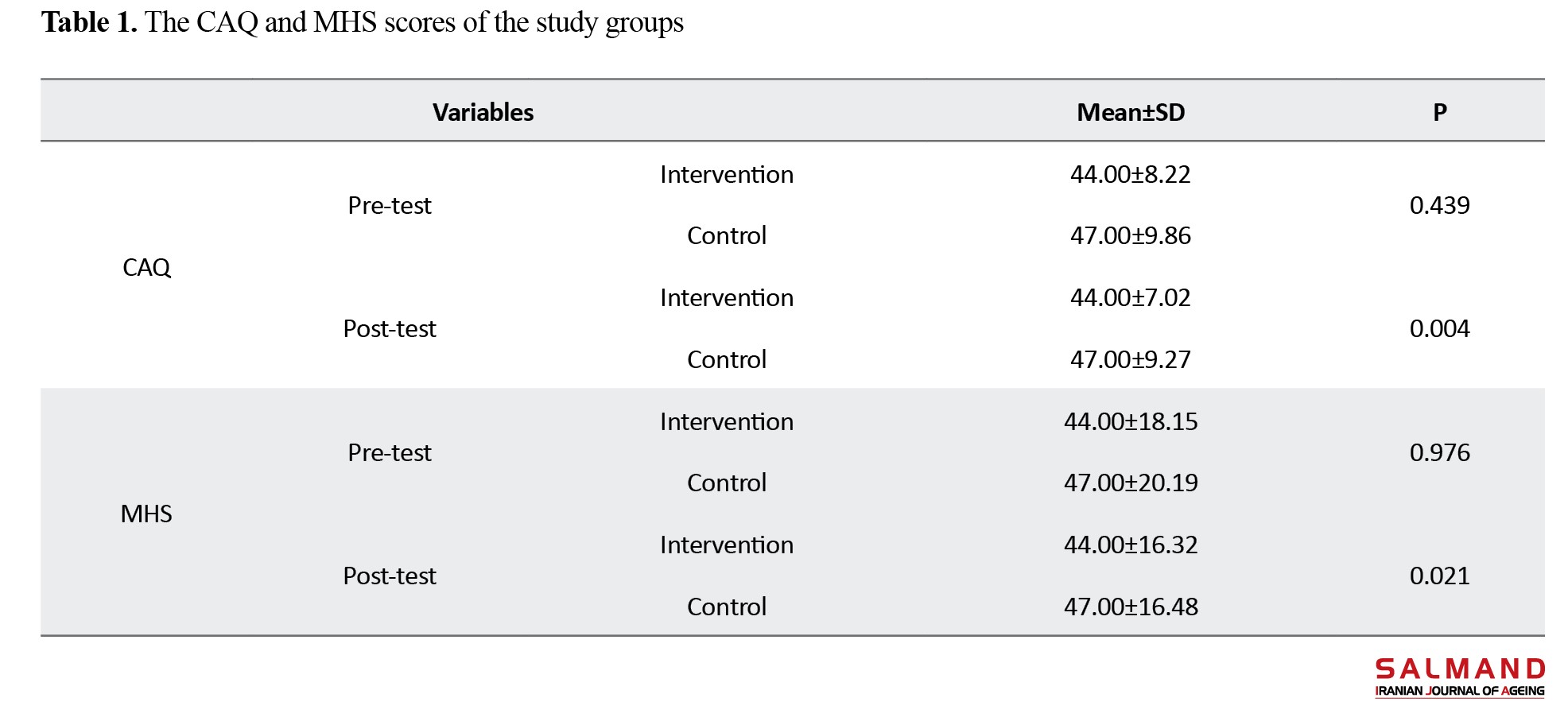
Implementing the self-management program reduced the level of anxiety (from 44.00±8.22 to 44.00±7.025) and improved hope (from 44.00±18.15 to 44.00±16.32). According to the paired t-test results, there was no significant difference in the mean CAQ score between the pre-test and post-test phases in the control group (P=0.486), but a significant decrease was observed in the intervention group (P<0.001). Similarly, the mean MHS scores did not show a significant difference between the pre-test and post-test in the control group (P=0.468), but a significant increase was observed in the intervention group (P<0.001). According to the results of the independent t-test, there was no statistically significant difference in the mean CAQ score between the control and intervention groups before the intervention (P=0.439), but after the intervention, a significant difference was reported, such that the intervention group showed a lower level of anxiety (P=0.004). In addition, the mean MHS score between the two groups before the intervention was not significantly different (P=0.976), but a statistically significant difference was observed in the post-test phase (P=0.021), with the intervention group having a higher score (Table 1).
Conclusion
The results of the present study showed that the online self-management educational program had a significant impact on the hope and cardiac anxiety of patients with congestive heart failure. It led to a significant decrease in the CAQ score and a significant increase in the MHS score. Therefore, the self-management education not only can improve the psychological and social functioning but also can prevent the progression of the physical symptoms of heart disease in patients.
Ethical Considerations
Compliance with ethical guidelines
This study was conducted in accordance with the ethical principles outlined in the Declaration of Helsinki. The study protocol was approved by the Ethics Committee of Shahid Beheshti University of Medical Sciences Tehran, Iran (Code: IR.SBMU.RETECH.REC.1403.101), and was registered by the Iranian Registry of Clinical Trials (ID: IRCT20200727048221N1).
Funding
This research did not receive any specific grant from funding agencies in the public, commercial, or not-for-profit sectors.
Authors' contributions
Marzieh Pazakian: Conceptualization, methodology, supervision, and writing the initial draft; Mahsa Bouzari: Conceptualization; Hanieh Molaei: Data collection and writing the initial draft; Maliheh Nasiri: Formal analysis and writing the initial draft; Fatemeh Saleh: Review & editing. All authors read and approved the final version of the manuscript.
Conflicts of interest
The authors declare no conflict of interest.
Acknowledgments
The authors would like to thank the patients and the Clinical Research Development Unit of Loghman Hakim Hospital in Tehran, Iran, for their support and cooperation during the study.
Hospitalized patients with heart diseases often experience fear of death, isolation from family and community, occupational challenges, and financial burdens, which can lead to anxiety and despair, and delay treatment progress and recovery. Another important factor for these patients is life expectancy, as it can improve physical condition and treatment tolerance. Many patients with congestive heart failure experience low levels of hope and high anxiety due to the lack of a definitive cure and the progressive nature of the disease, which can be addressed through self-management programs and enable patients to control their disease. Self-management increases patients’ knowledge of their disease, helps prevent further complications, and delays disease progression. Considering the importance of anxiety and hope in disease control and treatment adherence among these patients, this study aimed to design and implement an online self-management program and evaluate its impact on hope and anxiety in patients with congestive heart failure.
Materials and Methods
In this randomized clinical trial conducted in 2024, we enrolled 100 patients with congestive heart failure at hospitals affiliated with Shahid Beheshti University of Medical Sciences, Tehran, Iran, using convenience sampling. They were randomly assigned to intervention or control groups. Data collection tools included a sociodemographic checklist (age, gender, marital status, education level, occupation, time of heart failure diagnosis, comorbidities, medications used, monthly income, family history of heart disease, and other relevant factors), Eifert’s Cardiac Anxiety Questionnaire (CAQ), and the Miller Hope Scale (MHS). The intervention group received the self-management educational program for 6 weeks via WhatsApp based on Kern’s six-stage model. The self-management program covered various topics including understanding heart failure, causes and symptoms, treatment options, medication management, lifestyle modification, coping with challenges, and stress management. The collected data were analyzed using descriptive and statistical methods in SPSS software, version 19.
Results
Implementing the self-management program reduced the level of anxiety (from 44.00±8.22 to 44.00±7.025) and improved hope (from 44.00±18.15 to 44.00±16.32). According to the paired t-test results, there was no significant difference in the mean CAQ score between the pre-test and post-test phases in the control group (P=0.486), but a significant decrease was observed in the intervention group (P<0.001). Similarly, the mean MHS scores did not show a significant difference between the pre-test and post-test in the control group (P=0.468), but a significant increase was observed in the intervention group (P<0.001). According to the results of the independent t-test, there was no statistically significant difference in the mean CAQ score between the control and intervention groups before the intervention (P=0.439), but after the intervention, a significant difference was reported, such that the intervention group showed a lower level of anxiety (P=0.004). In addition, the mean MHS score between the two groups before the intervention was not significantly different (P=0.976), but a statistically significant difference was observed in the post-test phase (P=0.021), with the intervention group having a higher score (Table 1).
Conclusion
The results of the present study showed that the online self-management educational program had a significant impact on the hope and cardiac anxiety of patients with congestive heart failure. It led to a significant decrease in the CAQ score and a significant increase in the MHS score. Therefore, the self-management education not only can improve the psychological and social functioning but also can prevent the progression of the physical symptoms of heart disease in patients.
Ethical Considerations
Compliance with ethical guidelines
This study was conducted in accordance with the ethical principles outlined in the Declaration of Helsinki. The study protocol was approved by the Ethics Committee of Shahid Beheshti University of Medical Sciences Tehran, Iran (Code: IR.SBMU.RETECH.REC.1403.101), and was registered by the Iranian Registry of Clinical Trials (ID: IRCT20200727048221N1).
Funding
This research did not receive any specific grant from funding agencies in the public, commercial, or not-for-profit sectors.
Authors' contributions
Marzieh Pazakian: Conceptualization, methodology, supervision, and writing the initial draft; Mahsa Bouzari: Conceptualization; Hanieh Molaei: Data collection and writing the initial draft; Maliheh Nasiri: Formal analysis and writing the initial draft; Fatemeh Saleh: Review & editing. All authors read and approved the final version of the manuscript.
Conflicts of interest
The authors declare no conflict of interest.
Acknowledgments
The authors would like to thank the patients and the Clinical Research Development Unit of Loghman Hakim Hospital in Tehran, Iran, for their support and cooperation during the study.
References
- Wang H, Naghavi M, Allen C, Barber R, Bhutta Z, Carter A. A systematic analysis for the Global Burden of Disease Study 2015. Lancet. 2016; 388(10053):1459-544. [DOI:10.1016/S0140-6736(16)31012-1] [PMID] [PMCID]
- Murray CJ, Barber RM, Foreman KJ, Ozgoren AA, Abd-Allah F, Abera SF, et al. Global, regional, and national disability-adjusted life years (DALYs) for 306 diseases and injuries and healthy life expectancy (HALE) for 188 countries, 1990-2013: quantifying the epidemiological transition. Lancet. 2015; 386(10009):2145-91. [DOI:10.1016/S0140-6736(15)61340-X] [PMID] [PMCID]
- Borji M, Mousavimoghadam SR, Salimi E, Otaghi M, Azizi Y. The impact of spiritual care education on anxiety in family caregivers of patients with heart failure. Journal of Religion and Health. 2019; 58(6):1961-9. [DOI:10.1007/s10943-018-0689-9] [PMID]
- Mozaffarian D, Benjamin EJ, Go AS, Arnett DK, Blaha MJ, Cushman M, et al. Heart disease and stroke statistics-2015 update: A report from the American Heart Association. Circulation. 2015; 131(4):e29-322. [DOI:10.1161/CIR.0000000000000152]
- Lozano R, Naghavi M, Foreman K, Lim S, Shibuya K, Aboyans V, et al. Global and regional mortality from 235 causes of death for 20 age groups in 1990 and 2010: A systematic analysis for the Global Burden of Disease Study 2010. The lancet. 2012; 380(9859):2095-128. [DOI:10.1016/S0140-6736(12)61728-0] [PMID] [PMCID]
- Roth GA, Johnson C, Abajobir A, Abd-Allah F, Abera SF, Abyu G, et al. Global, regional, and national burden of cardiovascular diseases for 10 causes, 1990 to 2015. Journal of the American College of Cardiology. 2017; 70(1):1-25. [DOI:10.1016/j.jacc.2017.04.052] [PMID] [PMCID]
- Binaei N, Moeini M, Sadeghi M, Najafi M, Mohagheghian Z. Effects of hope promoting interventions based on religious beliefs on quality of life of patients with congestive heart failure and their families. Iranian Journal of Nursing and Midwifery Research. 2016; 21(1):77-83. [DOI:10.4103/1735-9066.174755] [PMID] [PMCID]
- Ghajar A, Esmaeili R, Yazdani-Charati J, Ashrafi Z, Mazdarani S, Heidari Gorji MA. [Effect of family-centered education on hope in patients with heart failure (Persian)]. Journal of Mazandaran University of Medical Sciences. 2018; 28(166):71-80. [Link]
- Smit J, Adelborg K, Thomsen RW, Søgaard M, Schønheyder HC. Chronic heart failure and mortality in patients with community-acquired Staphylococcus aureus bacteremia: a population-based cohort study. BMC Infectious Diseases. 2016; 16:227. [DOI:10.1186/s12879-016-1570-7] [PMID] [PMCID]
- Aghakhani N, sanaie K, Baghaei R, Khademvatan K. [The impact of educational-supportive self-care package on anxiety, depression and stress in myocardial infarction patients hospitalized in shahid gholipour hospital, Boukan, Iran, 2016 (Persian)]. Nursing and Midwifery Journal. 2017; 15(4):281-91. [Link]
- Polikandrioti M, Koutelekos I, Panoutsopoulos G, Gerogianni G, Zartaloudi A, Dousis E, et al. Hospitalized patients with heart failure: the impact of anxiety, fatigue, and therapy adherence on quality of life. Archives of Medical Science-Atherosclerotic Diseases. 2019; 4(1):268-79. [DOI:10.5114/amsad.2019.90257] [PMID] [PMCID]
- Hua C, Huang Y, Su Y, Bu J, Tao H. Collaborative care model improves self-care ability, quality of life and cardiac function of patients with chronic heart failure. Brazilian Journal of Medical and Biological Research. 2017; 50(11):e6355. [DOI:10.1590/1414-431x20176355] [PMID] [PMCID]
- Rao A, Zecchin R, Newton PJ, Phillips J, DiGiacomo M, Denniss AR, et al. The prevalence and impact of depression and anxiety in cardiac rehabilitation: A longitudinal cohort study. European Journal of Preventive Cardiology. 2020; 27(5):478-89. [DOI:10.1177/2047487319871716] [PMID]
- Aggelopoulou Z, Fotos NV, Chatziefstratiou AA, Giakoumidakis K, Elefsiniotis I, Brokalaki H. The level of anxiety, depression and quality of life among patients with heart failure in Greece. Applied Nursing Research. 2017; 34:52-6. [DOI:10.1016/j.apnr.2017.01.003] [PMID]
- Polikandrioti M, Panoutsopoulos G, Tsami A, Gerogianni G, Saroglou S, Thomai E, et al. Assessment of quality of life and anxiety in heart failure outpatients. Archives of Medical Science-Atherosclerotic Diseases. 2019; 4(1):38-46. [DOI:10.5114/amsad.2019.84444] [PMID] [PMCID]
- Kamalpour S, Sharafi H, Jafarnezhad A. [The effect of face to face education of Self-centered care on, life expectancy of cardiovascular patients in Mohammadi hospital of Bandar Abbas, In 2016-2017 (Persian)]. Medical Journal of Mashhad University of Medical Sciences. 2019; 62(4):1574-80. [DOI:10.22038/mjms.2019.14226]
- Shojaee A, Tahrir B, Naderi N, Zareian A. [Effect of patient education and telephone follow up by the nurse on the level of hope in patients suffering from heart failure (Persian)]. Journal of Nursing Education. 2013; 2(3):16-26. [Link]
- Nikkhah T, Bagheri H, Khajeh M, Khosravi A. [The effect of post-discharge telephone follow-up on the inherent dignity of patients with heart failure (Persian)]. Avicenna Journal of Nursing and Midwifery Care. 2021; 29(2):91-101. [DOI:10.30699/ajnmc.29.2.91]
- Meng K, Musekamp G, Schuler M, Seekatz B, Glatz J, Karger G, et al. The impact of a self-management patient education program for patients with chronic heart failure undergoing inpatient cardiac rehabilitation. Patient Education and Counseling. 2016; 99(7):1190-7. [DOI:10.1016/j.pec.2016.02.010] [PMID]
- Molos I, Kleisiaris C, Patelarou A, Kasimis G, Karavasileiadou S, Alanazi A, et al. Evaluation of a specialist nurse-led post-coronary heart disease support program: A prospective pre-post interventional study. Healthcare. 2024; 12(24):2497. [DOI:10.3390/healthcare12242497] [PMID] [PMCID]
- Aghamohammadi T, Khaleghipour M, Shahboulaghi FM, Dalvandi A, Maddah SSB. Effect of self-management program on health status of elderly patients with heart failure: A single-blind, randomized clinical trial. Journal of Acute Disease. 2019; 8(5):179-84. [DOI:10.4103/2221-6189.268405]
- Eifert GH, Thompson RN, Zvolensky MJ, Edwards K, Frazer NL, Haddad JW, et al. The cardiac anxiety questionnaire: development and preliminary validity. Behaviour Research and Therapy. 2000; 38(10):1039-53. [DOI:10.1016/S0005-7967(99)00132-1] [PMID]
- Miller JF, Powers MJ. Development of an instrument to measure hope. Nursing Research. 1988; 37(1):6-10. [DOI:10.1097/00006199-198801000-00002] [PMID]
- Schrank B, Woppmann A, Hay AG, Sibitz I, Zehetmayer S, Lauber C. Validation of the Integrative Hope Scale in people with psychosis. Psychiatry Research. 2012; 198(3):395-9. [DOI:10.1016/j.psychres.2011.12.052] [PMID]
- Gardetto NJ. Self-management in heart failure: Where have we been and where should we go? Journal of Multidisciplinary Healthcare. 2011; 4:39-51. [DOI:10.2147/JMDH.S8174] [PMID] [PMCID]
- Jiang Y, Koh KWL, Ramachandran HJ, Nguyen HD, Tay YK, Shorey S, et al. The effectiveness of a nurse-led home-based heart failure self-management programme (the HOM-HEMP) for patients with chronic heart failure: A three-arm stratified randomized controlled trial. International Journal of Nursing Studies. 2021; 122:104026. [DOI:10.1016/j.ijnurstu.2021.104026] [PMID]
- Luštrek M, Bohanec M, Barca CC, Ciancarelli MC, Clays E, Dawodu AA, et al. A personal health system for self-management of congestive heart failure (HeartMan): Development, technical evaluation, and proof-of-concept randomized controlled trial. JMIR Medical Informatics. 2021; 9(3):e24501. [DOI:10.2196/24501] [PMID] [PMCID]
- Moon MK, Yim J, Jeon MY. The effect of a telephone-based self-management program led by nurses on self-care behavior, biological index for cardiac function, and depression in ambulatory heart failure patients. Asian Nursing Research. 2018; 12(4):251-7. [DOI:10.1016/j.anr.2018.10.001] [PMID]
- Ditewig JB, Blok H, Havers J, van Veenendaal H. Effectiveness of self-management interventions on mortality, hospital readmissions, chronic heart failure hospitalization rate and quality of life in patients with chronic heart failure: A systematic review. Patient Education and Counseling. 2010; 78(3):297-315. [DOI:10.1016/j.pec.2010.01.016] [PMID]
- Tung HH, Lin CY, Chen KY, Chang CJ, Lin YP, Chou CH. Self‐management intervention to improve self‐care and quality of life in heart failure patients. Congestive Heart Failure. 2013; 19(4):E9-16. [DOI:10.1111/chf.12014] [PMID]
- Smeulders ES, van Haastregt JC, Ambergen T, Stoffers HE, Janssen-Boyne JJ, Uszko-Lencer NH, et al. Heart failure patients with a lower educational level and better cognitive status benefit most from a self-management group programme. Patient Education and Counseling. 2010; 81(2):214-21. [DOI:10.1016/j.pec.2010.01.003] [PMID]
- Demircelik MB, Cakmak M, Nazli Y, Şentepe E, Yigit D, Keklik M, et al. Effects of multimedia nursing education on disease-related depression and anxiety in patients staying in a coronary intensive care unit. Applied Nursing Research. 2016; 29:5-8. [DOI:10.1016/j.apnr.2015.03.014] [PMID]
- Bidwell JT, Vellone E, Lyons KS, D’Agostino F, Riegel B, Juárez‐Vela R, et al. Determinants of heart failure self‐care maintenance and management in patients and caregivers: a dyadic analysis. Research in nursing & health. 2015; 38(5):392-402. [DOI:10.1002/nur.21675] [PMID] [PMCID]
- Mirshahi A, Bakitas M, Khoshavi M, Khanipour-Kencha A, Riahi SM, Wells R, et al. The impact of an integrated early palliative care telehealth intervention on the quality of life of heart failure patients: A randomized controlled feasibility study. BMC palliative Care. 2024; 23(1):22. [DOI:10.1186/s12904-024-01348-z] [PMID] [PMCID]
Type of Study: Research |
Subject:
nursing
Received: 2025/07/10 | Accepted: 2025/11/29 | Published: 2026/07/01
Received: 2025/07/10 | Accepted: 2025/11/29 | Published: 2026/07/01
Send email to the article author
| Rights and permissions | |
 |
This work is licensed under a Creative Commons Attribution-NonCommercial 4.0 International License. |

Copyright © The Author(s);
This is an open access article distributed under the terms of the Creative Commons Attribution-NonCommercial 4.0 (CC-By-NC 4.0), which permits use, distribution, and reproduction in any medium, provided the original work is properly cited and is not used for commercial purposes.
Contact Information